Why bookmakers restrict winning accounts
Bookmakers limit stakes, withdraw offers or close accounts when they judge a customer likely to cost them money. What triggers a restriction, the arguments on each side, and the options open to a restricted customer.

Bookmakers restrict winning accounts because they are businesses that profit from the margin in their prices, and a customer who consistently beats those prices costs them money. Restrictions range from lower maximum stakes on some or all markets to exclusion from promotions and, in some cases, closure of the account. Operators are generally free to decide whose bets they accept, within their published terms and consumer law.
What a restriction looks like
- Stake limits: the maximum bet allowed on a market is cut, sometimes to a small fraction of the usual limit.
- Bet referrals: larger bets are passed to a trader, who can accept, reduce or refuse them.
- Promotions withdrawn: the account stops receiving free bets, price boosts and other offers.
- Closure: the operator ends the relationship and returns the balance.
Restrictions are often applied without explanation. Terms typically reserve the operator's right to limit stakes or close accounts at its discretion, and customers usually discover a restriction only when a bet is reduced or rejected.
Why operators do it
A bookmaker's pricing assumes most customers bet at odds that include a margin. A customer who repeatedly finds prices that are too generous reverses that. The signal bookmakers watch most closely is beating the closing price: taking odds that turn out to be longer than the final price before the event starts. If a customer backs a team at 2.20 and it starts at 2.00, they took a price implying a 45.5% chance when the market's final estimate was 50%. Doing that consistently suggests, as why betting odds move explains, that the customer is acting on information or judgement ahead of the market.
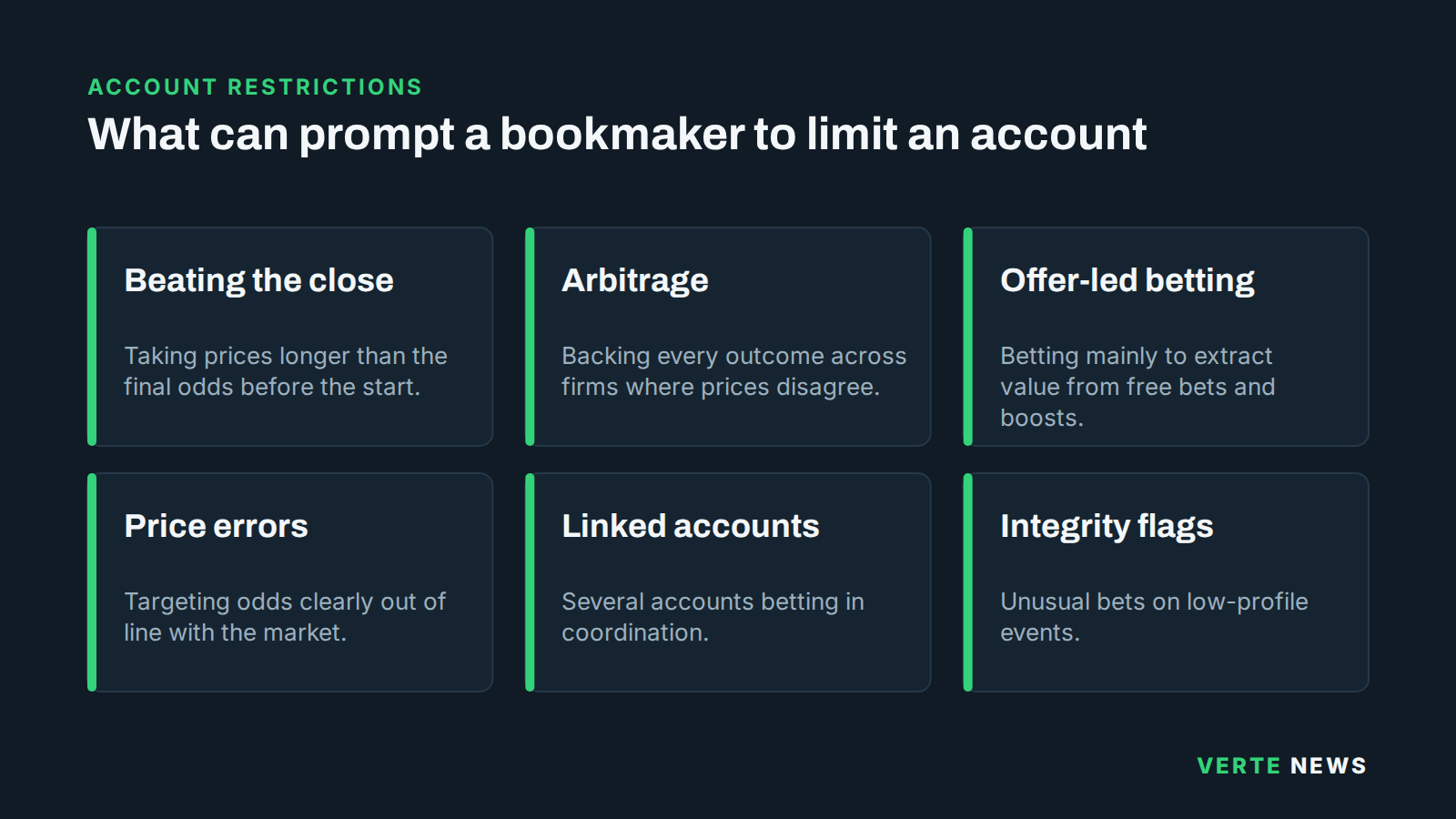
Other patterns that attract attention include:
- Arbitrage: backing every outcome of an event across different bookmakers where prices disagree, locking in a small profit.
- Offer-led betting: betting mainly to extract value from free bets and promotions; our guide to betting bonuses explains how those offers are structured.
- Targeting price errors: backing odds that are clearly out of line with the rest of the market.
- Linked accounts: several accounts betting in coordination, which may also breach terms.
- Integrity concerns: unusual bets on low-profile events that could point to inside information or match-fixing, which operators must report to the Gambling Commission and, where relevant, to the sport's governing body.
The case for and against
Operators argue that restrictions allow them to offer competitive prices and promotions to the majority of customers, because the cost of a small number of highly skilled or opportunistic accounts is contained. They also point out that pricing thousands of low-profile markets inevitably produces some errors, and that limiting exposure to people who exploit them is ordinary risk management.
Critics say the practice is one-sided: a customer who loses steadily is welcome to keep betting, while one who wins can be limited quickly. Odds are advertised that will not be honoured at meaningful stakes for everyone. Consumer law requires contract terms to be fair and transparent, and the treatment of winning customers has been a recurring point of contention between bettors and the industry. The Gambling Commission, which notes that there is no universal service obligation in gambling, collected data in 2025 from some of the largest online betting operators: of almost 15 million active accounts in the previous year, about 4.3% had some form of commercial restriction, most often a cap on stakes.
It is worth separating these commercial restrictions from limits applied for safer gambling reasons. Operators must monitor customers for signs of harm and can limit or close accounts on those grounds, which is not about profitability at all; see affordability checks explained.
What a restricted customer can do
Reading the terms is the place to start, since they set out the operator's rights on limits and closure. A restricted customer's balance and settled bets remain theirs, and bets the operator has already accepted should be settled in line with its rules. Complaints that cannot be resolved with the operator can be taken to an alternative dispute resolution provider, which operators licensed in Great Britain must offer.
Betting exchanges, described in bookmaker vs betting exchange, earn commission whoever wins, so they have less reason to restrict successful accounts, though some apply extra charges to consistently profitable customers.
Finally, being restricted is not proof that a customer will keep winning. Short-term results are noisy, and most people who bet regularly lose over time because of the margin. A restriction reflects the bookmaker's judgement of risk, not a guarantee of future returns.