Bookmaker vs betting exchange: the difference
A bookmaker sets prices and takes the other side of your bet; an exchange matches customers against each other and charges commission. How each model works, with the arithmetic of backing and laying.

A bookmaker sets its own prices and takes the other side of every bet, earning its profit from the margin built into those prices. A betting exchange sets no prices of its own: it matches customers who want to back an outcome with customers who want to bet against it, and earns its money by charging commission, usually on net winnings. The difference affects the odds you get, how you pay for the service and what you can do with a bet.
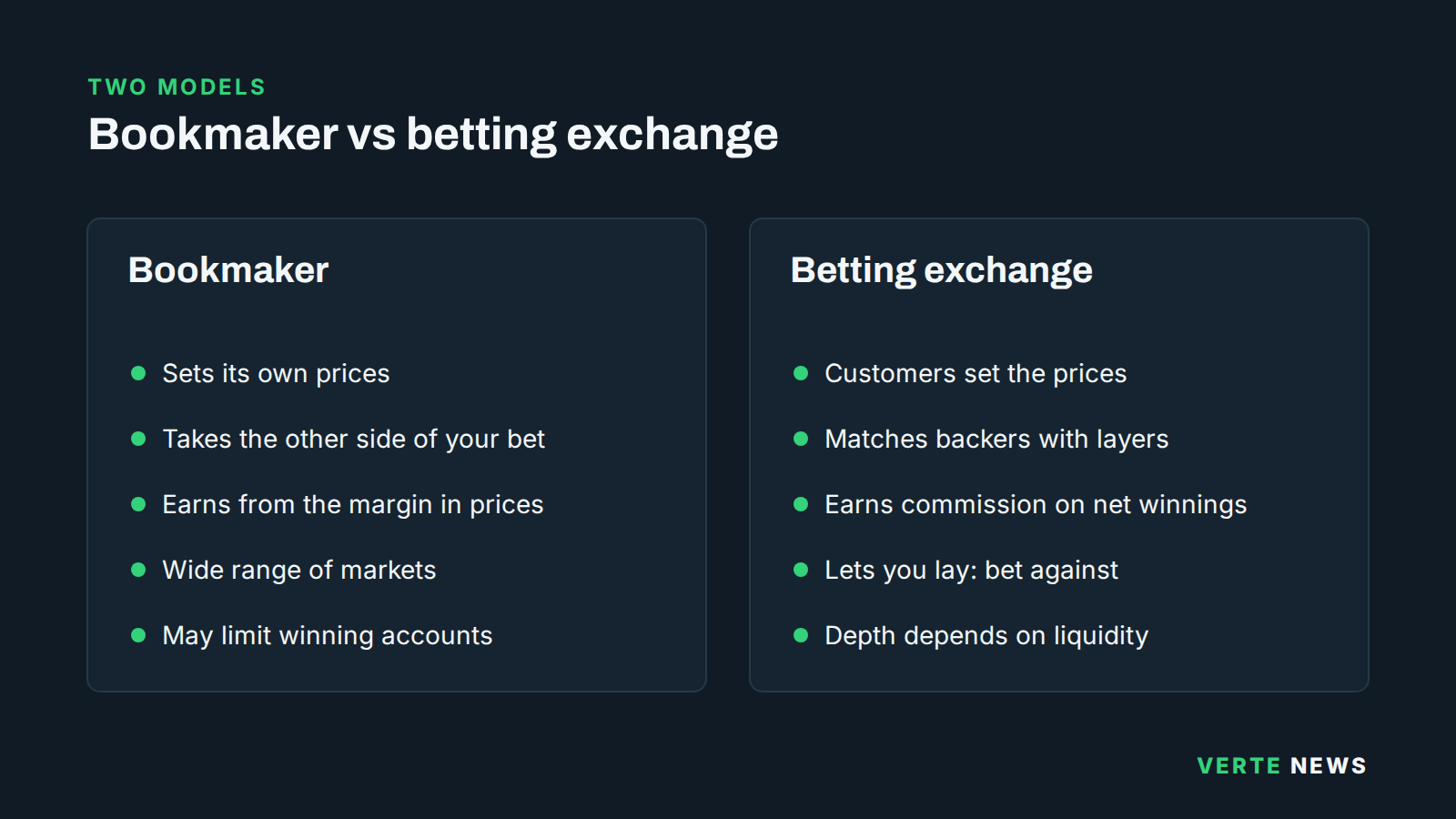
How a bookmaker works
When you bet with a bookmaker, the bookmaker is your counterparty. If your selection wins, it pays you from its own funds; if it loses, it keeps your stake. Its prices include a margin, so that the implied probabilities of all outcomes add up to more than 100%, as explained in how bookmakers set odds. The bookmaker decides which markets to offer, what the maximum stake is and, within its terms and the law, whose bets it accepts.
How an exchange works
On an exchange, customers can do two things. Backing is the familiar bet that something will happen. Laying is betting that it will not: the layer acts like a bookmaker for that bet, accepting the backer's stake and paying out if the selection wins.
Take a horse at decimal odds of 4.0. A backer stakes £10. The layer who matches that bet collects the £10 stake if the horse loses, but must pay £30, which is £10 × (4.0 − 1), if it wins. That £30 is the layer's liability, and the exchange holds it from their balance until the bet is settled. If the horse wins, the backer's £30 profit is subject to commission; at an illustrative rate of 5%, the backer would keep £28.50.
Prices on an exchange are set by supply and demand. Each selection shows the best available back and lay prices and the amount of money waiting to be matched at each. Because customers compete to offer prices, the implied probabilities on a busy exchange market typically add up to very close to 100%, which is why bookmakers use exchange prices as a reference. The trade-off is that commission comes off net winnings, and on quieter markets there may not be enough money available to match your bet at the price you want. A bet can be partly matched, or remain unmatched until someone takes it or you cancel it.
The practical differences
- Price: exchange prices on liquid markets are usually closer to fair, but commission comes off winnings, so compare net returns rather than headline odds.
- Range of markets: bookmakers generally offer more markets on more events, including specials and bet builders.
- Laying: only an exchange lets you bet directly against an outcome, or close out a position by laying a selection you previously backed.
- Liquidity: major football and horse racing markets are usually deep; smaller events can be thin, with wide gaps between back and lay prices.
- Account treatment: because an exchange earns commission whoever wins, it has less reason than a bookmaker to limit successful customers, which is a frequent complaint explained in why bookmakers restrict accounts. Exchanges can, however, apply additional charges to some consistently profitable accounts.
Which suits whom
Neither model changes the underlying arithmetic for most customers. A bookmaker's margin and an exchange's commission are both the cost of betting, and over time they mean customers as a group lose more than they win. Exchanges tend to appeal to people who bet on liquid markets and want prices close to fair; bookmakers to those who want a wide range of markets, simple bet slips and promotions.
Laying carries a specific risk that backing does not: the liability can be many times the amount you stand to win. Laying £10 at odds of 21.0 means risking £200 to win £10. A long run of small, successful lays can be wiped out by one losing one.
Both kinds of operator need a licence to serve customers in Great Britain and must provide safer gambling tools such as deposit limits and time-outs. Our explainer on how sportsbook businesses make money sets out the commercial models behind each in more detail.