Why betting odds move
Prices shorten and drift because new information changes the likely outcome, because money changes the bookmaker's exposure, and because markets follow one another. How to read a move, and what it does not tell you.
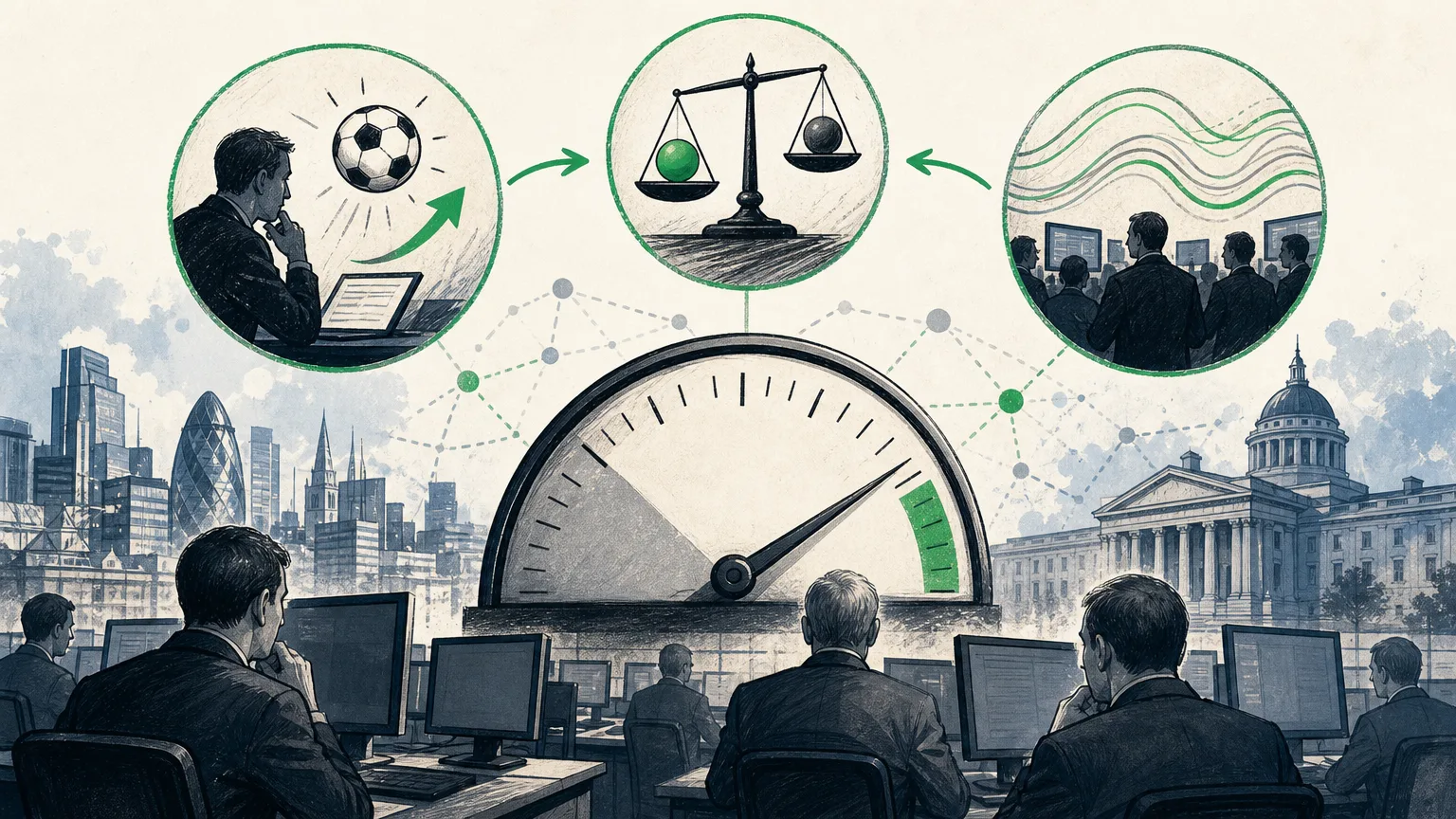
Betting odds move because the bookmaker's view of the probabilities changes, because its financial exposure changes, or both. New information such as injuries, line-ups or weather alters the likely outcome; money arriving on one side alters how much the bookmaker stands to lose. Prices are also pulled towards what other bookmakers and betting exchanges are offering. Once an event starts, what happens on the pitch or court becomes the main driver.
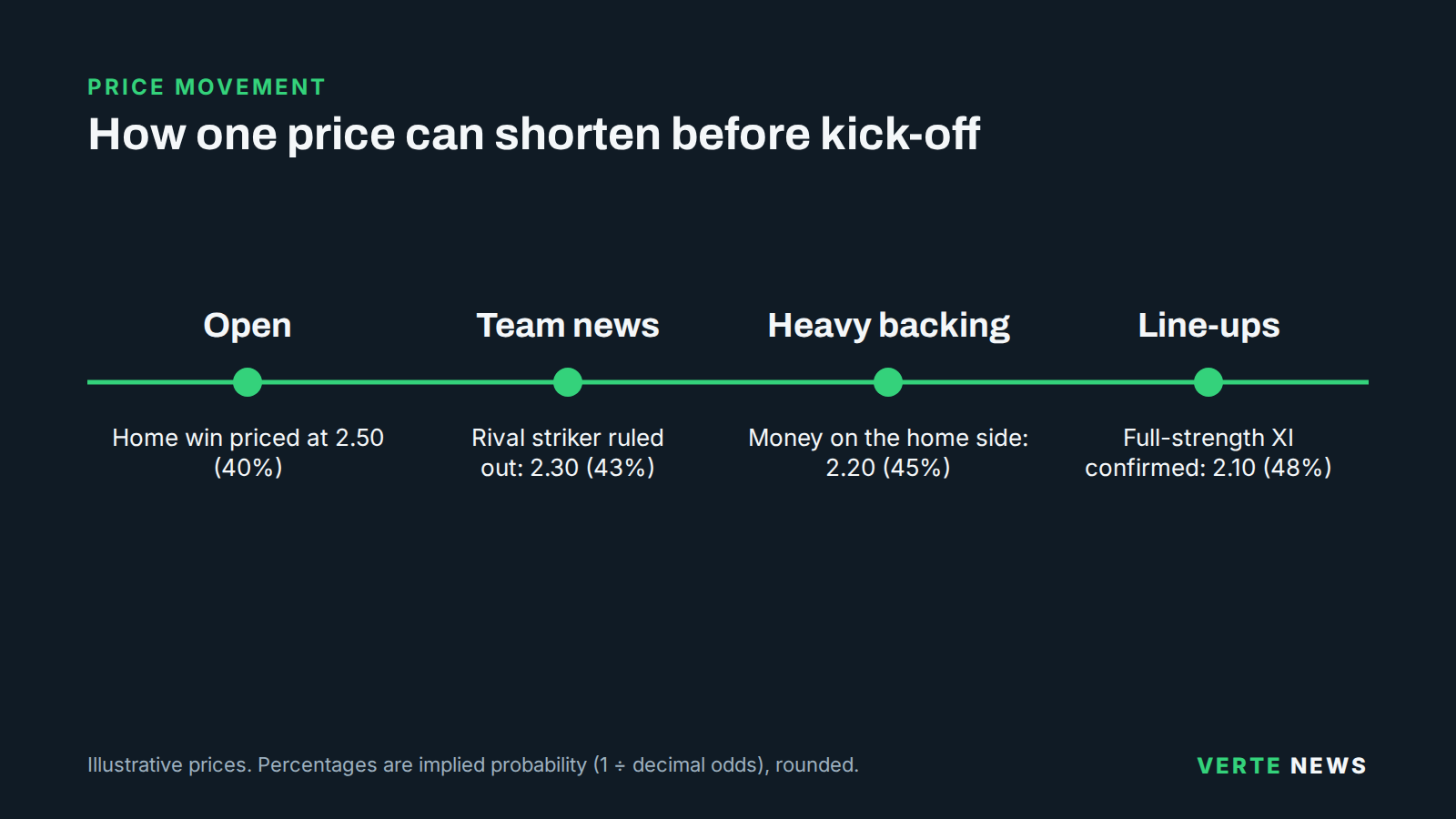
A move is easiest to understand as a change in implied probability. If a team shortens from 2.50 to 2.10, its implied chance rises from 40% (1 ÷ 2.50) to about 47.6% (1 ÷ 2.10). If a horse drifts from 4.00 to 5.00, its implied chance falls from 25% to 20%. Shortening means the price gets smaller and the outcome is considered more likely; drifting means the opposite. Because a book's implied probabilities have to add up to a total the bookmaker is content with, one price shortening usually means others lengthen.
The main causes
- New information. Confirmed team sheets, injuries, suspensions, a change of goalkeeper, a jockey switch, heavy rain on a racecourse or doubts over a tennis player's fitness all feed into the models and trading judgements described in how bookmakers set odds.
- Weight of money. If far more has been staked on one outcome than the others, the bookmaker faces a large loss if it wins. Shortening that price makes it less attractive, and lengthening the alternatives invites balancing bets.
- Who is betting. Bookmakers profile their customers. A modest bet from an account with a record of beating the market can move a price more than a large bet from a casual customer. This is closely linked to why bookmakers restrict accounts.
- Other prices. Operators monitor competitors and the exchanges. A bookmaker left out of line with the rest of the market can expect to attract bets from people looking for the longest price, so it tends to follow.
- Time. As an event approaches, uncertainty narrows and more information is priced in. Markets on major events generally become more efficient – harder to beat – closer to the start.
Movement once the event is under way
In in-play betting, prices are recalculated continuously from the score, the time remaining and incidents such as red cards. A football team priced at 2.00 before kick-off might be around 1.40 after scoring early, with the draw and away prices lengthening accordingly. Time alone moves prices too: a team leading 1–0 becomes a shorter price each minute the score stays the same, because there is less time left for the opponent to equalise. Markets are usually suspended briefly after goals and other major incidents while prices are reset.
The price you take is the price you get
Because odds move, the moment a bet is struck matters. A fixed-odds bet is settled at the price accepted when it was placed, whatever happens to the market afterwards. In British horse racing, customers can instead take the starting price, the official price at the off, which is compiled from a sample of bookmakers' prices under the oversight of the independent Starting Price Regulatory Commission. Since 2021 that sample has been drawn mainly from off-course bookmakers, with racecourse prices carrying a smaller weight. Some bookmakers offer a concession, commonly called best odds guaranteed, that pays the better of the price taken and the starting price on eligible races; terms and eligibility vary.
Price movement also drives cash-out values, because the amount a bookmaker offers to settle a bet early is based on the current price for the selection rather than the original one. A selection that has shortened since the bet was placed will usually carry a higher cash-out offer; one that has drifted, a lower one.
What movement does not tell you
A shortening price is sometimes presented as a sign that 'the money knows'. Sometimes that is true; often it reflects a popular team attracting a lot of small stakes, or one bookmaker simply following another. A move also says nothing about whether the new price is good value, because the margin is still built into it. The price after a move is the market's latest estimate plus the operator's cut, and over many bets that cut means bettors as a group lose.
It is also worth resisting the pressure a moving price can create. A price that is shortening can feel like an opportunity that is about to disappear, which is exactly the kind of urgency that leads to rushed decisions. Setting deposit limits in advance, and using time-outs if betting starts to feel reactive, are sensible ways to keep that in check.