What the bookmaker's margin is, and how to calculate it
Every set of odds adds up to more than 100%, and the excess is the bookmaker's margin. How to calculate it from any market in a few seconds, how to strip it out, and what it costs a bettor over time.
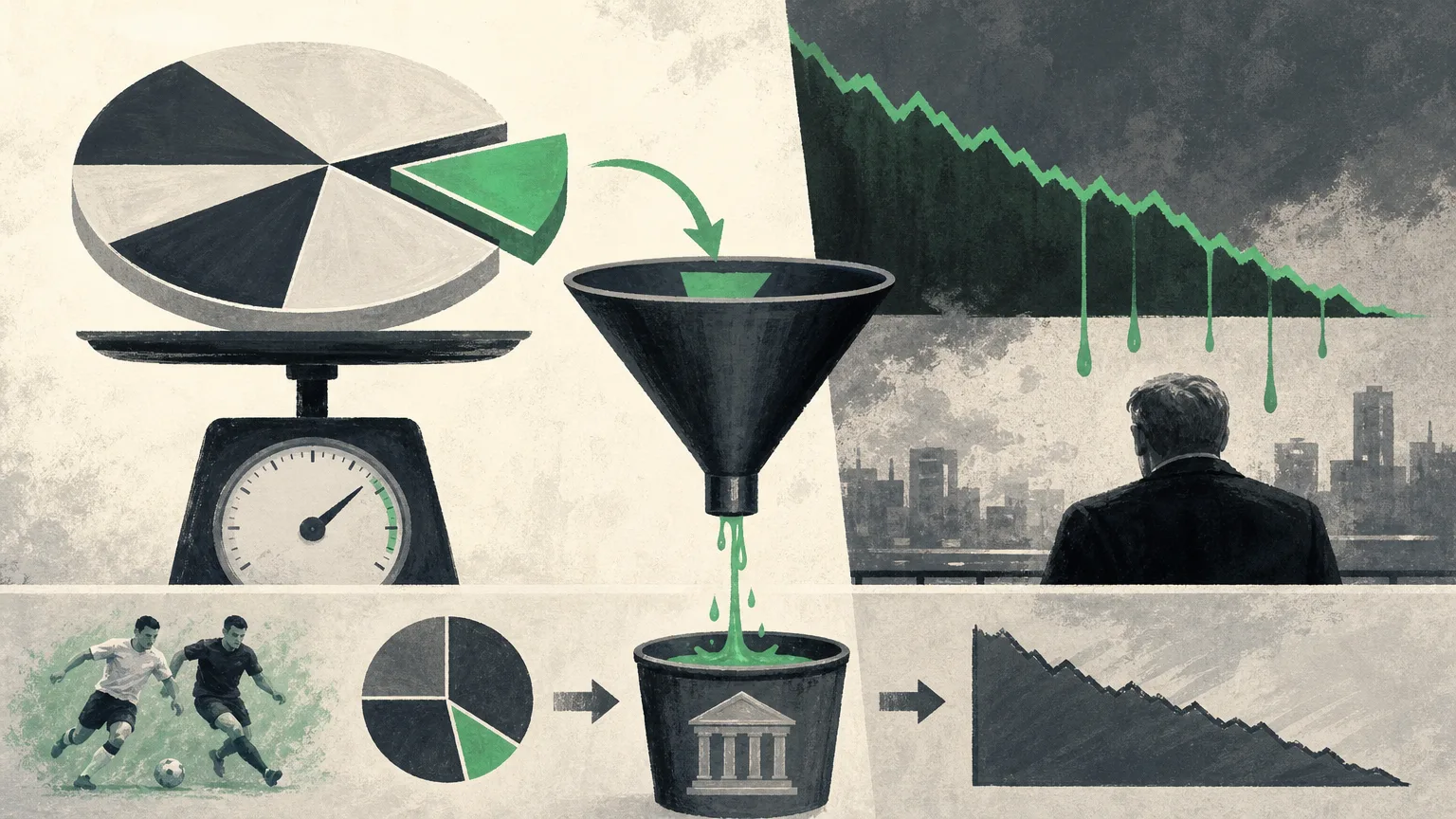
The bookmaker's margin is the amount by which the implied probabilities of all outcomes in a market add up to more than 100%. It is the built-in edge that lets a bookmaker profit whatever the result when its book is balanced, and it is the main reason bettors lose money on average over time. You can calculate it from any set of prices in a few seconds.
The calculation
Convert each price to an implied probability by dividing 1 by the decimal odds, then add the results together. The amount above 100% is known as the overround.
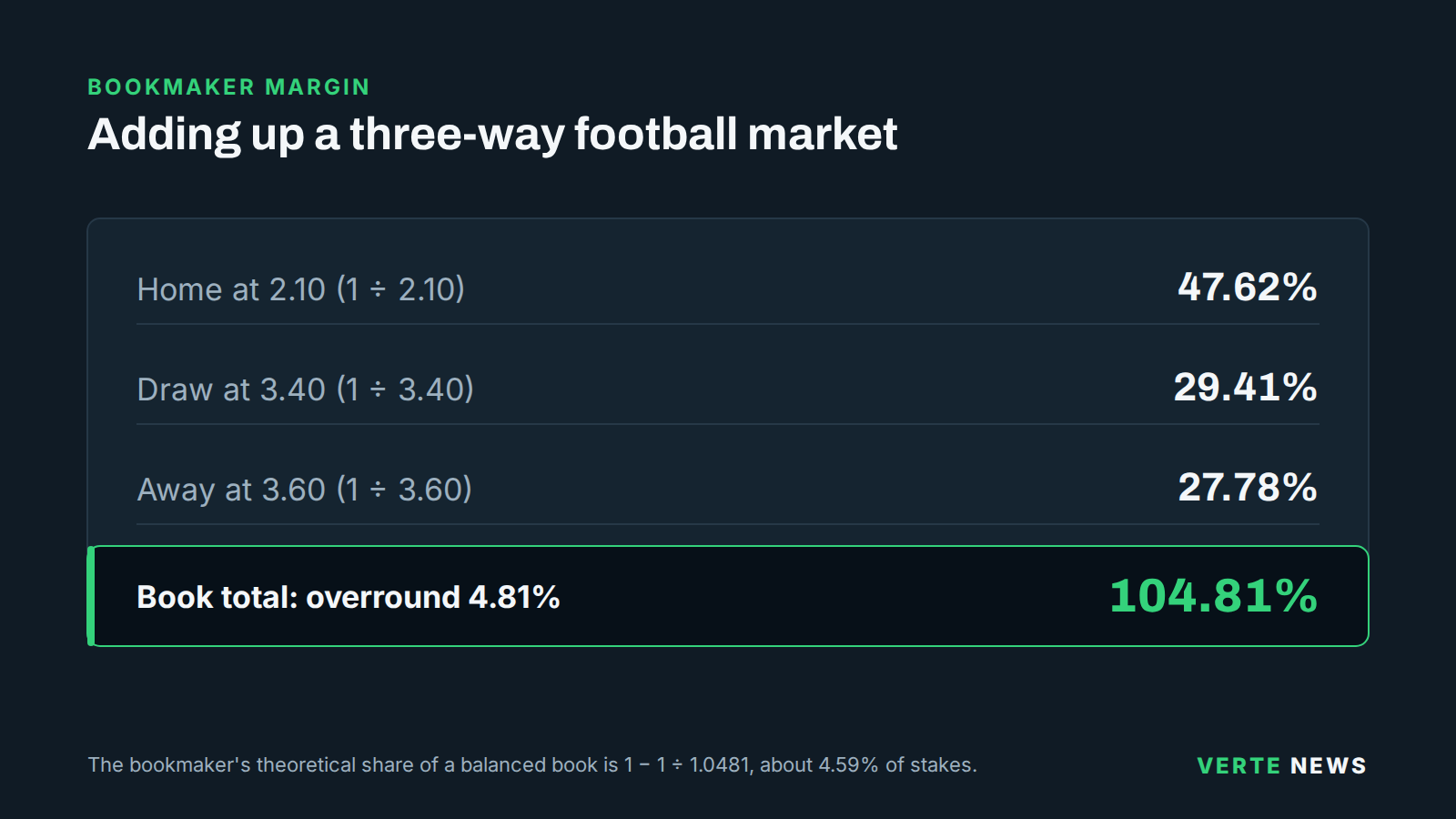
Take a football match priced at 2.10 for a home win, 3.40 for the draw and 3.60 for an away win. The implied probabilities are:
- Home: 1 ÷ 2.10 = 47.62%
- Draw: 1 ÷ 3.40 = 29.41%
- Away: 1 ÷ 3.60 = 27.78%
Together they come to 104.81%, so the overround is 4.81%. If the prices are shown in fractional form, convert them to decimal first by dividing the first number by the second and adding 1: 11/10 becomes 2.10, 12/5 becomes 3.40 and 13/5 becomes 3.60. Our guides to fractional odds and decimal odds cover the conversions in full.
Overround and the bookmaker's share
The overround is often loosely called the margin, but there is a subtle difference. If a bookmaker took bets in exact proportion to the implied probabilities, it would keep the same share of stakes whatever happened. That share is 1 − 1 ÷ 1.0481, or about 4.59% of the money staked. In the example, £104.81 spread across the three outcomes in those proportions returns £100 whichever wins – £47.62 on the home side at 2.10 returns £100, for instance – leaving the bookmaker £4.81, which is 4.59% of the total.
For a simple two-way market priced at 1.91 on each side, the overround is 4.71% and the bookmaker's theoretical share about 4.50%. Both measures appear in industry discussion; what matters is using the same one when comparing markets or operators.
Finding the fair odds
To estimate what the prices would be without the margin, divide each implied probability by the book total. In the example, 47.62% ÷ 1.0481 gives 45.43%, a fair price of about 2.20; the draw becomes 28.06%, or about 3.56; and the away win 26.50%, or about 3.77. These fair probabilities add up to 100%.
This proportional method is the simplest, but it assumes the margin is spread evenly across outcomes, which is not always the case. Bookmakers often build proportionally more margin into the prices of outsiders than favourites, so more sophisticated methods adjust for that. Either way, the result is an estimate, not a certainty.
Why the margin matters
The margin is what a bettor pays for each bet, whether it wins or loses. At a 4.59% share, a customer staking £1,000 in total over a season at similar prices would expect to get back around £954 on average, with the actual result depending on luck. Margins differ widely: match markets on major football and tennis tend to be among the lowest, while outright markets, niche events, in-play markets and combined bets often carry more. In an accumulator, the margin compounds with every leg.
Comparing books makes the point concrete. If another bookmaker priced the same match at 2.20, 3.50 and 3.50, its implied probabilities would be 45.45%, 28.57% and 28.57%, a total of 102.60% and an overround of 2.60%. That book is keener overall, but not on every outcome: its home price is longer than 2.10, while its away price of 3.50 is shorter than 3.60. Adding up the whole market, rather than looking at a single price, is what shows the difference.
The margin is also the core of the sportsbook business model, explained in how sportsbook businesses make money. Comparing margins across operators shows who is pricing a market more keenly, but no bookmaker offers prices without one. Over enough bets, it is the margin rather than the occasional win that decides the average outcome, which is worth remembering alongside the deposit limits and time-outs licensed operators provide.