The UK's online slot stake limits explained
Since 2025, online slot games offered in Great Britain have had a maximum stake per spin: £5 for adults aged 25 and over and £2 for those aged 18 to 24. Here is how the limits work, why they were introduced and what they mean in practice.

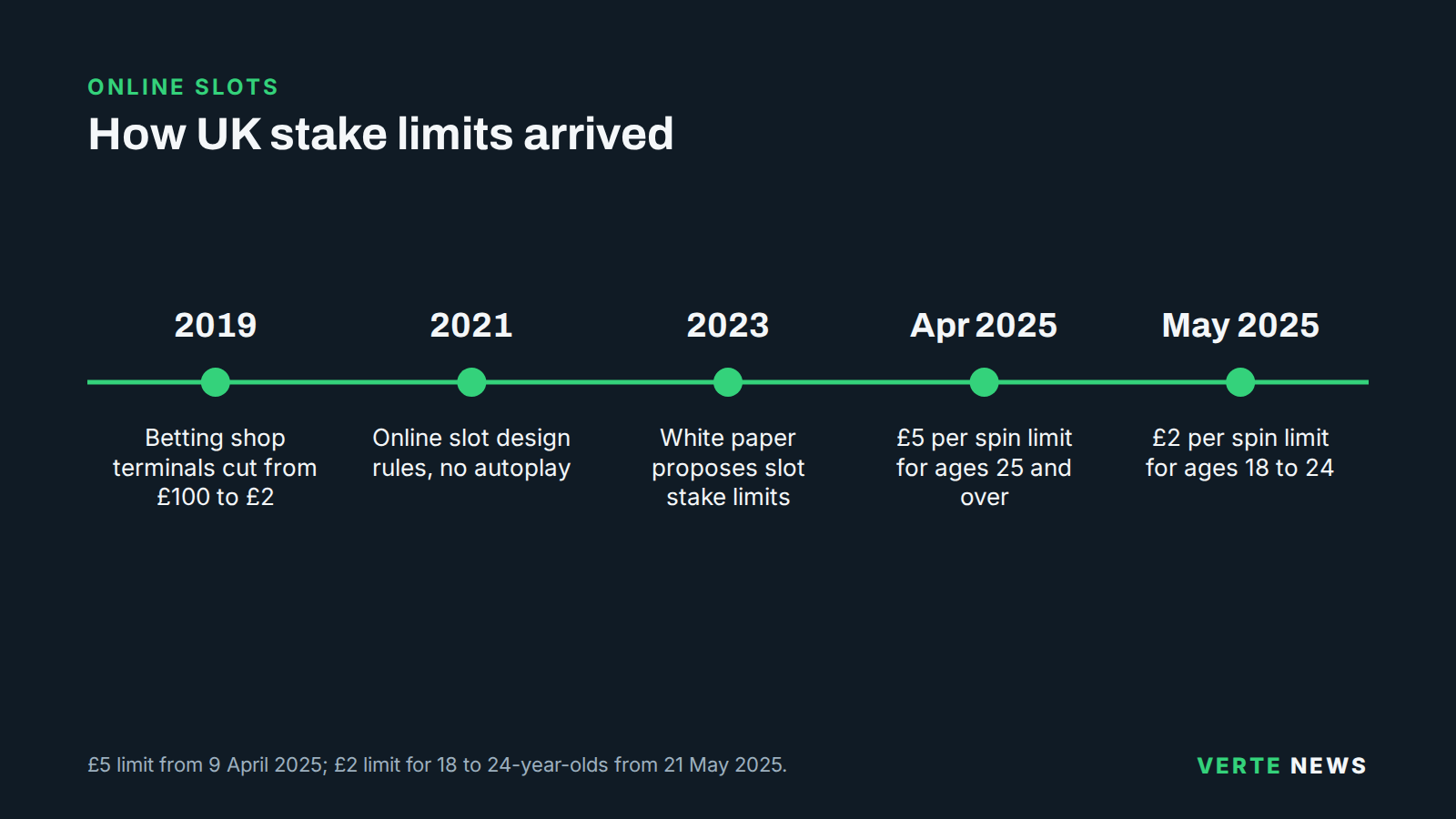
Online slot games offered to consumers in Great Britain have a maximum stake per spin. Customers aged 25 and over can stake no more than £5 a spin, a limit that took effect on 9 April 2025. Customers aged 18 to 24 are limited to £2 a spin, which took effect on 21 May 2025. The limits apply to every operator licensed by the Gambling Commission to offer online slots.
Before these limits, there was no maximum stake on online slots set in law or in licence conditions. That contrasted with land-based gaming machines, which have long been subject to stake limits by machine category. The most prominent example is the fixed-odds betting terminals in betting shops, whose maximum stake was cut from £100 to £2 in April 2019.
Why the limits were introduced
The limits came out of the government's review of the Gambling Act 2005, which led to the April 2023 white paper, High stakes: gambling reform for the digital age. The white paper identified online slots as a product associated with a higher risk of harm than many other forms of gambling, partly because of their speed and continuous play: a slot spin takes seconds, and results arrive one after another, so losses can build very quickly at high stakes.
The government consulted in 2023 on limits of between £2 and £15 a spin, and on a lower limit of between £2 and £4 for younger adults. It concluded that a £5 limit for adults aged 25 and over would reduce the potential for very large, rapid losses. The lower £2 limit for 18 to 24-year-olds reflected evidence that younger adults are more vulnerable to gambling harm, drawing on Gambling Commission advice that pointed to cognitive development continuing until around 25 and to the life stage at which people are first managing their own finances.
How the limits work in practice
The limit applies to the stake for a single game cycle, commonly a spin. Operators must stop customers from placing a stake above the applicable limit. In practice, that means stake selectors on slot games offered in Great Britain no longer offer higher values.
The age-based limit relies on the operator knowing the customer's age, which it already must under the rules requiring age and identity verification before anyone gambles. Our explainer on what KYC means in gambling covers how those checks work. The £2 limit applies until the customer's 25th birthday.
The limits sit on top of earlier rules on slot design. Since 2021, online slots in Great Britain have been subject to requirements that include a minimum spin speed of 2.5 seconds, a ban on autoplay and on features that speed up play, a ban on celebrating a return that is equal to or less than the stake, and a requirement to show the player's net position and time spent. Together with stake limits, they are designed to slow play and make losses clearer.
The limits do not change a game's return to player or its volatility. A slot's RTP is the same at £0.10 or £5 a spin, and its volatility still determines how often and how much it tends to pay. What changes is the maximum that can be lost on a single spin.
Who the limits apply to
The limits cover online slot games offered by Gambling Commission licensees to consumers in Great Britain. They do not apply to other online casino games such as roulette or blackjack, or to sports betting, though other rules apply to those products. Land-based gaming machines remain subject to their own stake limits under separate regulations.
The limits do not apply to gambling sites that are not licensed in Great Britain. Those sites are not permitted to serve British consumers in the first place, and none of the British protections apply to them, as explained in what non-GamStop means.
What it means for operators and players
For operators and their game suppliers, the limits required changes to game configuration and account systems, including a way of applying the lower limit to customers under 25. That is one of the ways regulation shapes the product described in our guide to how online casinos work.
For players, the most visible change is a lower ceiling on the stake selector. For most people who play slots at modest stakes, little else changes. The limits are one part of a wider set of reforms, alongside affordability checks and new rules on bonuses, and details are published on the Gambling Commission website and GOV.UK.