How online sports betting works
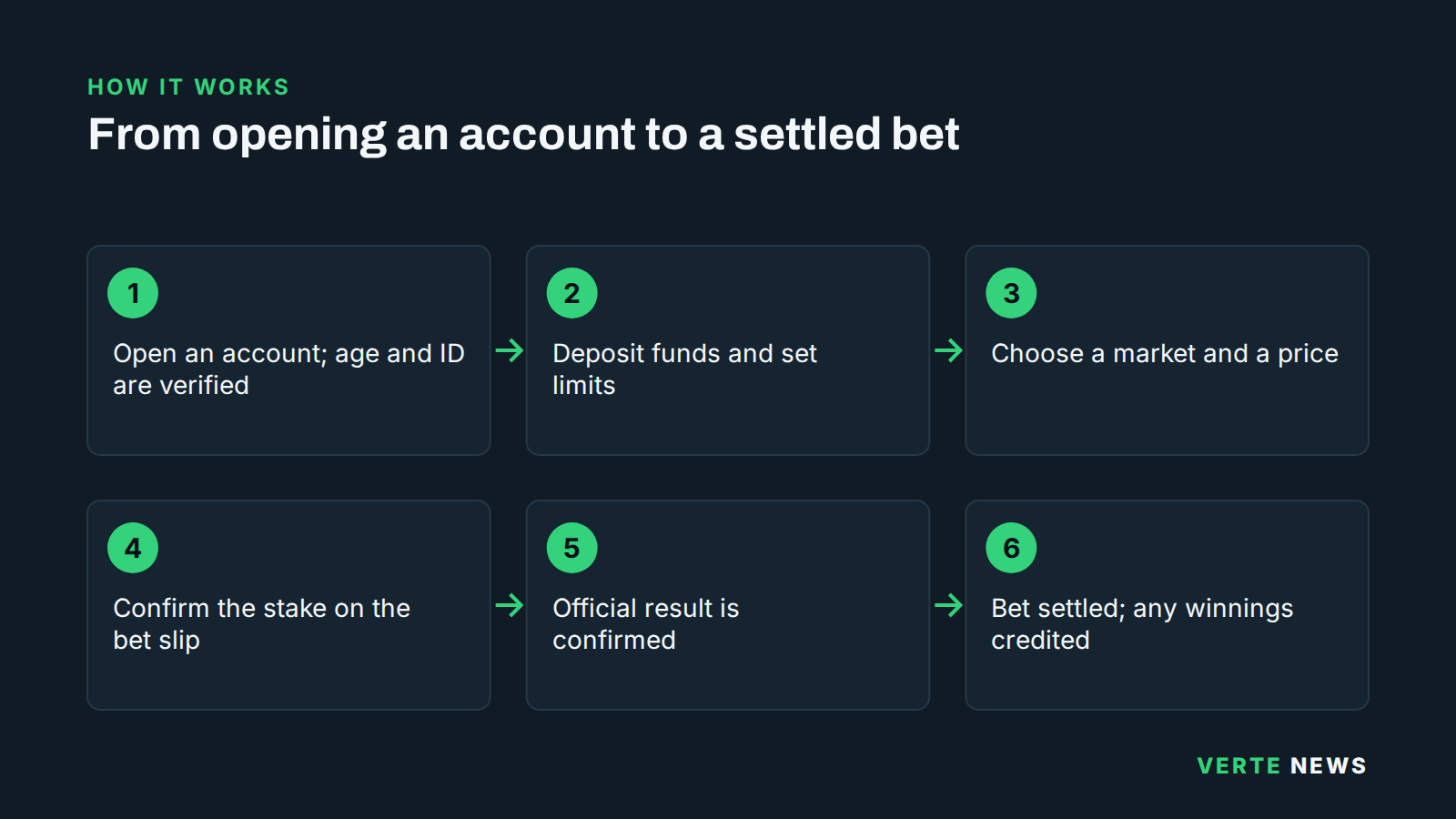
From opening an account to settling a bet, online sports betting runs on identity checks, prices, bet slips and settlement rules. Here is how the pieces fit together, and where the operator's edge sits.

Online sports betting is a contract between a customer and a licensed operator. You stake money on an outcome at a price the operator offers; if the outcome happens, the operator pays out according to that price, and if it does not, the operator keeps the stake. Everything else on a sportsbook website or app – account checks, odds displays, the bet slip, settlement – is machinery for making that contract quick, traceable and, in regulated markets, subject to rules on who may bet and how.
Before the first bet: the account
To take bets from customers in Great Britain, an operator needs a licence from the Gambling Commission. Licensed operators must verify that a customer is at least 18 before they can deposit or bet, and must verify their name, address and date of birth before they can gamble. The process is usually automated against electronic records, with documents requested when those checks do not match. Our explainer on what KYC means in gambling covers this in more detail.
Operators may also ask about income or the source of funds as spending rises, under their duties to prevent gambling harm and money laundering; affordability checks are the most debated part of that. Licensed operators have to offer tools such as deposit limits, time-outs and self-exclusion, and since 31 October 2025 they must prompt customers to set a deposit limit when they register or first deposit. These tools are worth setting at the start rather than after a bad run.
Markets, prices and the bet slip
Once the account is funded, the customer chooses an event and a market. A single football match might offer dozens: the result, the number of goals, both teams to score, corners, cards and individual player outcomes. Our guide to how betting markets work explains the main types. Each outcome carries a price, shown on UK sportsbooks as fractional or decimal odds.
Decimal odds are the simplest to read: they give the total return per £1 staked, including the stake. A £10 bet at 2.50 returns £25 if it wins, which is £15 profit plus the £10 stake back. The same price in fractional form is 6/4: £15 profit for every £10 staked.
Selections go onto a bet slip, which shows the stake and the potential return. A single is one selection; combining several into one bet creates a multiple, such as an accumulator, where every selection has to win. When the customer confirms, the operator's systems check that the price is still current and that the stake is within the limits set for that market and that customer. If the price has moved, the slip will typically ask the customer to accept the new one. Once the bet is accepted, the stake leaves the balance and the price is fixed.
Where the operator's edge comes from
Sportsbooks do not need to predict results better than their customers on every bet. They set prices whose combined implied probabilities add up to more than 100%. Take a tennis match with both players priced at 1.90. Each price implies a 52.6% chance (1 ÷ 1.90), so the two together imply about 105.3%. If one customer staked £100 on each player, the operator would take £200 and pay out £190 whichever player won, keeping £10, or 5% of the money staked.
Real books are never that neatly balanced, and operators manage risk through trading teams, data feeds and stake limits. But the margin, explained in what the bookmaker's margin is, means that across many bets customers as a group get back less than they stake. Individual bettors can win in the short run; over time, the average outcome is a loss.
Settlement and withdrawals
After the event, the operator settles bets against the official result under its published rules. These rules matter more than most customers realise. Football bets are normally settled on the score after 90 minutes plus stoppage time, not extra time or penalties, unless the market says otherwise. A tennis player retiring injured, a match being abandoned or a player not taking part can each void a bet or leave it standing, depending on the market and the operator's terms.
Winnings are credited to the account balance. Withdrawals go back to the customer's payment method, and a first withdrawal can prompt additional verification if it was not completed earlier. Processing times vary by operator and payment method.
Before betting, it is worth checking:
- That the operator is licensed to serve customers where you live; in Great Britain the Gambling Commission publishes a register of licensees.
- The settlement rules for the markets you use, including what happens to voided selections.
- Any maximum payout limits in the terms and conditions.
- Deposit limits and time-outs, set before you start rather than after a loss.
Online betting is entertainment with a cost attached, not a way to make money. If it stops feeling like that, free and confidential support is available 24 hours a day from the National Gambling Helpline on 0808 8020 133, run by GamCare.