Affordability checks explained
Affordability checks are how licensed gambling operators in Great Britain assess whether a customer's spending might be causing financial harm. Here is why they exist, how they work in practice and why they remain contested.

Affordability checks are assessments that licensed gambling operators in Great Britain make to judge whether a customer's level of gambling spending could be harmful to them financially. They range from automatic checks using publicly available financial data, which most customers never notice, to requests for documents such as payslips when spending is high. They are part of a wider duty on operators to spot and respond to signs of gambling harm.
The principle is not new. Gambling Commission rules have long required operators to interact with customers who may be experiencing harm and to take account of their circumstances. What has changed in recent years is the degree of structure: the government's April 2023 white paper, High stakes: gambling reform for the digital age, proposed a more consistent framework of financial risk checks, and the Commission has been introducing it in stages. The Commission itself uses the terms financial vulnerability checks and financial risk assessments rather than affordability checks.
Why operators check affordability
Gambling harm often shows up first as money trouble. Several high-profile regulatory cases have involved customers who lost sums far beyond their means, in some cases using money stolen from an employer, while the operator continued to treat them as valued or VIP customers. The Commission's view is that operators, which can see a customer's deposits and losses in detail, are well placed to notice when spending looks out of line and must act on it.
The checks therefore have two purposes: to identify customers who may be in financial difficulty or vulnerable, and to make sure intervention happens before losses become severe. They sit alongside KYC and anti-money laundering checks, which ask where money comes from, and customer interaction rules, which cover behavioural signs of harm such as chasing losses or gambling for long periods.
How the checks work
The framework set out in the white paper and developed by the Commission has two levels.
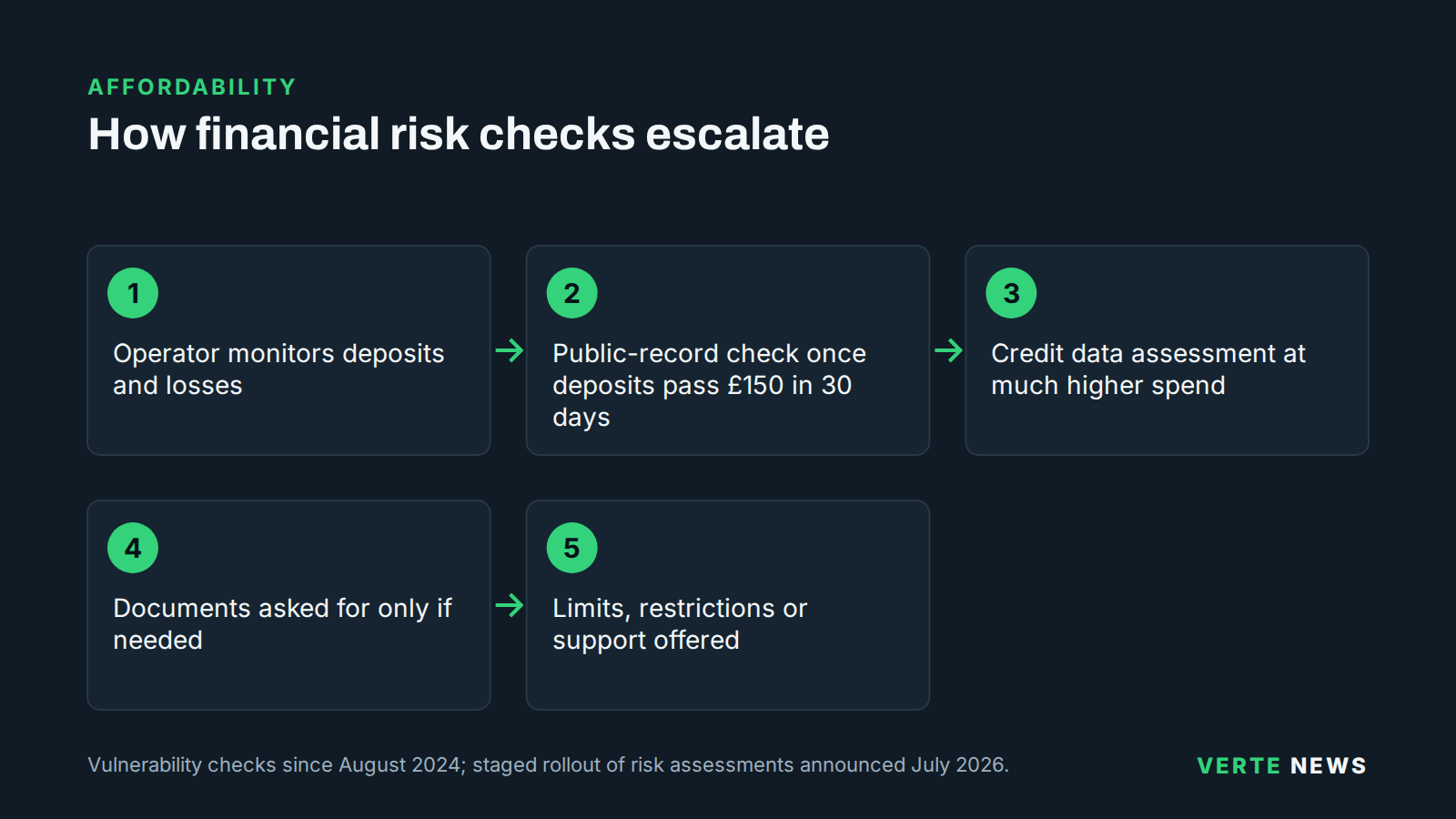
- Financial vulnerability checks have applied to online operators since 30 August 2024. When a customer's net deposits (deposits minus withdrawals) pass a set level, which has been £150 in a rolling 30-day period since February 2025, the operator must check public records for significant signs of financial vulnerability, such as a bankruptcy order or a county court judgment. The customer is not asked for anything.
- Financial risk assessments are more detailed checks at much higher levels of net deposits. They use credit reference agency data to look for signs of financial difficulty, such as defaults, arrears or debt management plans, and are designed to be completed without documents in the great majority of cases.
Financial risk assessments were piloted with operators and credit reference agencies during 2024 and 2025. In July 2026 the Commission announced that it would introduce them in stages, beginning with the largest operators and only the highest-spending customers, with lower thresholds to follow once they are fully in place. It has emphasised that it wants the checks to be frictionless for the great majority of customers. Its current requirements are published on the Gambling Commission website.
In practice, operators already use their own risk models. A customer whose deposits rise sharply, or whose losses look high relative to what the operator knows about them, may be contacted, asked questions about their income or asked to provide evidence. Depending on the outcome, the operator may set a deposit limit, restrict the account or, in some cases, close it.
What customers can expect
Most people who gamble modest amounts will never be asked for anything. For those who are, it helps to know:
- What is being asked, and why. An operator asking about income or requesting bank statements is fulfilling a regulatory duty, not accusing the customer of anything.
- Credit data. The Commission says these checks do not affect a customer's credit score, unlike a loan or credit card application.
- Limits are available at any time. Customers can set their own deposit limits without waiting for a check. Many find this a simpler way to stay in control.
- Refusing to provide information may lead an operator to restrict an account, since it cannot then show that it has met its obligations.
Why the checks are contested
Affordability checks are one of the most debated parts of gambling reform. Supporters, including many people with lived experience of gambling harm, argue they are an overdue safeguard against catastrophic losses. Critics, including parts of the horseracing industry, argue that intrusive document requests drive customers away from licensed operators and towards the unlicensed market, where no checks apply at all. That concern is part of the context for our explainer on what non-GamStop means.
The Commission's response has been to focus on frictionless, data-led checks, to pilot them and to introduce the more detailed assessments in stages. The debate is likely to continue as evidence accumulates on how well they work.
Other help
Affordability checks are an operator's duty, but customers have tools of their own. GamStop lets people exclude themselves from all online operators licensed in Great Britain, and many banks offer gambling payment blocks. Free, confidential support is available from the National Gambling Helpline, run by GamCare, on 0808 8020 133, and through the GamCare website.