Betting bonuses explained
Free bets, deposit matches, price boosts and money-back offers all come with terms that decide what they are really worth. Here is how the main types of sportsbook bonus work and what to read before accepting one.

A betting bonus is any incentive a sportsbook offers beyond the odds themselves: free bets, deposit matches, enhanced prices, money-back offers and loyalty rewards. They share a purpose, which is attracting and keeping customers, and they all come with terms that decide what the bonus is actually worth. Those terms matter far more than the headline figure.
The main types
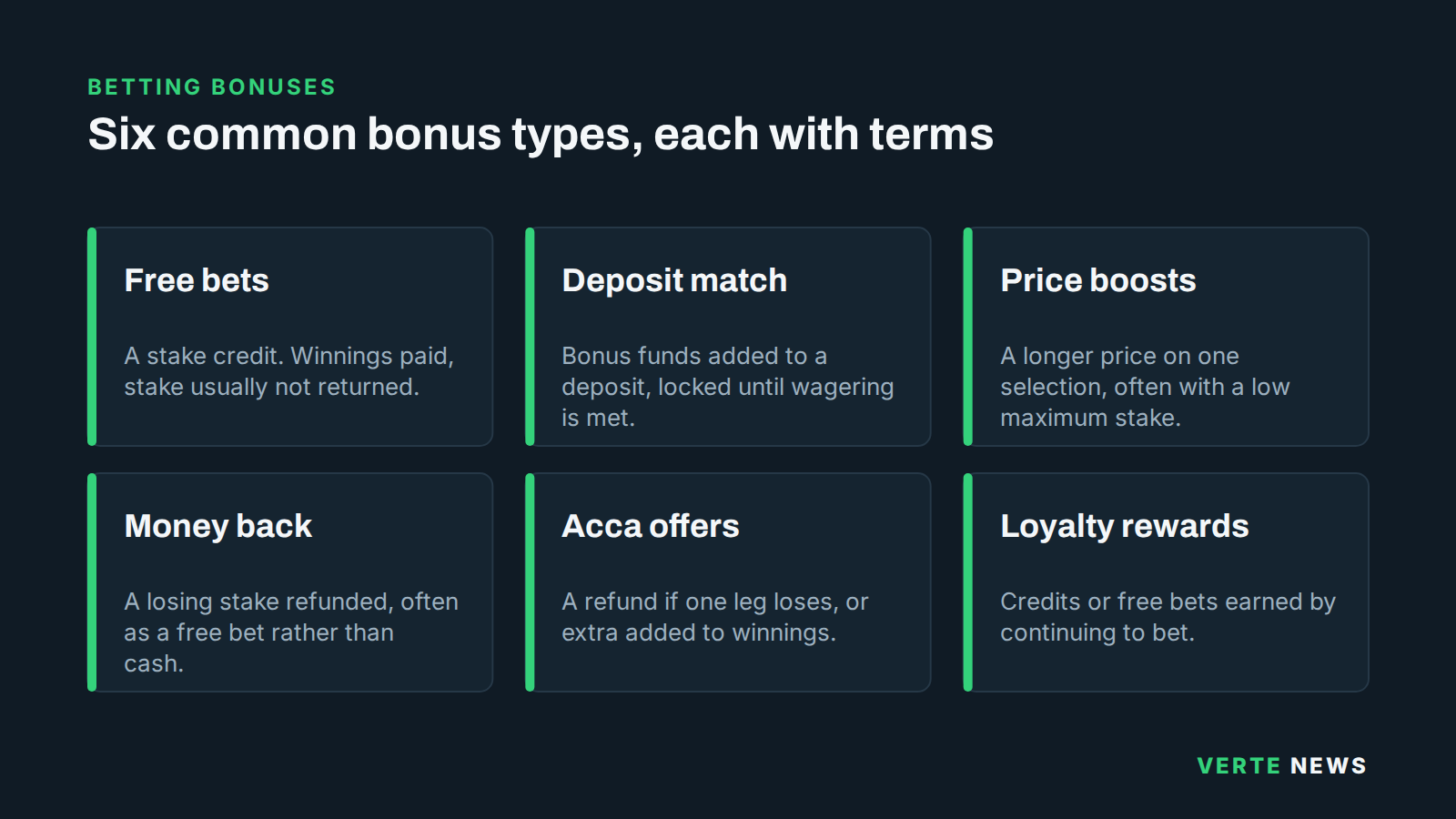
- Free bets: a stake credit, usually paying the winnings but not the stake. The mechanics are covered in free bets explained.
- Deposit match: the operator adds bonus funds in proportion to a deposit, up to a limit. The bonus is normally locked until wagering conditions are met.
- Enhanced odds or price boosts: a longer price than usual on a particular selection, typically with a low maximum stake.
- Money back or refunds: a stake refunded if a bet loses in a defined way, often as a free bet rather than cash.
- Accumulator offers: a refund if one leg of a multiple lets the bet down, or a percentage added to winnings.
- Loyalty and reward schemes: credits or free bets earned through continued betting.
Casino offers, such as free spins and casino deposit matches, follow their own rules and are covered in how casino bonuses work.
Wagering requirements
A wagering requirement is the amount you must bet before bonus funds, or the winnings from them, can be withdrawn. It is expressed as a multiple. With a £20 bonus and a 10x requirement on the bonus amount, you would need to place £200 of qualifying bets. Some offers have in the past calculated the requirement on the bonus plus the deposit, which would double the figure in that example to £400, so the basis of the calculation matters as much as the multiple.
Every pound wagered is exposed to the bookmaker's margin, so the more you are required to bet, the more of the bonus you should expect to lose along the way. What wagering requirements mean works through the calculation in more detail.
In Great Britain, the Gambling Commission capped wagering requirements at 10 times the bonus funds from 19 January 2026, and banned bonuses that combine different gambling products, such as an offer that requires a sports bet to unlock casino spins. Older articles, screenshots and forum posts may describe conditions that no longer apply to British-licensed operators, so the current terms on the operator's site are the reference.
Other terms that change the value
- Minimum odds: qualifying bets and bonus bets often need to be placed at or above a set price.
- Expiry: bonuses and free bets usually lapse if they are not used within a set period.
- Maximum stake and maximum win: price boosts and bonus funds often cap how much can be staked or won.
- Eligible bets: some markets, or bets that are cashed out, may not count towards a requirement.
- Payment exclusions: deposits made through some methods may not qualify.
- One per customer: offers are normally limited to one per person, household or device.
A useful habit before accepting any offer is to write down what you would need to do to withdraw any winnings, in pounds and in days. If you cannot answer that from the terms, the bonus is not clear enough to rely on.
It also helps to keep the bonus separate from the decision to bet at all. An offer that needs a deposit or a qualifying bet is only worth considering if you would have deposited or bet that amount anyway; otherwise it simply adds to what you spend.
Bonuses in context
Bonuses are a cost of acquiring and keeping customers, and operators design them to be affordable on that basis. At best they offset part of the margin on a small number of bets; they do not turn betting into a source of income. Chasing a wagering target can also push spending beyond what was planned, which is a good reason to set a deposit limit first. You can usually decline a bonus, and there is no obligation to accept one.
When comparing operators, the licence, the terms, how quickly withdrawals are processed and the account tools on offer matter more than the size of any promotion. What to check before choosing a bookmaker sets those checks out in order.