How to turn odds into implied probability
Implied probability converts a betting price into the percentage chance it represents. It is the clearest way to compare odds, and it shows exactly how much margin a bookmaker has built into a market.
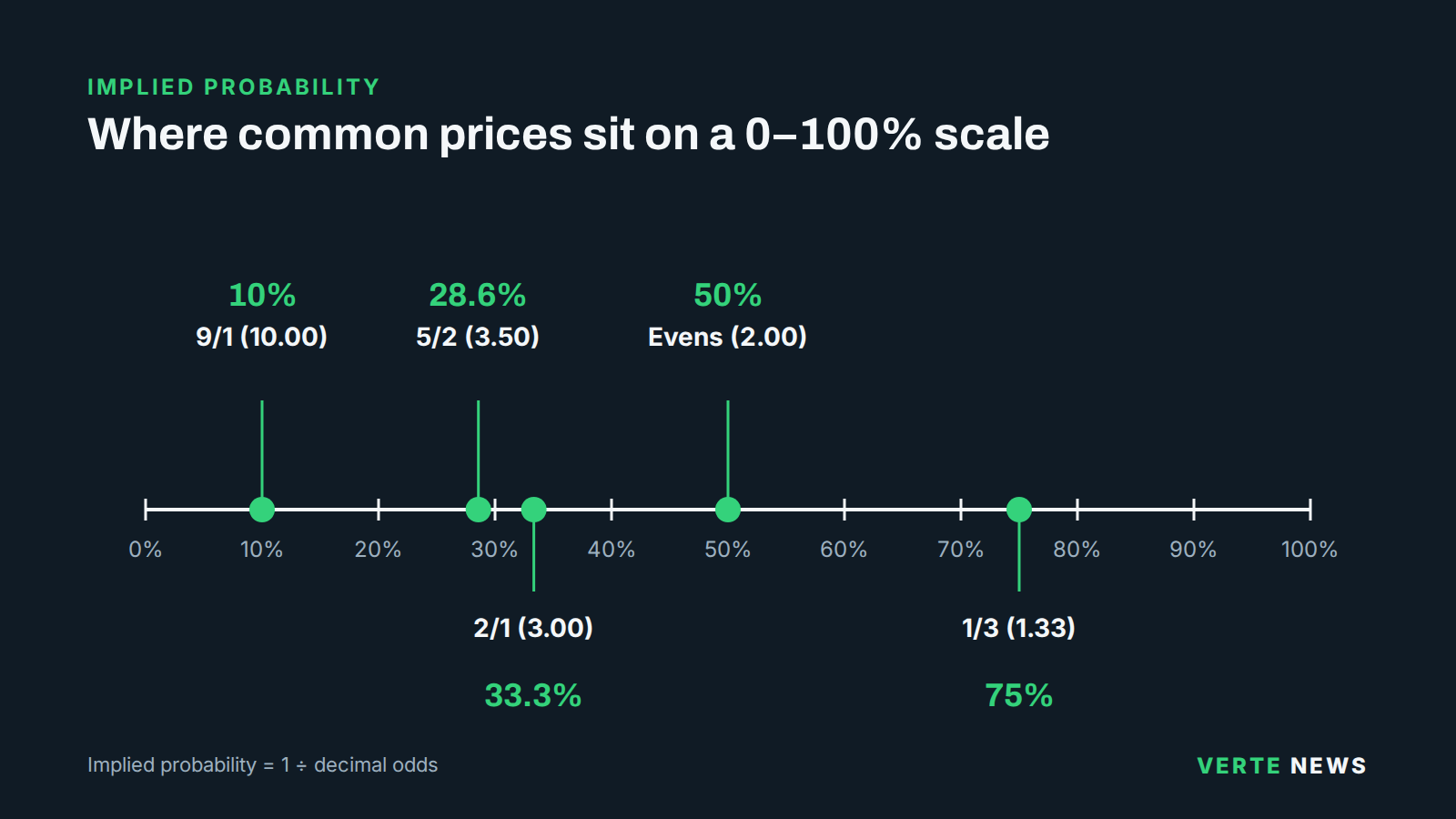
Implied probability is the chance of an outcome that a set of odds represents. For decimal odds it is 1 divided by the price: 2.00 implies 50%, 4.00 implies 25% and 1.25 implies 80%. Converting odds this way is the most useful single skill for understanding betting prices, because it turns a number designed for calculating payouts into one you can judge against your own view of how likely something is. It also exposes the margin the bookmaker has built into the market.
The formula for each format
- Decimal: 1 ÷ odds. 3.50 gives 1 ÷ 3.50 = 28.6%.
- Fractional (a/b): b ÷ (a + b). 5/2 gives 2 ÷ 7 = 28.6%; 1/2 gives 2 ÷ 3 = 66.7%.
- American, plus: 100 ÷ (odds + 100). +250 gives 100 ÷ 350 = 28.6%.
- American, minus: odds ÷ (odds + 100), ignoring the sign. -200 gives 200 ÷ 300 = 66.7%.
The three 28.6% results are no coincidence: 5/2, 3.50 and +250 are the same price written three ways. Each notation is covered in its own guide: fractional odds, decimal odds and the American moneyline format.
The percentages here are rounded to one decimal place. That is enough for comparing two prices, but when adding up a whole market it is better to keep more decimal places until the end, or rounding can make the margin look slightly larger or smaller than it is.
Why a market adds up to more than 100%
Take a football match priced at 2.10 for a home win, 3.40 for the draw and 3.60 for an away win. Converted:
- Home: 1 ÷ 2.10 = 47.6%
- Draw: 1 ÷ 3.40 = 29.4%
- Away: 1 ÷ 3.60 = 27.8%
One of those three outcomes must happen, so their true probabilities add up to exactly 100%. The implied probabilities, however, total 104.8%. The extra 4.8 percentage points are the overround: the bookmaker's built-in margin. It means each price is slightly shorter than a fair price would be. The bookmaker's margin explains the different ways that figure is expressed. As a rule, the closer a market's total is to 100%, the less the prices are tilted against the bettor.
Removing the margin
To estimate what the prices would imply without the margin, divide each figure by the total. Dividing by 1.048 gives about 45.4% for the home win, 28.1% for the draw and 26.5% for the away win, which now add up to 100%. Those are the bookmaker's approximate underlying estimates.
This simple proportional method assumes the margin is spread evenly across every outcome. In practice it often is not: bookmakers can load relatively more margin onto longer prices, a pattern linked to what researchers call the favourite-longshot bias. Treat the adjusted figures as a reasonable approximation rather than an exact measurement.
What implied probability is useful for
- Comparing prices. A move from 3.00 to 2.50 is a shift from 33.3% to 40%. Seen as percentages, it is clearer how much the market's view has changed; why betting odds move looks at what drives those shifts.
- Spotting price differences. Two bookmakers might offer the same favourite at 1.80 and 1.85: 55.6% against 54.1%. The gap looks small, but it matters more the more often you bet.
- Understanding multiples. Probabilities multiply. Three independent selections at 50% each have a combined chance of 12.5%, which is why accumulators lose far more often than they win.
- Testing a view. If you think something is more likely than its price implies, the conversion tells you by how much. It does not tell you that your view is right.
That last point matters. Implied probability describes a price, not the future. Bookmakers set prices using large amounts of data and adjust them quickly, and the margin means that someone who backs outcomes at their implied probabilities should expect to lose a share of every pound staked roughly in line with that margin. In the example above, a total of 104.8% corresponds to an expected loss of about 4.6p per £1 staked if the underlying estimates are right (1 − 1 ÷ 1.048).
Understanding the conversion is a way of seeing clearly what you are paying, not a method for winning. If betting stops feeling like spending on entertainment, UK-licensed operators offer deposit limits and time-outs, and free, confidential support is available 24 hours a day from the National Gambling Helpline on 0808 8020 133, run by GamCare.