Fractional odds explained
Fractional odds such as 5/2 or 4/6 show the profit a winning bet makes relative to the stake. Here is how to read them, work out returns and convert them into other formats.

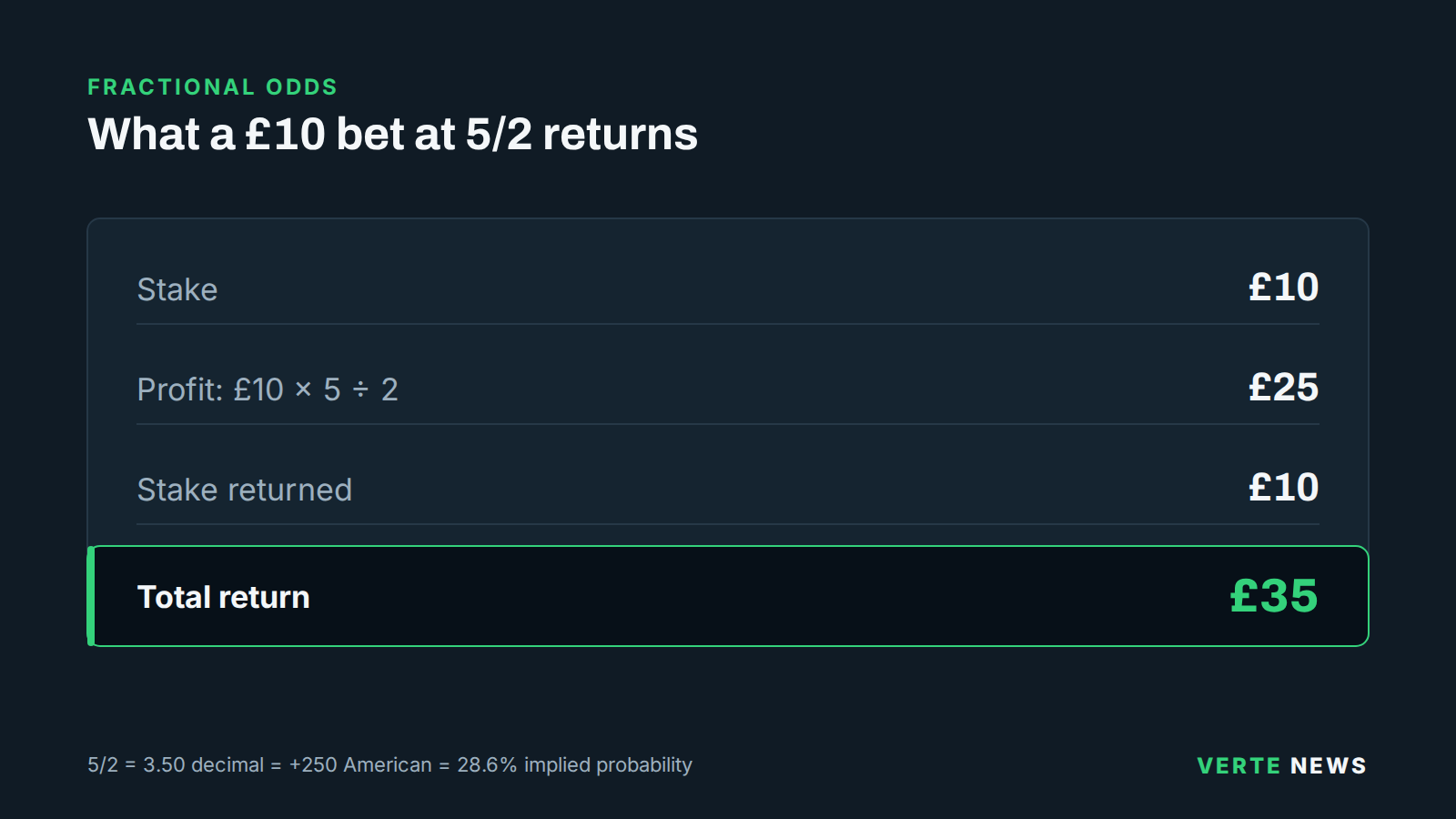
Fractional odds tell you how much profit a winning bet makes relative to the stake. At 5/2, every £2 staked wins £5 in profit, and the stake comes back on top. A £10 bet at 5/2 therefore returns £35: £25 profit plus the original £10. Fractions are the traditional format in British and Irish betting, especially in horse racing, and they appear alongside decimal odds on most UK betting sites.
How to read the fraction
The number on the left is what you win; the number on the right is what you have to stake to win it. Read 5/2 as 'five to two': stake two units, win five. The same logic applies to every price:
- Evens (1/1): stake £10, win £10 profit, £20 returned.
- 2/1: stake £10, win £20 profit, £30 returned.
- 11/4: stake £10, win £27.50 profit (10 × 11 ÷ 4), £37.50 returned.
- 1/2: stake £10, win £5 profit, £15 returned.
The general formula is profit = stake × (left number ÷ right number), and the total return is that profit plus the stake. When the left number is bigger than the right, the price is 'odds against': the bookmaker rates the outcome as less likely than not, and a winning bet pays more than the stake. When the left number is smaller, as in 1/2 or 4/6, the price is 'odds on': the outcome is rated as more likely than not, and you risk more than you stand to win.
Some fractions look odd because bookmakers work from a conventional ladder of prices rather than any fraction at all. You will see 6/4 rather than 3/2, 100/30 rather than 10/3, and 8/13 or 4/11 for short-priced favourites. They are simply ratios: 6/4 pays exactly the same as 3/2.
Converting fractional odds
Fractions are awkward to compare at a glance. Is 8/13 shorter than 4/7? Converting them answers the question, and three conversions cover almost everything:
- To decimal: divide the left number by the right and add 1. 5/2 becomes 2.5 + 1 = 3.50; 1/2 becomes 1.50.
- To American: for odds against, multiply the fraction by 100 and add a plus sign, so 5/2 is +250. For odds on, divide 100 by the fraction and add a minus sign, so 1/2 is -200. The guide to American odds covers that format in detail.
- To implied probability: divide the right number by the sum of both numbers. For 5/2 that is 2 ÷ (5 + 2) = 28.6%. Evens is 50%; 1/2 is 66.7%.
Back to the earlier question: 8/13 is about 1.62 in decimal and 4/7 about 1.57, so 4/7 is the shorter price. The last of the three conversions is the most useful. Implied probability turns a price into the chance the bookmaker is effectively quoting, which is the clearest way to judge whether a price is short or long.
What the fraction does not tell you
A fractional price is not a neutral estimate of how likely something is. Bookmakers build a margin into every market, so the implied probabilities of all the outcomes add up to more than 100%. In a two-way contest priced at 5/6 each, each side implies 54.5% (6 ÷ 11), a total of 109.1%. The 9.1 points above 100% are the bookmaker's built-in edge; the article on the bookmaker's margin shows how to calculate it for a full market.
Fractions can also hide small differences. 10/11 and 5/6 look similar, yet 10/11 (about 1.91 in decimal) pays more than 5/6 (about 1.83). On a £20 stake that is £18.18 of profit against £16.67. Across many bets those gaps add up, which is one reason regular bettors often switch their account display to decimal.
Prices also change. The odds on offer before a race or match reflect the bookmaker's view and the money it has taken, and they move as new information arrives; why betting odds move explains the main drivers. A bet struck at a fixed price normally keeps that price even if the odds later lengthen or shorten. If you take the starting price (SP) in racing instead, you are paid at the official odds when the race begins. In horse racing, winnings at a fixed price can also be reduced by a deduction if a runner is withdrawn late, under what is known as Rule 4.
Practical points
- Check whether the figure shown on a bet slip is the total return, stake included, or only the profit.
- Compare prices in the same format. Mixing fractions and decimals is where arithmetic mistakes tend to happen.
- A longer price means a lower implied chance, not a better bet. The price describes risk as well as reward.
- Remember that each-way bets split the stake into two equal bets, one to win and one to place, so a £10 each-way bet costs £20.
Understanding the format does not change the arithmetic of betting: over time the margin works in the bookmaker's favour, whichever way the odds are written. Anyone who bets should use money they can afford to lose, and UK-licensed operators offer tools such as deposit limits and time-outs to help keep it that way.