American odds explained
American, or moneyline, odds use plus and minus numbers built around 100. Here is what +250 and -200 mean, how to work out a payout and how to convert them into formats UK readers know.

American odds, also called moneyline odds, use a plus or minus sign against a base of 100. A plus number shows the profit on a 100 stake; a minus number shows how much you must stake to win 100. So +250 means a £100 bet makes £250 profit, and -200 means you must stake £200 to make £100 profit. The format is standard in US sports betting and appears as a display option on many UK sites, alongside decimal odds and fractions.
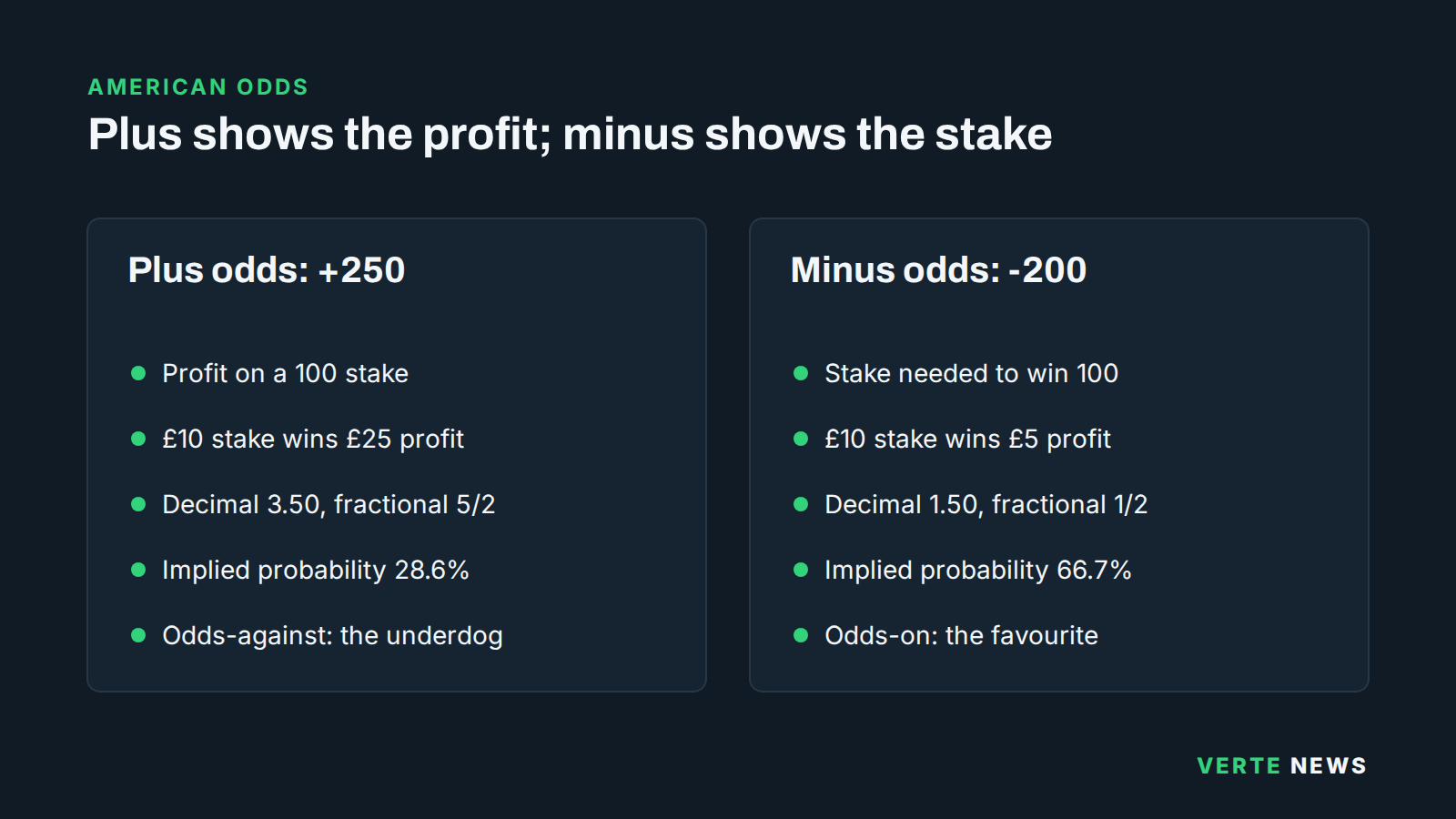
Plus odds and minus odds
A plus sign means the outcome is odds-against: the underdog, or anything priced as less likely than not. Profit = stake × (number ÷ 100).
- +250: £10 wins £25 profit, £35 returned.
- +100: £10 wins £10 profit. This is evens.
- +450: £20 wins £90 profit, £110 returned.
A minus sign means the outcome is odds-on: the favourite. Profit = stake × (100 ÷ number, ignoring the sign).
- -200: £10 wins £5 profit, £15 returned.
- -110: £22 wins £20 profit (22 × 100 ÷ 110), £42 returned.
- -150: £30 wins £20 profit, £50 returned.
There is no American price between -100 and +100. Evens can be written as either +100 or -100, and both mean the same thing. The numbers do not have to be staked in hundreds; they simply fix the ratio, and the formulas work the same for £1 or £1,000.
The name is also worth knowing. In US betting, a moneyline bet is simply a bet on who wins, as distinct from a point-spread bet, which applies a handicap to one side. The odds format took its name from that market, although the same notation is used for spreads and totals too.
Converting American odds
- To decimal: for plus odds, divide by 100 and add 1, so +250 becomes 3.50. For minus odds, divide 100 by the number and add 1, so -150 becomes about 1.67 and -110 about 1.91.
- To fractional: for plus odds, the number over 100, so +250 is 250/100, or 5/2. For minus odds, 100 over the number, so -200 is 100/200, or 1/2. The fractional odds guide explains that format.
- To implied probability: for plus odds, 100 ÷ (number + 100), so +250 is 100 ÷ 350 = 28.6%. For minus odds, number ÷ (number + 100), so -150 is 150 ÷ 250 = 60%.
The minus-side formula catches people out because the number itself goes on top. It helps to remember that a minus price is always above 50%, and the bigger the number, the closer to 100% it gets: -400 implies 80%. How to turn odds into implied probability covers the conversion in every format.
The -110 market and the built-in margin
In US point-spread and totals markets, both sides are often priced at -110. Each side implies 52.4% (110 ÷ 210), so together they come to 104.8%. The 4.8 points above 100% are the bookmaker's margin. It also means that anyone betting at -110 needs to win about 52.4% of those bets simply to break even, before any other costs.
The same principle applies in every format and every market: the implied probabilities of all outcomes add up to more than 100%, and the difference is the operator's edge. What the bookmaker's margin is shows how to measure it across a full market, and how bookmakers set odds explains where the prices come from in the first place.
Reading American odds sensibly
- The sign matters more than the size. +150 and -150 are very different prices: about 2.50 and 1.67 in decimal, or 40% and 60% in implied probability.
- Big minus numbers risk a lot for a little. At -500, a £50 stake wins £10. One loss costs as much as five wins earn.
- Convert before comparing. Mixing formats across different sites is where mistakes happen. Pick one format and convert everything into it.
- Check the display setting. Many sites let you choose American, decimal or fractional odds in the account settings. The price is identical in each; only the notation changes.
American odds are only a notation. The three formats describe exactly the same prices, and none of them changes the underlying economics: a price carries the operator's margin whichever way it is written, and over time that margin favours the operator. Setting deposit limits or a time-out before you bet is a sensible precaution, and UK-licensed operators are required to make such tools available.