Decimal odds explained
Decimal odds show the total return for every £1 staked, stake included. One multiplication gives the payout, which makes them the easiest format to compare and convert.

Decimal odds show the total amount a winning bet returns for every £1 staked, including the stake itself. At 3.50, a £10 bet returns £35 if it wins: £25 profit plus the £10 stake. That single multiplication is why decimal odds are the standard on betting exchanges and across much of Europe, and why most UK sites offer them as an alternative to fractional odds.
The one calculation you need
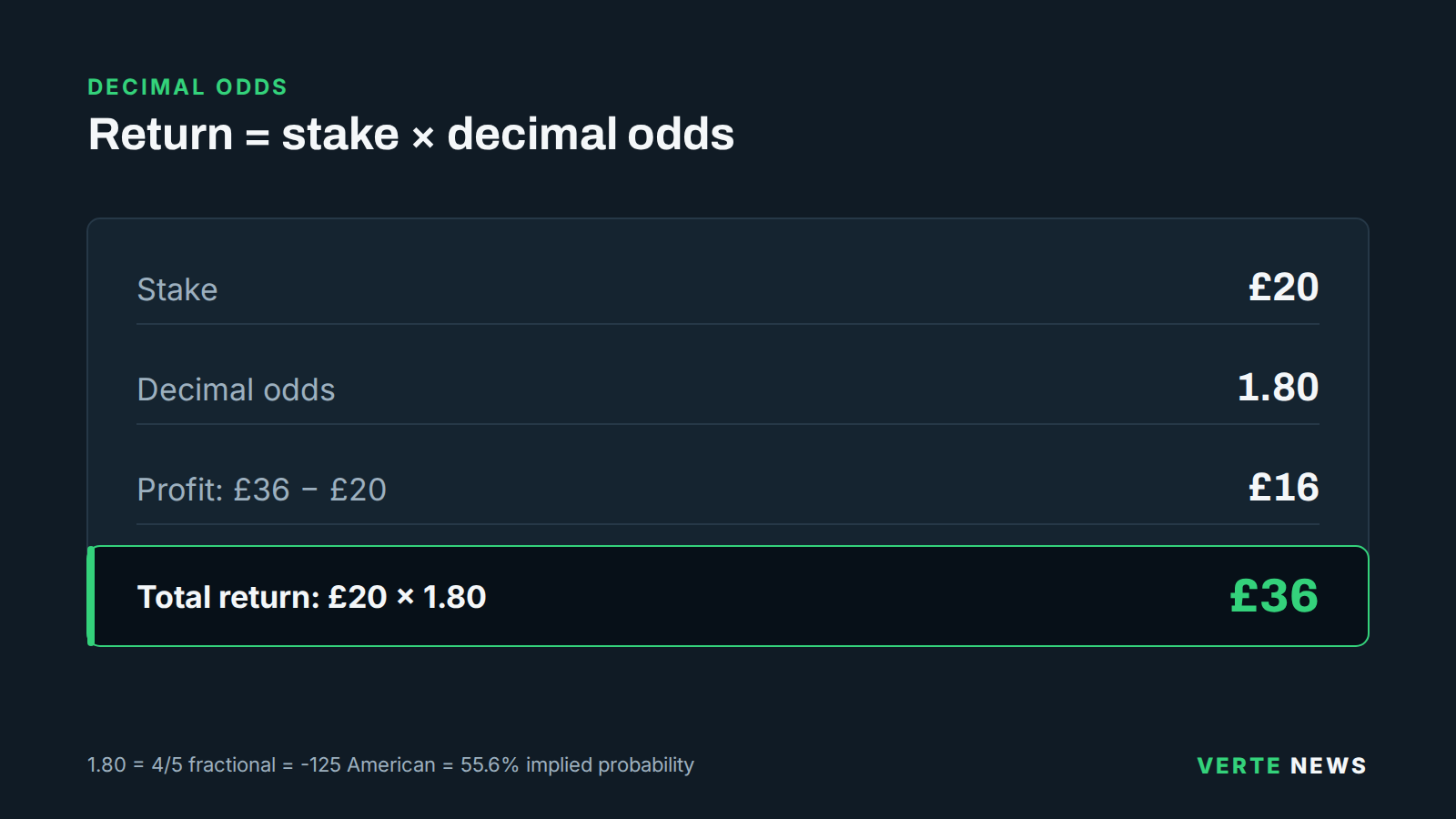
Return = stake × decimal odds. Profit = return minus stake, or stake × (odds − 1). A few examples:
- 2.00: this is evens. £10 returns £20, a profit of £10.
- 1.80: £20 returns £36, a profit of £16.
- 5.00: £10 returns £50, a profit of £40.
- 1.25: £40 returns £50, a profit of £10.
A decimal price can never be 1.00 or below, because 1.00 would simply return the stake. Anything below 2.00 is odds-on, meaning you risk more than you can win. Anything above 2.00 is odds-against.
Why decimals are easier to compare
Decimal odds sit on a single scale, so comparison is simple: the higher number pays more. That is not always obvious with fractions. 8/13 and 4/7 look similar, but in decimal they are about 1.62 and 1.57. On a £50 stake the gap is worth about £2.20 in profit, which is easy to miss when the prices are written as fractions.
Decimals also make multiple bets straightforward. The odds of an accumulator are the individual prices multiplied together: three selections at 1.80, 2.10 and 1.50 combine to 5.67 (1.80 × 2.10 × 1.50). A £5 stake returns £28.35 if all three win, and nothing if any one of them loses. The mechanics, and the way the bookmaker's edge compounds across the legs, are explained in how accumulator bets work.
Converting decimal odds
- To implied probability: 1 ÷ decimal odds. 2.00 is 50%, 1.80 is 55.6%, 4.00 is 25%. The method is set out step by step in how to turn odds into implied probability.
- To fractional: subtract 1 and express what is left as a fraction. 3.50 − 1 = 2.5, which is 5/2; 1.80 − 1 = 0.8, which is 4/5.
- To American: at 2.00 or above, multiply (odds − 1) by 100 and add a plus sign, so 3.50 is +250. Below 2.00, divide 100 by (odds − 1) and add a minus sign, so 1.80 is -125.
Some decimal prices do not map to a tidy fraction. 1.91 is approximately 10/11, and bookmakers round prices to their own ladders, so conversions between formats are sometimes approximate in the second decimal place. When the exact payout matters, the bet slip is the reference.
Odds are fixed when a bet is accepted, not when you first click on them. If a price changes while you are completing the bet slip, the site will normally ask you to accept the new price, so it is the figure on the confirmation, not the one you started with, that determines the payout.
What to watch for
Because the stake is built into a decimal price, it is easy to misjudge the profit. A price of 1.20 can sound safe until you work out that £100 staked wins only £20, while a loss costs the full £100. Short prices carry a large downside relative to their upside, and one loss can wipe out the profit from several wins.
Exchanges display decimal odds too, but they take commission from net winnings, so the effective price is a little lower than the one on screen. Rates vary between exchanges; at an illustrative 5% commission on winnings and an exchange price of 3.00, a £10 winning bet makes £19 rather than £20. The wider differences are set out in bookmaker vs betting exchange.
Finally, if you convert every outcome in a market to implied probability and add them up, the total will be more than 100%. That excess is the bookmaker's margin, and it is why the prices on screen are slightly shorter than fair odds would be. Decimal odds make the margin easier to see; they do not remove it.
Seeing the numbers clearly is useful, but it is not the same as having an advantage. Setting a deposit limit in your account before you start betting is a simple way to keep spending within a budget you have planned in advance.