What in-play betting means
In-play betting lets customers bet after an event has started, on prices that update by the second. How live prices are produced, why bets are delayed or rejected, and what the speed means for the bettor.

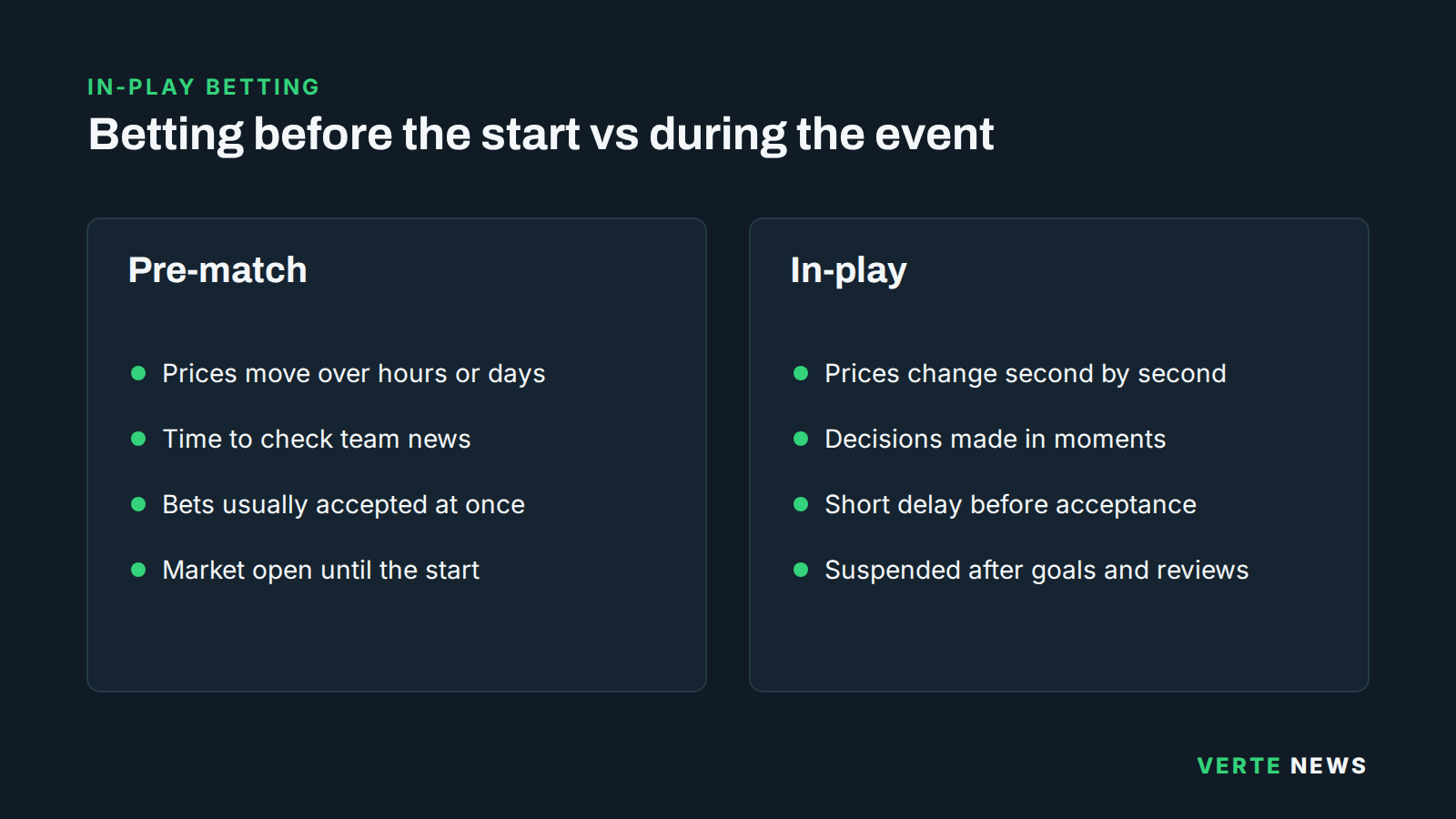
In-play betting, also called live betting, means placing bets on an event after it has started. Prices update continuously as the match unfolds, markets open and close within seconds, and bookmakers build in safeguards such as short acceptance delays and suspensions after key incidents. It is the same fixed-odds contract as a pre-match bet, but made under very different conditions.
How in-play prices are produced
Before kick-off, a bookmaker's model holds an estimate of each team's strength. In-play, it combines that estimate with live data: the score, the time remaining, red cards and, in some sports, possession, shots or serve statistics. The model recalculates the probability of each outcome many times a minute, and prices are generated from those probabilities with a margin added, as described in how bookmakers set odds.
That data usually comes from specialist providers with fast feeds from the venue, because the price depends on the bookmaker knowing what has just happened before the customer does. Television and streaming pictures typically run some seconds behind real time, which makes them a poor basis for quick decisions: the market may already have moved by the time a viewer sees the incident.
An example shows how quickly things change. A home side priced at 2.00 before kick-off, an implied chance of 50%, scores after 20 minutes. Its price might shorten to around 1.40, an implied chance of about 71%. A £10 bet at 1.40 would return £14 if the lead holds: £4 profit, compared with £10 profit for the same stake taken before the match. The draw and away prices lengthen at the same time. Why betting odds move covers the wider mechanics.
Suspensions, delays and rejected bets
In-play markets are suspended whenever something significant is happening or about to happen: a goal, a penalty, a video review, a red card or, in tennis, a key point. While a market is suspended, no bets are accepted. When it reopens, prices reflect the new situation.
Prices can also swing sharply between suspensions. In tennis, a player serving at 40–0 is a much shorter price to hold serve than one facing break point, and the match odds move with almost every point played.
Most operators also apply a short delay between a customer confirming an in-play bet and the bet being accepted. If the price moves or the market is suspended during that delay, the bet may be rejected or offered back at a different price. The delay protects the bookmaker against customers with faster information, and it means the price on screen is not guaranteed until the bet is confirmed as accepted.
Common in-play markets
- Match result and next team to score.
- Total goals or points, as in over/under betting, with the line adjusting as the score changes.
- Next point, game or set in tennis.
- Corners, cards and other statistical markets.
In-play betting is also where cash-out is used most, since the value of an open bet changes with every movement in the price.
What to watch for
The margin on in-play markets is not fixed and can be wider than on the equivalent pre-match market, particularly on fast-moving or less popular markets. Every price still carries the bookmaker's edge, so frequent in-play betting compounds it: the more bets placed, the larger the expected loss, because each bet pays the margin again.
Settlement rules still apply in full. A football in-play bet on the match result is normally settled on 90 minutes plus stoppage time, and statistical markets such as corners are settled on the operator's chosen data source, which may not match what a viewer believes they saw.
The speed of in-play betting is the other issue. Decisions are made in seconds, often during an emotionally charged match, and a loss can be followed immediately by another bet. That is a large part of why in-play betting attracts attention in discussions of gambling harm. Deposit limits and time-outs are available on licensed sites and are especially relevant here. For anyone who finds betting harder to control, free and confidential support is available 24 hours a day from the National Gambling Helpline on 0808 8020 133, run by GamCare.
A useful habit is to decide before an event starts whether you will bet in-play at all, and with what limit, rather than making that decision while the match is being played.