How Murphy v. NCAA cleared the way for state sports betting
The Supreme Court did not legalise sports betting itself in 2018 — it ruled a federal law could not stop states doing so, opening the market state by state.
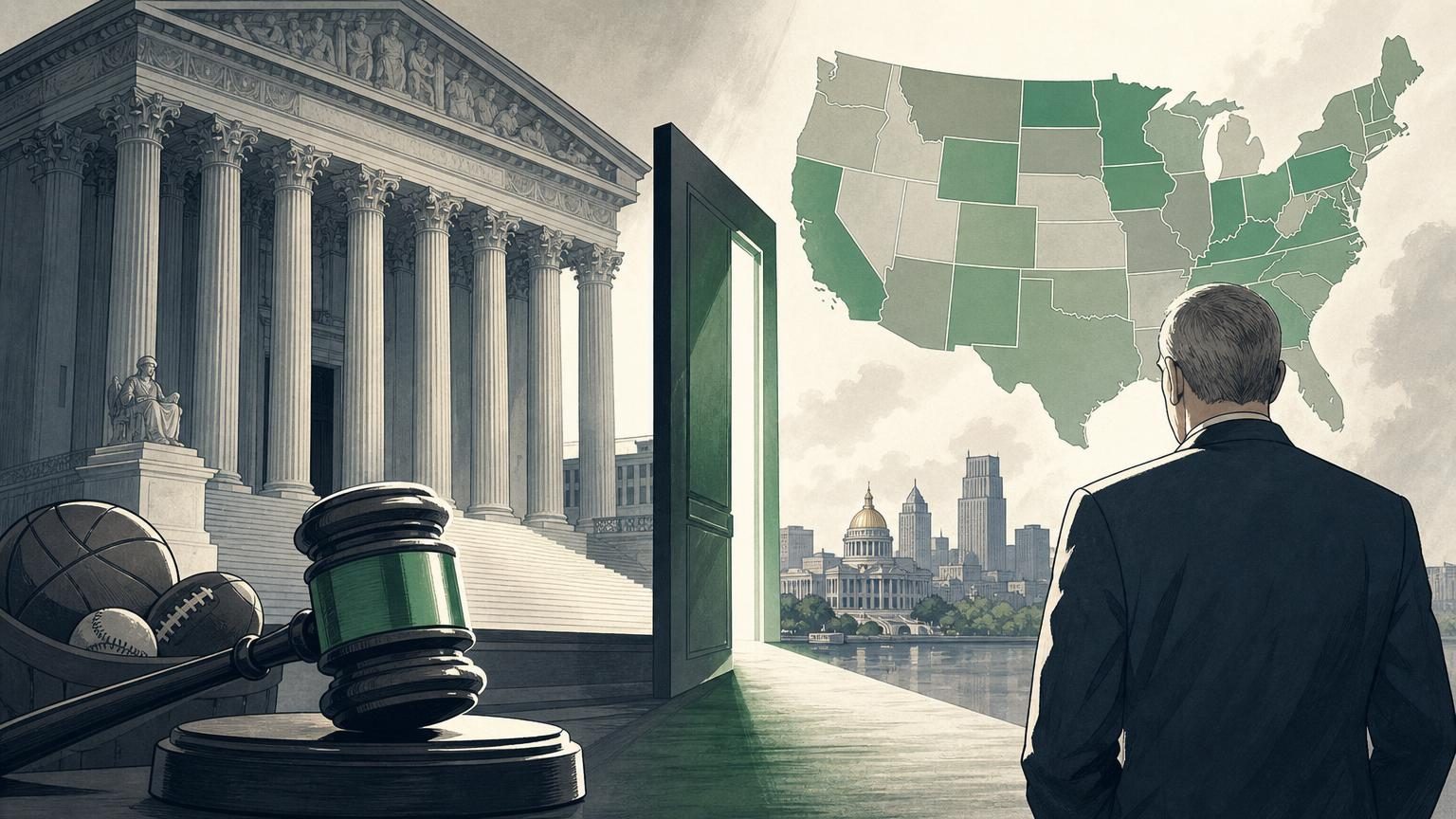
US states can set their own rules on sports betting because the Supreme Court found, in Murphy v. National Collegiate Athletic Association, that Congress had no power to forbid states from legalising it themselves.
The case turned on a 1992 federal law, the Professional and Amateur Sports Protection Act, or PASPA. PASPA did not make sports betting a federal crime. Instead it barred states from authorising, licensing or operating sports betting schemes, effectively freezing state law in place rather than regulating the activity directly.
Four states with pre-existing arrangements — Nevada, Delaware, Montana and Oregon — were grandfathered in and exempt from PASPA's restrictions. Every other state remained locked out of legal sports betting regardless of what its own legislature wanted.
New Jersey, under then-Governor Chris Christie and later Governor Phil Murphy, challenged that arrangement after years of trying to legalise betting at its casinos and racetracks, including at Monmouth Park Racetrack, where the New Jersey Thoroughbred Horsemen's Association joined the litigation over the track's economic position without legal wagering.
The state's argument rested on the Tenth Amendment's anticommandeering principle, drawn from the precedent New York v. United States, which holds that the federal government cannot force state officials to enforce federal policy by directing them to maintain particular state laws.
The case reached the Supreme Court as Christie v. NCAA and was renamed Murphy v. NCAA after Murphy succeeded Christie as governor during the litigation. It was combined with the NJ Thoroughbred Horsemen's parallel petition and argued before the Court on 4 December 2017.
On 14 May 2018, the Court ruled 7–2 that PASPA's command to states violated the anticommandeering doctrine because it told states what they could not do with their own law-making power, which the Court treated as functionally the same as telling states what to do.
On severability, the justices divided 6–3 and struck down PASPA in its entirety rather than preserving the parts the federal government could lawfully enforce. Justice Clarence Thomas wrote separately urging the Court to revisit severability doctrine more broadly; Justice Stephen Breyer dissented in part on that question. Justice Ruth Bader Ginsburg, joined by Justice Sonia Sotomayor and in part by Breyer, dissented, arguing that striking the whole statute went further than necessary.
The ruling meant states were free to authorise and regulate sports betting within their own borders, but it changed nothing about interstate betting, which remains restricted under the separate federal Wire Act.
Several states had draft legislation ready in anticipation of the ruling. Delaware became the first state beyond the original four to launch legal sports betting, on 5 June 2018, and New Jersey's own legalising bill passed both legislative chambers and was signed by Governor Murphy by 11 June 2018.
The major professional leagues, including the NFL, NBA and NHL, signalled they would accept federally regulated sports betting once the ruling came down, while the NCAA pressed to keep betting on college and amateur sport restricted.
According to Wikipedia, by January 2024, 37 states plus Washington DC and Puerto Rico had operational legal sports betting, with 30 of those jurisdictions, plus DC and Puerto Rico, permitting it online; by 2026, 27 states had legalised online sports gambling specifically. Reports cited by Wikipedia also put total US sports betting spending at more than $20 billion in the two years following the decision.