No Betting Progression Beats Roulette's Built-In House Edge
Martingale, anti-martingale and every stake-progression system rely on streak logic that the maths of independent spins and wheel geometry simply does not support, according to Wikipedia's analysis of the game.
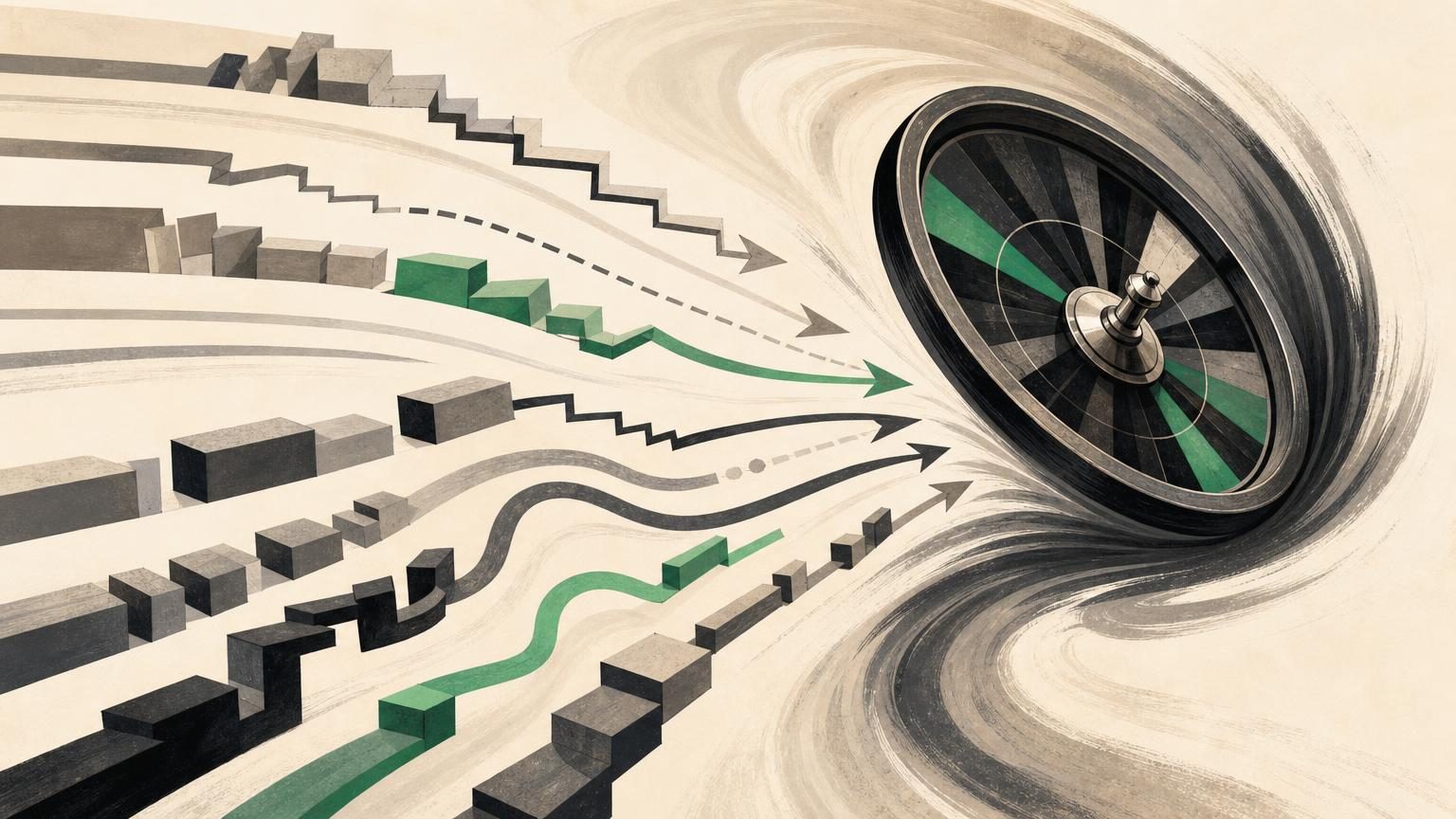
No way of sizing or sequencing bets changes the fact that every single spin of a roulette wheel pays out at odds that favour the casino, regardless of how a player varies the stake from one spin to the next.
That gap is built into the wheel itself. A European wheel has 37 pockets, including one zero; an American wheel has 38, including both a zero and a double zero. Wikipedia sets out a simple formula for the average return on any bet: 36 divided by the total number of pockets.
On a single-zero wheel that comes to 36/37, leaving the casino a margin of roughly 2.7%. On the American double-zero wheel the player's position is worse still: Wikipedia states bet profitability ranges between about -7.89% and -5.26% of the stake, depending on the bet chosen, compared with a theoretical break-even of zero.
A bet on red or black, for instance, wins on 18 of 37 numbers on a single-zero wheel but pays even money, as if there were only 36 numbers. That single-pocket shortfall is where the house edge lives, on every spin, independent of stake size.
Why doubling up does not change it
The martingale system, which Wikipedia traces to 18th-century France, asks a gambler to double the bet after every loss, so that an eventual win recovers all prior losses and adds one unit of profit.
Wikipedia's mathematical treatment shows why this fails. Taking q as the probability of losing a given bet (20/38 for red or black on an American wheel), the expected profit of one martingale round works out to B multiplied by (1 minus (2q) to the power n), where B is the initial bet and n the number of losses the gambler can afford.
Because q is greater than one half whenever the house holds an edge, that expression is negative, meaning the expected outcome of the system is a loss, however the stake is escalated.
Wikipedia illustrates this with a 63-unit bankroll, doubling from a 1-unit opening bet. Six consecutive losses exhaust it entirely. The probability of that happening is given as (10/19) to the sixth power, or 2.1256%, against a 97.8744% chance of a win somewhere along the way. The resulting expected value across both outcomes comes out at -0.360374 units.
The risk of a long losing streak is also easy to underestimate. Wikipedia cites research showing the chance of a 6-loss streak occurring at some point across 200 plays is close to 84%, far higher than intuition suggests, and attributes the misjudgement to what psychologists call the representativeness heuristic.
To cut the chance of ruin to under 10% across 5,000 plays, Wikipedia states a bettor would need a bankroll more than 65,500 times the size of the original stake, and even then would face roughly a 5.5% chance of losing everything. The reverse version of the system, known as anti-martingale, which raises stakes after wins rather than losses, is likewise reported to fail to produce a profit in practice.
Wikipedia also notes that, absent any limit on bankroll, bet size or time, the martingale could in theory never lose, a result proven through the optional stopping theorem. Every real casino and every real bankroll imposes exactly those limits, which is why the theoretical case does not apply at the table.
Independence, not patterns, governs each spin
Underlying all of this is the gambler's fallacy: the mistaken belief that past spins alter the odds of the next one. Wikipedia points to the Monte Carlo Casino in August 1913, when the ball landed on black 26 times in succession, an event it calculates had odds of roughly 1 in 68.4 million. Gamblers lost heavily betting against the streak continuing, wrongly assuming red was somehow overdue.
Each spin remains statistically independent of the last, whatever the pattern of recent results. No progression of stakes can alter that independence, and none can alter the payout structure that gives the wheel its edge on every individual bet.