How accumulator bets work
An accumulator multiplies the odds of several selections into one bet that pays only if every leg wins. The returns grow quickly with each leg added, and so does the bookmaker's share.

An accumulator, or acca, is a single bet that combines several selections, all of which must win for the bet to pay out. The odds of each selection are multiplied together, so the potential return grows quickly with each leg added. So does the chance of losing, and so does the bookmaker's margin, which compounds with every selection.
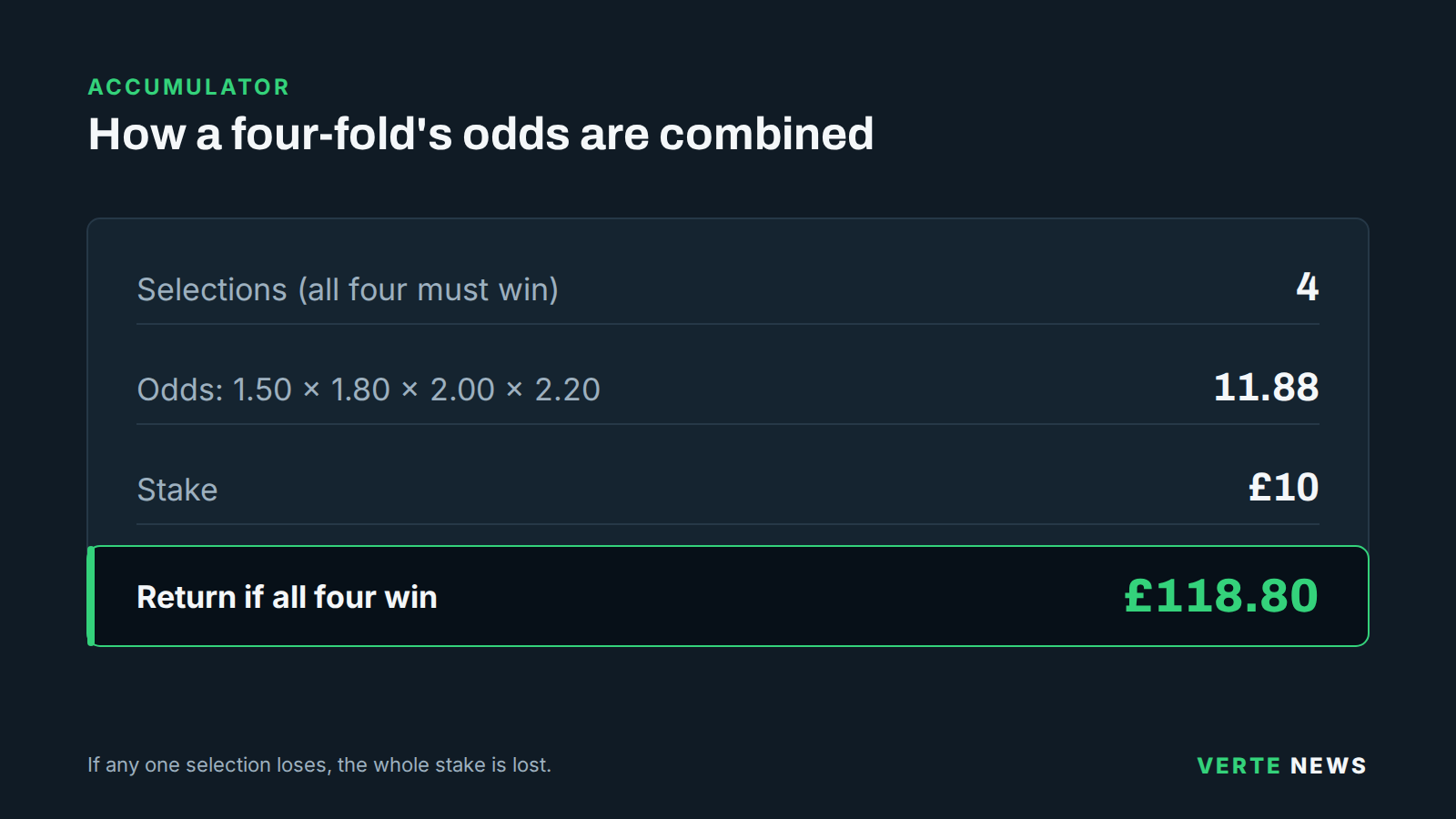
How the odds combine
Take four football selections from different matches at decimal odds of 1.50, 1.80, 2.00 and 2.20. The combined odds are 1.50 × 1.80 × 2.00 × 2.20 = 11.88. A £10 accumulator returns £118.80 if all four win, a profit of £108.80. If any one of them loses, the whole £10 is lost. Decimal odds make this arithmetic much easier than fractional; see decimal odds explained.
Two selections make a double and three a treble; four or more are usually called a four-fold, five-fold and so on. If a selection is void – because a match is postponed, for instance – it is normally treated as having odds of 1.00, so a four-fold becomes a treble at the remaining odds rather than being lost. Settlement rules vary between operators and are worth checking.
Accumulators combine selections from separate events. Combining selections from the same match is a different product, the bet builder, because outcomes within one match are linked and cannot simply be multiplied.
Why the odds look better than they are
The implied probability of all four selections winning is 1 ÷ 11.88, or about 8.4% – roughly one chance in twelve. That is before accounting for the margin in each price, which means the true chance is lower still. Put another way, someone placing a four-fold like this every week should expect it to land less often than once every twelve weeks, and the occasional win would not, on average, cover the stakes lost in between.
The margin is the key to understanding accumulators. Every price includes the bookmaker's margin. Suppose each selection, on average, returns 95p for every £1 staked over the long run. A single bet keeps 95% of the stake on average. An accumulator multiplies these average returns as well as the odds: over four legs, the average return is 0.95 × 0.95 × 0.95 × 0.95, or about 81p per £1. Five legs gives about 77p, and ten legs about 60p. The bookmaker's expected share rises from 5% on a single to roughly 19% on a four-fold and 40% on a ten-fold.
That is why accumulators matter commercially to bookmakers, and why they are often promoted with price boosts or 'acca insurance', which typically refunds the stake as a free bet if exactly one selection loses. Such offers reduce the effective margin slightly on the bets they apply to; they do not remove it, and they come with terms worth reading. Our guide to betting bonuses covers how these promotions work.
Cash-out and system bets
Many operators offer cash-out on accumulators, so a customer whose first three legs have won can settle before the fourth is played. The offer is based on the current price of the remaining selection and usually sits below its fair value.
System bets spread a stake across combinations so that not every selection has to win. A Yankee, for example, is 11 bets on four selections: six doubles, four trebles and one four-fold. At £1 per bet it costs £11 in total. It softens the all-or-nothing nature of a single accumulator, but each of those 11 bets still carries compounded margin, and the total staked is larger.
What to keep in mind
- Each added leg multiplies both the potential return and the chance of losing.
- The margin compounds: a four-fold gives the bookmaker a much larger expected share than a single bet.
- Check void and settlement rules before placing the bet.
- Treat the stake as money you can afford to lose in full, because for an accumulator of this size that is the most likely outcome.
Accumulators are designed to make small stakes feel like a route to a large return. The arithmetic above shows why that return is rarely collected, and why the deposit limits and time-outs offered by licensed operators are worth setting before placing them.