What wagering requirements mean
A wagering requirement is the amount you must stake before bonus money can be withdrawn. It is the most important term in any casino bonus, and simple arithmetic shows why.

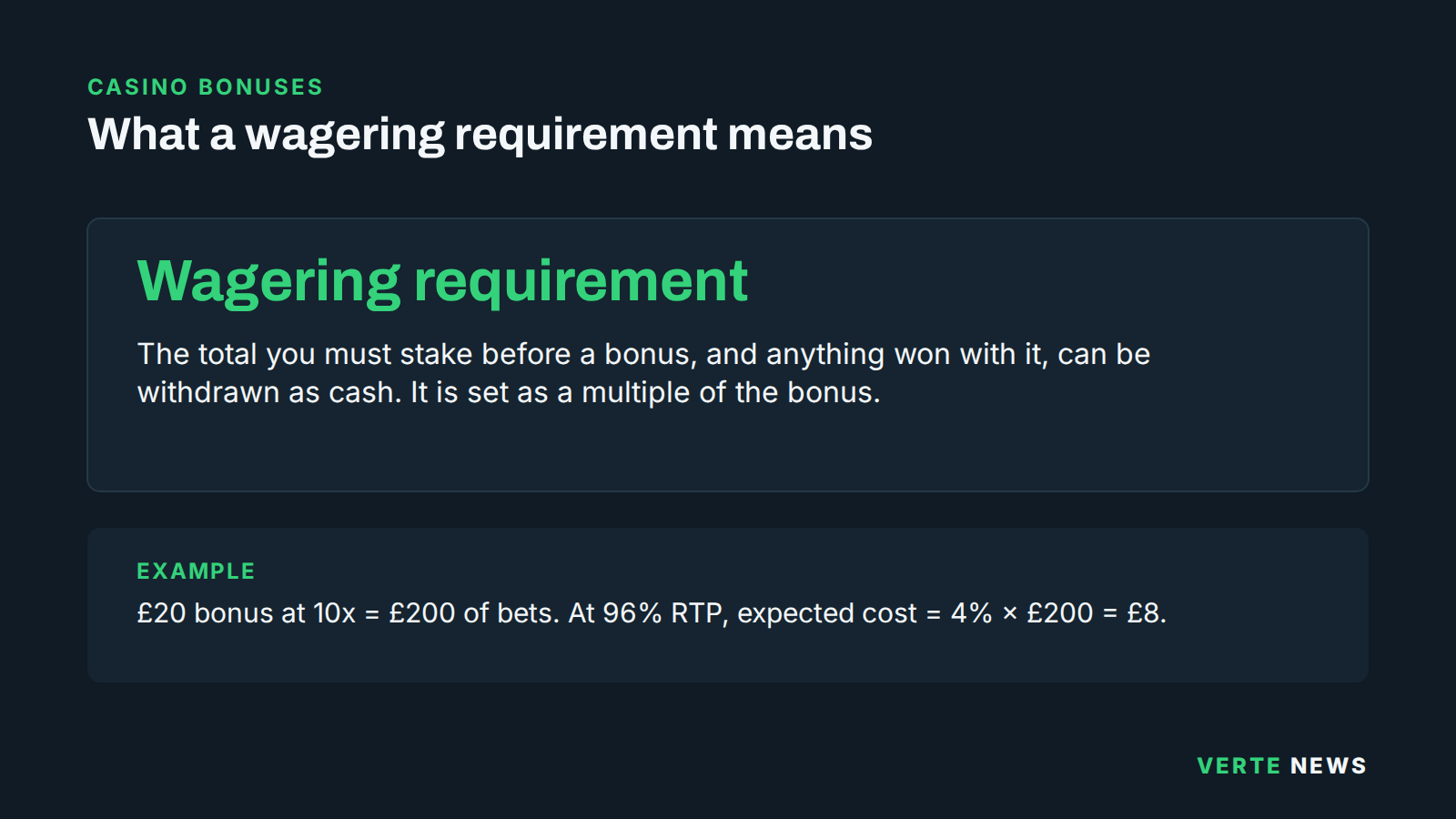
A wagering requirement, sometimes called a playthrough requirement, is a condition on a bonus that sets how much you must bet before the bonus, and anything won with it, becomes cash you can withdraw. It is expressed as a multiple. A £20 bonus with a 10x requirement means you must place £200 of bets first. Until then the money is held in a bonus balance.
The requirement exists because, without it, a bonus would simply be cash: a customer could take a £20 bonus and withdraw it straight away. Wagering exposes the bonus to the house edge, which recovers part or all of its cost for the operator.
How to work out what it costs
The expected cost of meeting a requirement is roughly the total wagering multiplied by the house edge of the game you play. The house edge is 100% minus the game's RTP, explained in what RTP means.
A worked example: a £20 bonus at 10x requires £200 of wagering. On a slot with a 96% RTP the house edge is 4%, so the expected loss is £8 (4% of £200). On average you would finish with about £12 of the £20, which is the bonus's rough expected value.
Now take the same £20 bonus at 40x, a multiple that was allowed before the cap: the Gambling Commission found some operators applying requirements of up to 60 times. That requires £800 of wagering, with an expected loss of £32: more than the bonus is worth. In practice some players would go bust before finishing, which cuts the loss short, but on average the bonus costs more to clear than it gives you.
Two details make a large difference:
- Bonus only, or bonus plus deposit? A 10x requirement on a £20 bonus means £200 of wagering. The same multiple applied to a £20 deposit plus the £20 bonus means £400, doubling the expected cost.
- The game's RTP. Clearing £200 on a 94% slot costs £12 on average, against £8 on a 96% slot. The version of the game matters as well as the title.
Game contribution and other traps
Not every bet counts equally. Terms often say slots contribute 100% while table games such as blackjack or roulette contribute a fraction, or nothing. If blackjack contributes 10%, each £10 bet counts as £1, so £200 of wagering needs £2,000 of actual blackjack bets. Low-edge games are usually weighted down for exactly that reason.
Other conditions interact with the requirement:
- a maximum stake per spin or hand while the bonus is active, which, if broken, can void the bonus and its winnings;
- an expiry period, after which unfinished wagering and the remaining bonus are lost;
- a cap on winnings that can be converted, common on free spins and no-deposit offers;
- rules on withdrawing early, which may forfeit the bonus.
Free-spin winnings are often credited as bonus funds with their own requirement, so read those terms as well. The wider picture of offer types is in how casino bonuses work, and the equivalent sportsbook mechanics are in free bets explained.
The 10x cap in Great Britain
From 19 January 2026, the Gambling Commission capped wagering requirements at 10 times the bonus amount for operators licensed in Great Britain. At the same time it banned promotions that require play across different gambling products, for example betting and casino, to release a bonus. Operators licensed elsewhere may still use higher multiples, which is one of several reasons to check who licenses a site; see how UK gambling licences work.
The cap makes bonuses more transparent, but it does not make them free. Even at 10x, the average player loses part of the bonus to the house edge while clearing it, and the wagering itself encourages more play than you might otherwise choose.
A useful habit is to do the sum before you accept: multiply the total wagering by the game's house edge, compare the result with the bonus, and ask whether the extra play is something you actually want. If it is not, decline the offer; you are never obliged to take one. Deposit limits and time reminders are worth setting either way.