Nevada Regulator Presses Bally's Over A's Stadium Infrastructure Pledges
Nevada Gaming Control Board chair Mike Dreitzer told Bally's its Las Vegas obligations around the Athletics' new ballpark cannot slip, as the operator juggles projects in Chicago and the Bronx.
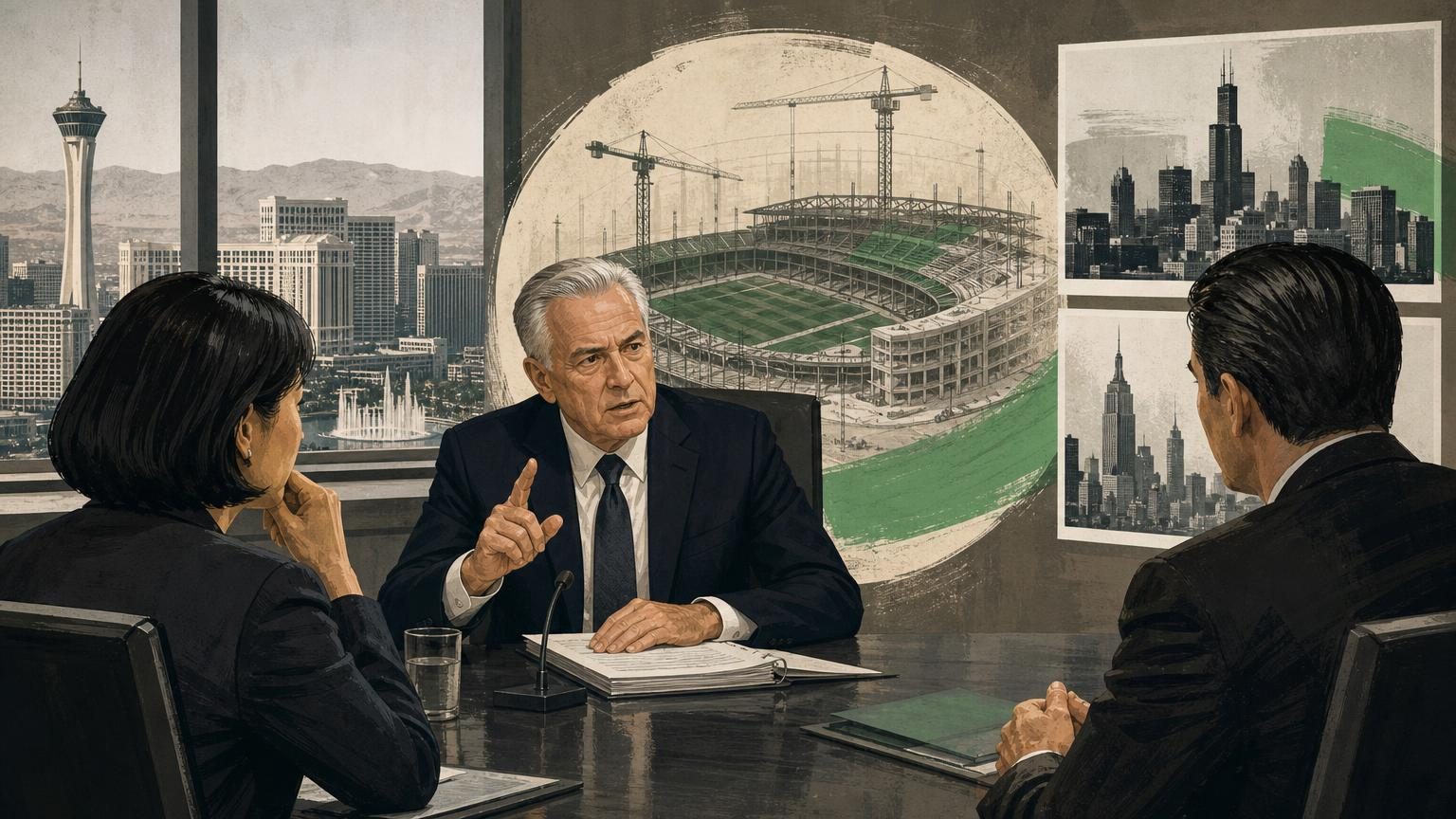
Nevada's top gaming regulator has pressed Bally's Corporation to confirm it will meet its infrastructure commitments around the Athletics' future Las Vegas ballpark before the stadium opens, Casino.org reported.
The exchange took place at a Nevada Gaming Control Board hearing on 19 November that had been convened mainly to consider Bally's application, through its Bally's Intralot subsidiary, to take control of UK-listed online gaming company Evoke plc. Board chair Mike Dreitzer used the session to turn to the former Tropicana site, where the Athletics are due to open a $2.1 billion ballpark in April 2028.
Dreitzer said he was concerned that Bally's obligations in Las Vegas could be losing priority against the company's other large projects. "As a fiduciary to the state of Nevada, I have some significant concerns," he said, describing the site at one of the city's most prominent intersections as appearing to sit "at the bottom of the barrel" relative to Bally's other commitments.
Bally's controlling shareholder Soo Kim, who leads Standard General as managing partner, told the board the company would meet its obligations before opening day. These cover completed parking facilities, utility connections and pedestrian links between the corners of Las Vegas Boulevard and Tropicana Avenue and the ballpark entrance.
Kim stressed that the development is not solely Bally's responsibility. "Our obligations are part of the deal with the A's, but this is a three-party deal," he said, pointing to the involvement of the baseball team alongside landowner Gaming and Leisure Properties Inc., a real estate investment trust known as GLPI.
GLPI has earmarked $125 million from proceeds of the Tropicana's demolition for the surrounding development and is weighing additional financing to ensure the podium and shared-access structures are finished, though that extra funding has not been finalised. "There will be parking, utility connections and a connection between the corners of the Strip and the entrance to the ballpark," Kim said. "We believe that each of those obligations will be met before April '28."
Scepticism about Bally's capacity to deliver persists given its parallel commitments. The company is completing a casino resort in Chicago, where construction on its 34-storey hotel tower was halted on 9 August, and pursuing a $4 billion casino-resort project in the Bronx, New York.
Over the past two months Bally's has announced two separate $560 million financing packages. One, tied to the New York scheme, pairs $400 million in up-front term-loan funds with a $160 million delayed-draw facility that can be tapped later. The other, unveiled in November, draws $500 million from new loan proceeds and adds $60 million in GLPI funding set aside for the Chicago build.
By the close of the third quarter Bally's held $497 million in cash against total debt of $4.84 billion. Shares in the company dropped 7% on 19 November and have lost around 40% of their value this year, according to Casino.org.
Little visible progress has emerged on Bally's share of the former Tropicana site in the two years since the old resort was brought down in October 2024, even as construction of the Athletics' ballpark itself continues. Bally's broader plan for the property, including a casino resort, thousands of hotel rooms, retail and entertainment space, is not expected to be finished until at least 2031.
"We don't intend to let the state or the board or the county or the city down," Kim said, adding that Bally's cannot achieve its ambitions as a global gaming company without a strong presence in Las Vegas.
Dreitzer indicated the board's scrutiny would continue. "We're watching this very, very closely," he said, arguing that stadiums and sports teams belong to the whole city. "It's such an important item for us that 'We'll see what happens' is not good enough. It has to happen."