How online casinos work
An online casino is a licensed business that hosts games mostly built by other companies, handles your money and identity checks, and earns its revenue from the house edge built into every game.

An online casino is a website or app, run by a licensed operator, that lets you stake money on games of chance such as slots, roulette and blackjack. The operator holds your account and your funds, but it usually does not make the games: most are built by specialist studios and supplied under licence. The business earns money because every game is designed to return slightly less than it takes in, so across millions of bets the operator keeps a predictable share.
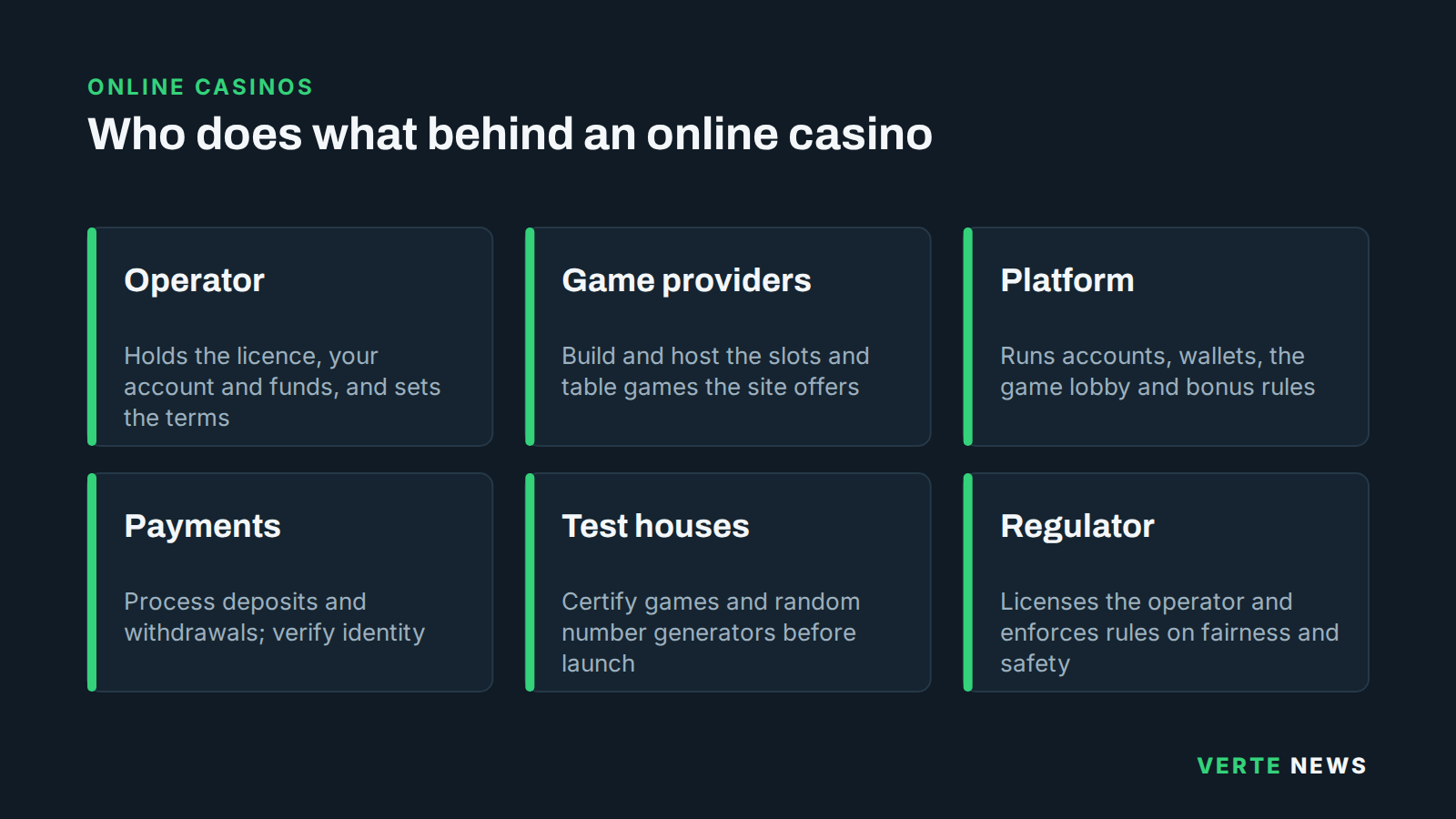
Who does what behind the site
What looks like a single brand is usually a chain of companies, each with a defined job.
- The operator holds the gambling licence, owns the customer relationship, sets the terms and is responsible for verification, safer-gambling duties and paying out winnings.
- Game providers design and host the games. A slot from a studio such as NetEnt or Pragmatic Play can appear on hundreds of sites at once; the operator is offering it, not running its own copy of the maths. See how casino game providers work.
- The platform is the software that runs accounts, wallets, the game lobby and bonus rules. Some operators build their own; others rent one, and some brands are white-label casinos run on another company's licence and technology.
- Payment providers move deposits and withdrawals, and identity-verification services check who you are.
- Test houses independently check games and random number generators before they go live.
- The regulator licenses the operator and sets the rules. In Great Britain that is the Gambling Commission.
This supply chain is why the same game often looks identical from one casino to the next, and why the practical differences between sites are mostly about terms, payments, service and how seriously the operator takes its obligations. The wider supplier ecosystem is covered in how B2B suppliers power the gambling industry.
How the money works
The key number is return to player, or RTP: the share of all money staked on a game that is paid back as winnings over the very long run. A slot with an RTP of 96% is designed to pay back £96 for every £100 wagered on it across a huge number of spins, leaving £4 with the operator. That £4 is the house edge, explained in more detail in what RTP means.
Scaled up, that arithmetic is the operator's business model. If players collectively stake £1,000,000 on games averaging 96% RTP, the expected gross gaming revenue (stakes minus winnings) is about £40,000. Out of that the operator pays game providers, usually as a share of the revenue their games generate, plus payment fees, marketing, staff, compliance costs and gambling duty.
Two points follow for players. First, the edge applies to every pound wagered, not to the money you deposit. Winnings that are staked again are exposed to the edge again, so a £50 deposit cycled through £500 of spins at 96% carries an expected loss of £20, not £2. Second, individual results vary widely around that average. Some players win in a session; the operator's return comes from the total, which is why it can afford to pay large prizes.
What a licensed casino must do
To take bets from people in Great Britain, an operator needs a licence from the Gambling Commission, and the licence comes with conditions. In practice that means:
- verifying your age and identity before you can gamble, a process covered in what KYC means in gambling;
- offering tools such as deposit limits, time-outs, reality checks and self-exclusion;
- using games and random number generators that have been tested against the Commission's technical standards;
- not accepting credit cards for gambling, a ban in place since April 2020;
- applying online slot stake limits of £5 per spin for adults aged 25 and over and £2 for 18 to 24-year-olds;
- keeping bonus wagering requirements to no more than 10 times the bonus, a cap that took effect in January 2026.
Operators must also carry out checks designed to spot customers who may be spending more than they can afford, and they have anti-money laundering duties, which is one reason withdrawals sometimes prompt further questions.
What to look for as a player
The useful questions are unglamorous ones. Is the site licensed for where you live, and does its licence appear on the regulator's public register? Are the bonus terms written plainly, and can you find each game's RTP in its help screen? How are withdrawals handled, and which payment methods can you use to take money out as well as put it in? Are deposit limits and time-outs easy to find and set?
Above all, treat an online casino as paid entertainment with a built-in cost. The games are designed so that, over time, the player loses on average. Setting a budget and a time limit before you start, and using the tools the site is required to provide, matters more than any choice of game.