What RTP means in online casino games
Return to player is the share of all money staked on a game that it is designed to pay back over the long run. It tells you the built-in cost of playing, not what will happen in your session.

RTP, or return to player, is the percentage of all money wagered on a casino game that the game is designed to pay back as winnings over a very large number of plays. A slot with a 96% RTP is expected to return £96 for every £100 staked on it in the long run. The missing 4% is the house edge: the built-in cost of playing, and the way the game makes money for the operator.
The important words are 'over the long run'. RTP is a statistical average across millions of spins and many players. It is not a promise about what you will get back from a session, a day or a deposit.
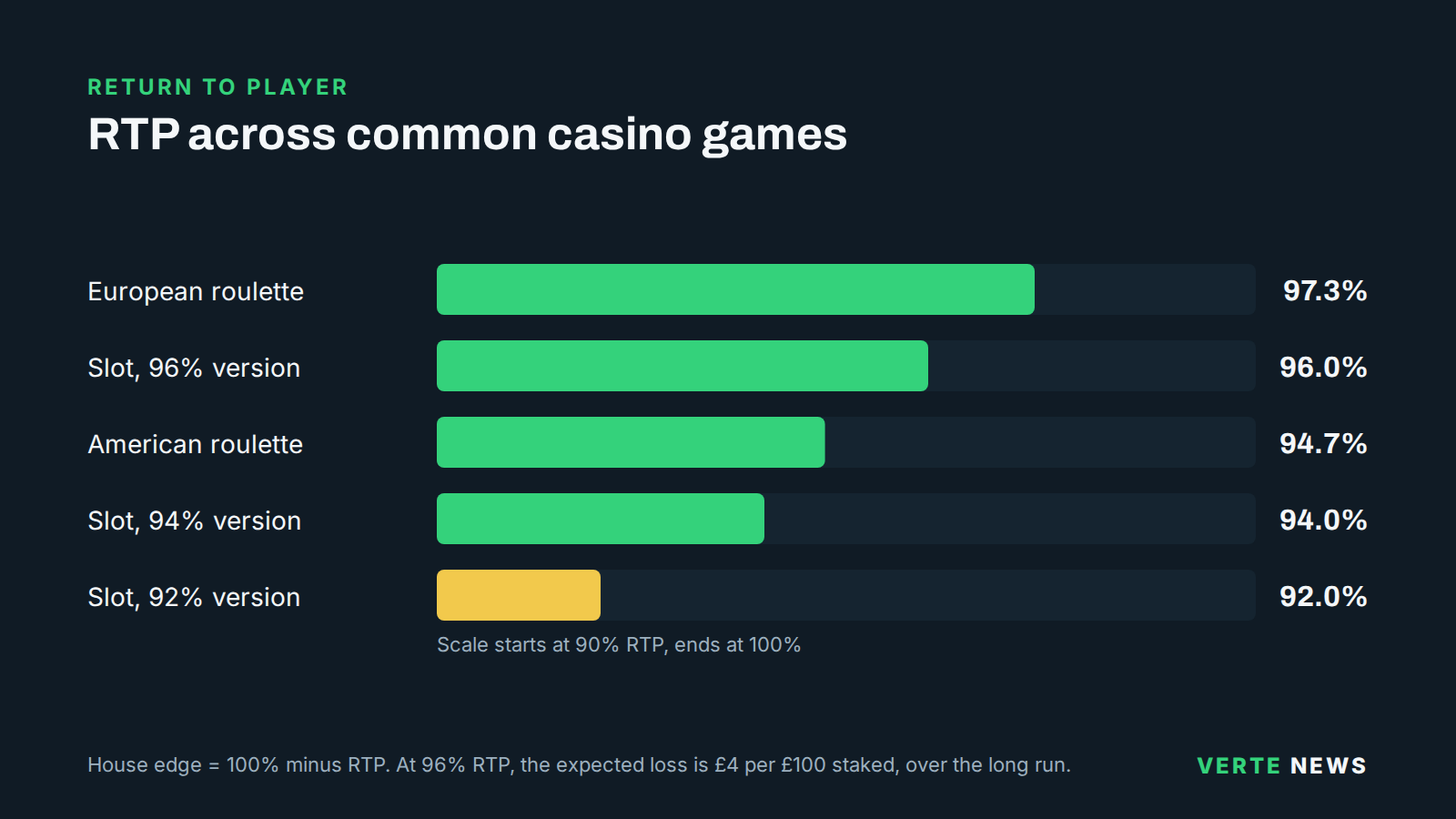
How RTP and the house edge fit together
RTP and house edge are two ways of stating the same thing. They always add up to 100%.
- A 96% RTP means a 4% house edge: an expected loss of £4 per £100 wagered.
- A 97.3% RTP, the figure for single-zero European roulette, means a 2.7% edge.
- A 94.74% RTP, the figure for double-zero American roulette, means an edge of about 5.26%.
Roulette shows where the numbers come from. A European wheel has 37 pockets, numbered 0 to 36. A £1 bet on a single number pays 35 to 1, so a win returns £36 including your stake. You win once in 37 spins on average, so each £1 bet is worth 36 ÷ 37, or about 97.3p. The house keeps the rest because the zero is not paid for. Add a second zero, as on American wheels, and the same payout is spread over 38 pockets: 36 ÷ 38 is about 94.7p.
Slots work the same way in principle, but the maths is hidden inside the game's design: the symbols on each reel, how often each combination lands and what it pays. The designer sets those so that the total return comes out at a chosen percentage, and independent test houses check that it does. How the underlying results are drawn is explained in how random number generators keep games fair.
The arithmetic that matters: turnover, not deposits
The edge is charged on every pound you stake, including winnings you put back in. That is why thinking only about your deposit understates what a session can cost.
Take £1 spins on a 96% slot. After 500 spins you have staked £500, and the expected loss is 4% of that: £20. Now suppose you deposit £100 and keep playing, re-staking any wins. If your total wagering reaches £1,000, the expected loss is £40. If you carry on until the balance runs out, you lose all £100, however high the RTP. A higher RTP slows the drain; it does not reverse it.
At the same time, results around the average are wide. Two players each staking £500 on the same game can finish far apart: one well up after a large win, the other having lost most of the stake. How widely results spread is a separate property, covered in what slot volatility means. RTP tells you the average cost; volatility tells you how bumpy the ride is.
Where to find RTP, and what to watch for
Reputable games state their RTP in the help or information screen. Things to be aware of:
- Same game, different RTP. Many game studios offer operators several versions of a slot, for example 96%, 94% or lower. The artwork is identical; only the maths differs. Check the figure on the site you are using rather than assuming it matches one quoted elsewhere.
- Features can change the figure. Some games quote separate RTPs for bonus-buy features or optional side bets, and these can differ from the base game.
- Table games depend on rules and play. Blackjack's return varies with the rules in use and with how well each hand is played.
- RTP is not a hot or cold indicator. A game that has not paid out for a while is not 'due'. Each result is independent.
In Great Britain, games are tested by an approved test house against the Gambling Commission's technical standards before they go live. Those standards require information about how a game works and your chances of winning to be easily available before you play, and a game's theoretical RTP is the figure shown in its player-facing rules. That makes the figure trustworthy as a description of the game's design, not as a forecast of your result.
The honest summary: every mainstream casino game has an RTP below 100%, so players as a group lose. Choosing a higher-RTP game lowers the expected cost of a given amount of play, and is worth doing, but the most reliable way to control cost is to control how much you stake in total. How online casinos work puts the figure in the context of the wider business. Setting a deposit limit before you start is the simplest safeguard.