How casino bonuses work
A casino bonus is promotional credit or free play with conditions attached. The conditions decide what it is actually worth, so they deserve more attention than the headline figure.

A casino bonus is an incentive an operator gives you, usually extra credit or free spins, in return for signing up, depositing or playing. It is not free money. Bonus funds normally sit in a separate balance and cannot be withdrawn until you meet the conditions, most importantly a wagering requirement. The terms decide whether a bonus is worth anything to you, and they are where operators control what it costs them.
The main types
- Deposit match. The operator adds a percentage of your deposit as bonus funds: a 100% match on a £20 deposit gives you £20 of bonus money.
- Free spins. A set number of spins on named slots at a fixed stake. Winnings from them are often paid as bonus funds with their own conditions.
- No-deposit bonus. A small amount of credit or spins for registering. These tend to carry tight limits on how much can be won.
- Cashback. A percentage of net losses over a period, returned either as cash or as bonus funds. Which of the two makes a large difference.
- Reload and loyalty offers. Bonuses for existing customers, often linked to how much they play.
The same principles apply to sportsbook promotions, covered in betting bonuses explained and free bets explained.
The terms that decide the value
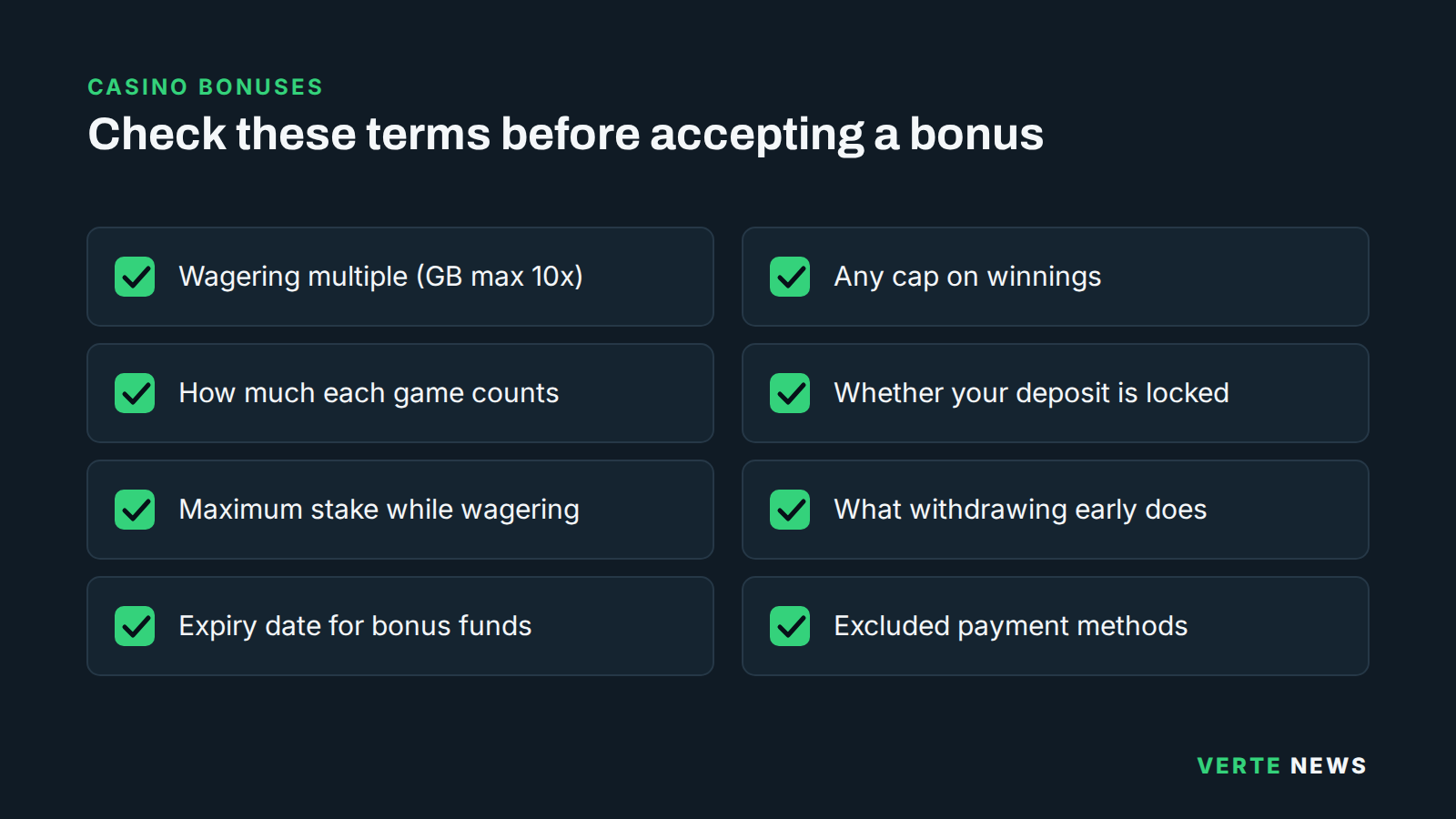
Headline amounts tell you little. These are the conditions to read:
- Wagering requirement. How many times you must stake the bonus before it becomes withdrawable cash. The mechanics are set out in what wagering requirements mean.
- Game contribution. Slots often count in full towards wagering, while table games may count at a fraction or not at all.
- Maximum stake. Many bonuses cap the stake per spin or hand while wagering is in progress. Breaking the rule can void the bonus and its winnings.
- Expiry. Bonus funds and free spins usually lapse after a set number of days.
- Winnings caps. Some bonuses, particularly no-deposit offers, limit how much you can withdraw from them.
- Balance order and early withdrawal. Check whether your own deposit is used first, and whether withdrawing before wagering is complete forfeits the bonus.
- Eligible payment methods. Some offers exclude deposits made by particular methods.
A worked example
Suppose you deposit £50 and receive a 100% match: £50 of bonus funds with a 10x wagering requirement on the bonus. You must place £500 of bets (10 × £50) before the bonus converts to cash. On slots with a 96% RTP, the expected loss on £500 of wagering is £20 (4% of £500).
On average, then, you would expect to finish the wagering with about £80 of your £100 combined balance, roughly £30 more than you deposited. That is the bonus's expected value in simple terms. Real outcomes vary widely: you may lose the whole balance before completing the wagering, or finish well ahead. A cap on winnings, a lower-RTP game or a game that contributes less than 100% all reduce the value. Why the game's RTP matters is explained in what RTP means.
Compare the higher multiples used before the rules changed: the Gambling Commission found some operators applying wagering requirements of up to 60 times. At 35x, the same £50 bonus would require £1,750 of wagering, with an expected loss of £70: more than the bonus itself. The simple calculation ignores the fact that some players go bust before finishing, but the direction is clear: the multiple matters far more than the headline amount.
The rules in Great Britain
From 19 January 2026, the Gambling Commission capped wagering requirements on bonuses at 10 times the bonus amount. At the same time it banned promotions that require customers to play across different types of gambling, such as betting and casino, to unlock a reward. Advertising rules require significant conditions, such as wagering requirements and time limits, to be stated clearly, and electronic marketing, including bonus offers, can only be sent to customers who have consented to receive it. Sites licensed elsewhere may not follow these rules.
A bonus also changes behaviour: it is designed to encourage you to play more, and for longer, than you otherwise might. If you use one, set a deposit limit first, decide in advance how much of your own money you are prepared to lose, and remember that you can decline an offer. You can also withdraw your consent to marketing, including bonus offers, at any time.