What cash-out means in betting
Cash-out lets you settle a bet before the event ends, for an amount the bookmaker calculates from current prices. How that figure is worked out, why it is usually below fair value, and when it is not offered.
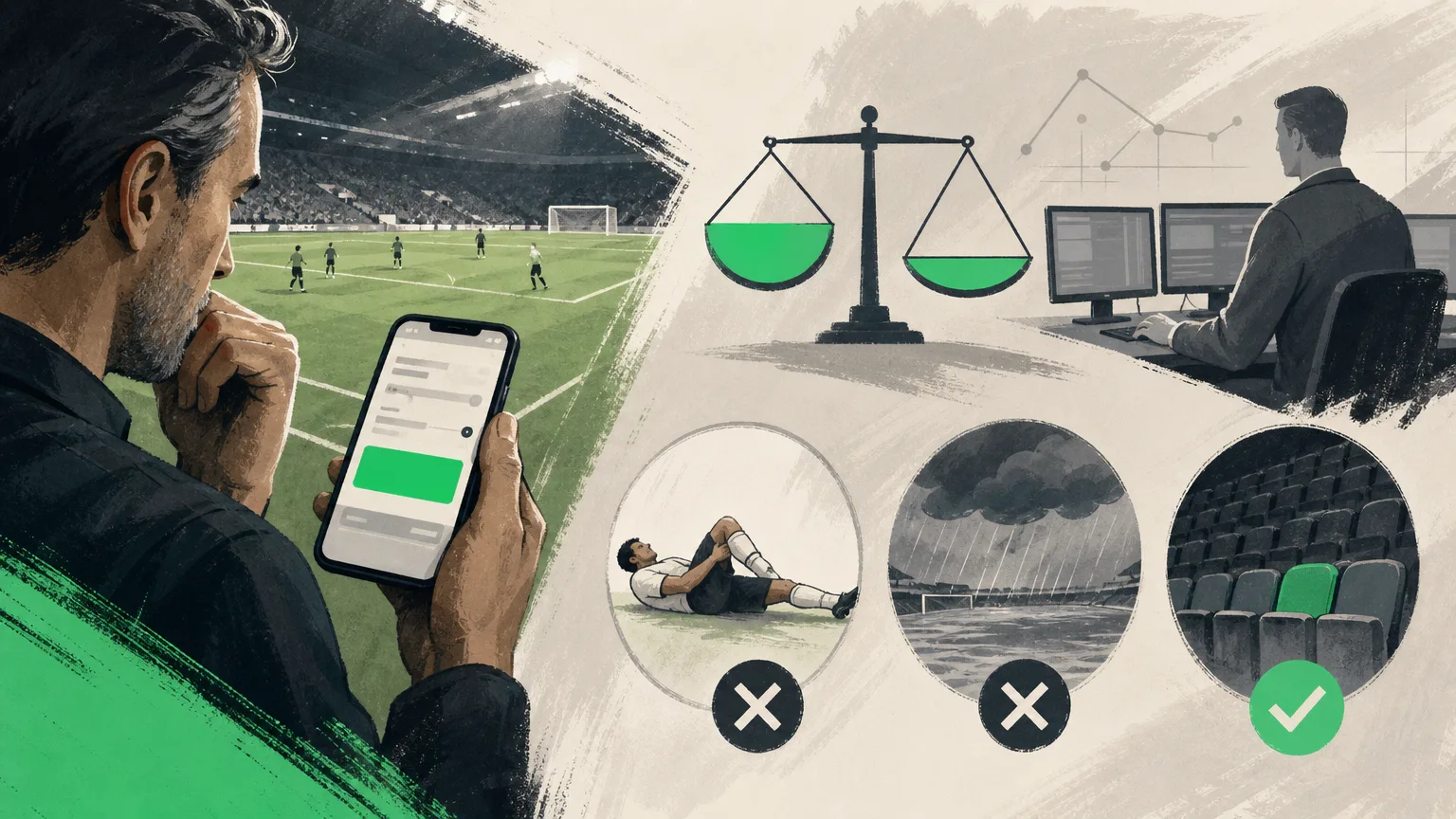
Cash-out is an offer from a bookmaker to settle a bet before the event has finished. The amount offered is based on how likely the bet now looks to win, calculated from current prices, minus a deduction. Taking it locks in a result – a smaller profit or a smaller loss – and ends the bet. Declining it leaves the bet running to its normal settlement.
How the cash-out value is calculated
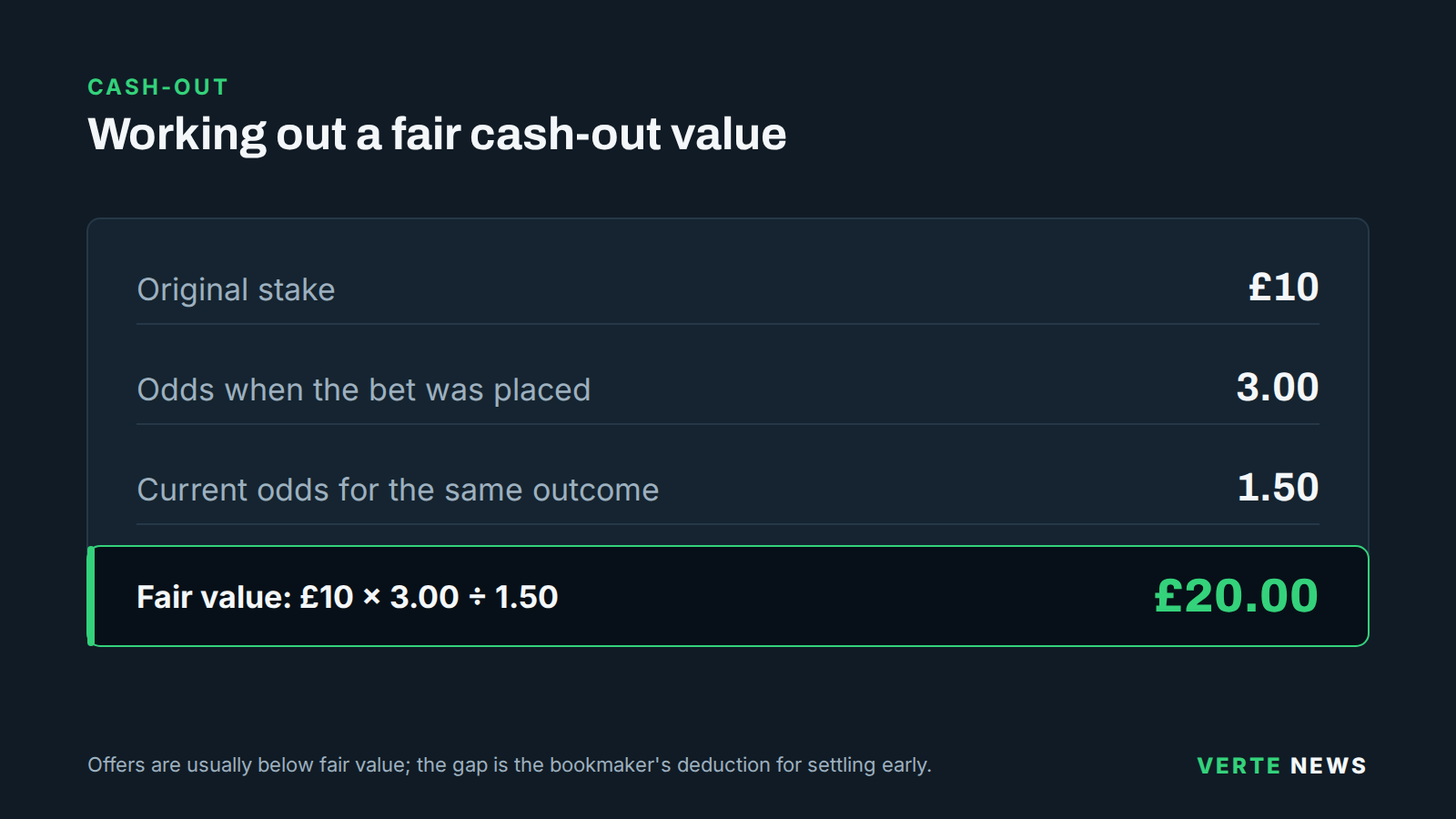
Operators do not publish their exact formulas, but the starting point is straightforward. A fair cash-out value is the original stake multiplied by the original odds, divided by the current odds for the same outcome.
Suppose you stake £10 at decimal odds of 3.00 on a team to win. The team goes ahead and its price shortens to 1.50. The fair value of your bet is £10 × 3.00 ÷ 1.50 = £20. That is the amount which, staked at the current price of 1.50, would return the same £30 your bet returns if it wins. If the team instead falls behind and its price lengthens to 6.00, the fair value drops to £10 × 3.00 ÷ 6.00 = £5.
The offer you see will usually be below that fair figure. The difference is the bookmaker's charge for settling early, on top of the margin already built into the prices. In the example, an offer of £18.50 rather than £20 would represent a deduction of 7.5%. Deductions vary by operator, market and moment, and are rarely stated.
Full, partial and automatic cash-out
- Full cash-out settles the whole bet immediately at the offered amount.
- Partial cash-out settles part of the stake and leaves the rest running. Cashing out half of the £10 bet above at fair value would pay £10 now and leave £5 running at 3.00.
- Automatic cash-out lets you set a value at which the bet will be cashed out if the offer reaches it.
Cash-out is most often used during in-play betting, and on multiples such as accumulators, where some selections have already won and the rest are still to play.
The same formula applies to an accumulator. If three legs of a £5 four-fold at combined odds of 11.88 have won and the last selection is now priced at 2.00, the bet stands to return £59.40, and its fair cash-out value is £59.40 ÷ 2.00 = £29.70 – before the bookmaker's deduction.
When cash-out is not available
Cash-out is a feature the bookmaker chooses to offer, not a right. It is typically unavailable while a market is suspended, for example immediately after a goal, and may not be offered at all on some markets, on bets placed with free bet tokens or on certain promotions. An offer can also change or disappear between the moment you see it and the moment you accept it, for the same reasons that odds move. Operators' terms usually allow them to suspend or withdraw cash-out at their discretion.
Is cashing out worth it?
In expected-value terms, accepting a cash-out offer below fair value is a small loss compared with letting the bet run, because you are selling the bet back to the bookmaker at a discount. Done repeatedly, those discounts add to the margin already paid when each bet was placed. The feature can still suit someone who values certainty over the average outcome – someone who would rather take £18.50 now than hold a bet the market gives about a two-in-three chance of paying £30 – but it does not improve the long-run result, which for bettors as a group is a loss.
Betting exchanges offer a similar outcome by a different route: a customer can lay the selection they previously backed and hedge the position themselves, paying commission rather than a cash-out deduction. Our explainer on bookmakers and betting exchanges sets out how the two models differ.
It is also worth being honest about why cash-out appeals. It gives a sense of control and a reason to keep watching and interacting with a bet. If cashing out has become a way to recover stakes quickly in order to bet again, that is a signal to use the deposit limits and time-outs that licensed operators provide.