What “non-GamStop” means, and the risks
“Non-GamStop” is a label for gambling sites that are not licensed in Great Britain and so are not part of the national self-exclusion scheme. Here is what the term means, why British protections do not apply, and where to get help.

“Non-GamStop” describes gambling websites that are not licensed by the UK Gambling Commission and therefore do not take part in GamStop, the national online self-exclusion scheme. They either hold a licence from another country's regulator or have no licence at all. It is not lawful for them to offer gambling to consumers in Great Britain, and none of the British rules designed to protect customers apply to them.
The phrase is used mostly in online marketing, where it is often presented as a feature. In regulatory terms it means something simpler: the site sits outside the British system.
Why these sites are outside GamStop
Every operator that offers online gambling to people in Great Britain needs a Gambling Commission licence, and a condition of that licence is membership of GamStop. The scheme works by requiring licensed operators to check customers against its register and refuse anyone who has excluded themselves.
An operator without a British licence is not bound by that condition, so it does not check the register. Some hold licences from other jurisdictions, which may authorise them to serve particular markets but do not permit them to target Great Britain. Others operate with no meaningful oversight. Our explainer on how offshore gambling regulation works sets out how these licences differ and what they do and do not cover.
Because the law is based on where the customer is, the location of the company does not change the position. Offering gambling to British consumers without a Commission licence is an offence, and the Gambling Commission works with payment firms, search engines and other platforms to disrupt sites that do it.
Which protections are missing
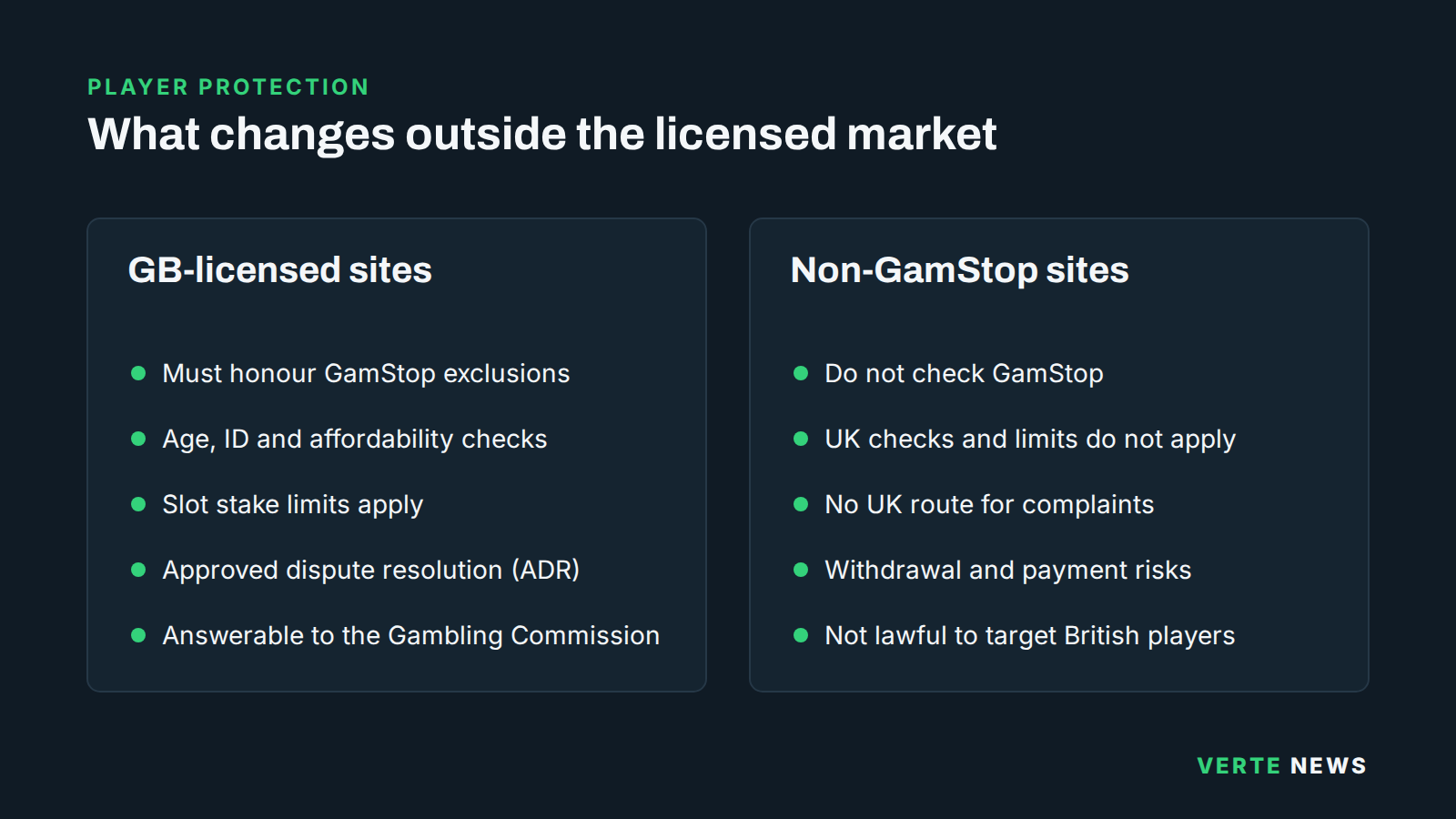
The practical consequence is that a British customer using such a site loses the safeguards that the licensed market must provide. Among them:
- Self-exclusion. The site will not honour a GamStop exclusion.
- Age and identity checks. British rules require verification before anyone gambles; see what KYC means in gambling.
- Affordability and customer interaction duties. Licensed operators must monitor for signs of harm and check that spending is affordable, as covered in affordability checks explained.
- Product rules. Online slot stake limits, slot design rules and the ban on gambling with credit cards do not apply.
- Bonus rules. Licence conditions on promotions, such as the cap on wagering requirements, do not apply.
- Complaints and dispute resolution. There is no access to a British-approved alternative dispute resolution service, and the Gambling Commission cannot act on the customer's behalf.
The risks in practice
The most commonly reported problems concern money. Without British oversight, there is no guarantee that a site will pay winnings, that withdrawal terms will be fair or that they will be applied consistently. Terms may allow a site to void winnings or close an account on broad grounds, sometimes after large withdrawal requests or long delays. If a dispute arises, the only route may be a regulator in another country, if there is one at all, and it may have little interest in, or power to act on, a complaint from someone its licensee was not allowed to serve.
Payments carry their own risks. Some unlicensed sites route transactions through intermediaries or push customers towards payment methods that are hard to reverse. That makes it more difficult to get money back when something goes wrong, and payments that are not identified as gambling may not be caught by the gambling blocks that banks offer.
There is also no assurance about the games themselves. In the licensed market, games must meet technical standards and be tested; see how random number generators keep games fair. Outside it, the customer has to rely on whatever the site or its foreign regulator requires. Customers may also have little practical recourse if their personal data is mishandled.
If you have self-excluded
For someone who has registered with GamStop, the plain point is this: a non-GamStop site bypasses a protection that person deliberately chose. Self-exclusion is designed to hold firm during the moments when the urge to gamble is strongest, and the appearance of these sites in search results or social media can be one of those moments. Noticing that pull is common, and it is not a failure.
Several steps can help strengthen the barrier:
- turn on the gambling block offered by your bank or card provider;
- install blocking software on phones, tablets and computers;
- consider land-based self-exclusion schemes as well as GamStop;
- talk to someone about how you are feeling.
The National Gambling Helpline, run by GamCare, offers free, confidential support on 0808 8020 133, 24 hours a day, with live chat on the GamCare website. Anyone who comes across a site targeting British consumers without a licence can report it to the Gambling Commission.