What KYC means in gambling
KYC, or know your customer, is the set of checks gambling operators use to confirm who a customer is, how old they are and where their money comes from. Here is what the checks involve, why they exist and when they happen.

KYC stands for know your customer. In gambling, it means the checks an operator carries out to confirm that a customer is who they say they are, is old enough to gamble, is not excluded and is not using the account to launder money. In Great Britain, online operators must verify a customer's age and identity before that person can deposit or gamble.
The term comes from financial services, where banks have long been required to identify customers. Gambling businesses handle large volumes of money and can be targets for criminals, so they face similar expectations, adapted to the risks of the sector.
Why operators carry out KYC
Three sets of rules drive the checks.
- Age. Gambling is restricted to adults, and in Great Britain most commercial gambling is restricted to people aged 18 and over. Operators must stop children gambling.
- Identity and exclusion. Knowing who a customer is lets an operator apply self-exclusion, including the national GamStop scheme, and stop the same person opening multiple accounts.
- Crime prevention. Anti-money laundering and counter-terrorist financing law requires businesses at risk of being used by criminals to understand their customers and report suspicions.
The Gambling Commission tightened the rules on timing on 7 May 2019. Before then, online operators had up to 72 hours to complete age checks after an account was opened. Since then, age and identity must be verified before the customer can deposit money or gamble, including on free-to-play versions of games. The changes were also intended to stop operators asking for identity information at the point of withdrawal that they could have requested earlier, although further checks can still be needed later, for example under anti-money laundering rules.
What the checks involve
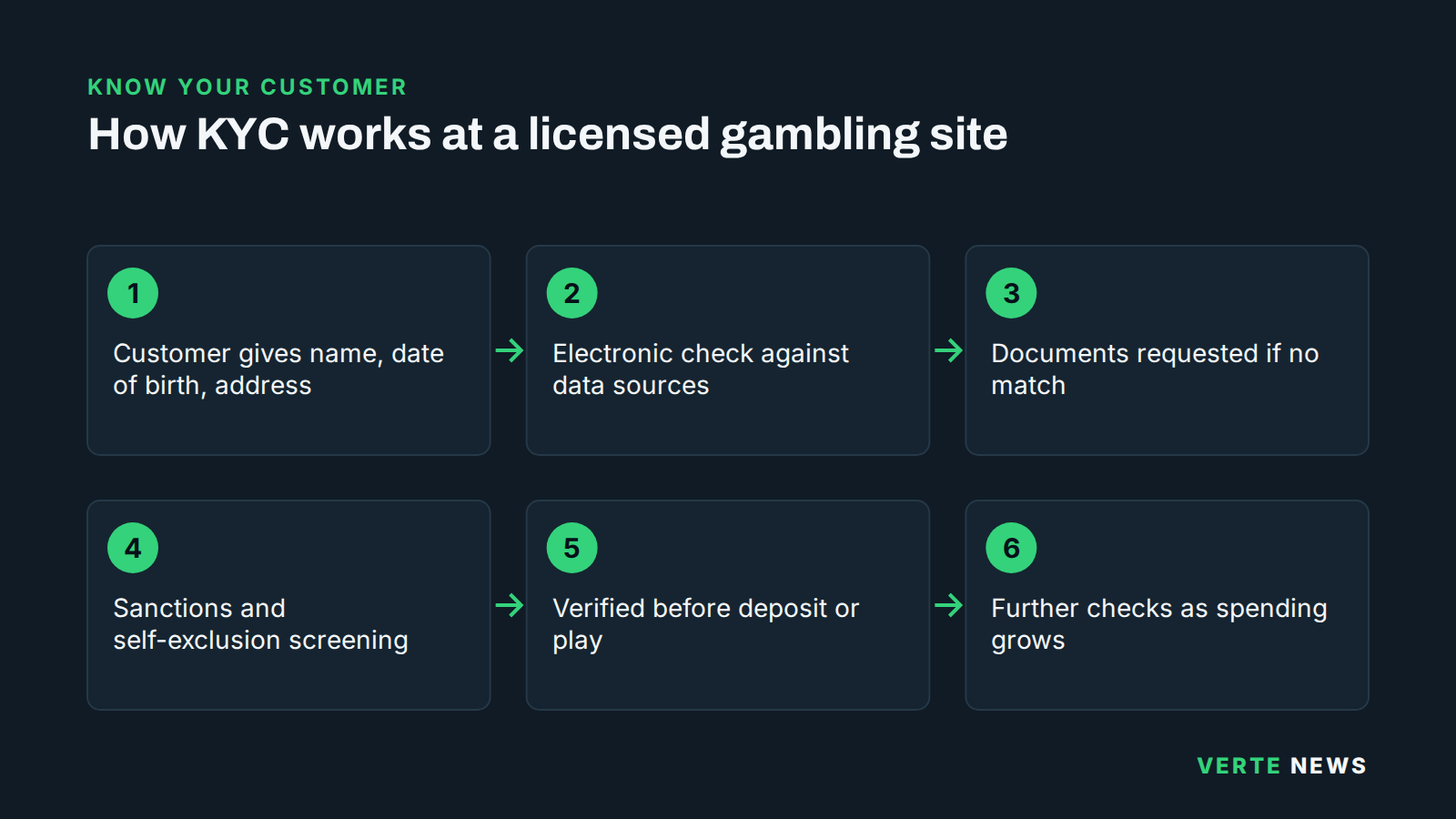
For most people, KYC at sign-up is quick and largely invisible. The operator takes the name, date of birth and address provided and checks them electronically against data sources such as credit reference agencies and electoral records. If the details match, the account is verified in seconds.
When electronic checks cannot confirm the details, the operator will ask for documents, typically:
- photo identification such as a passport or driving licence;
- proof of address such as a recent utility bill or bank statement;
- in some cases, a selfie or short video to match the person to the document.
Operators also screen customers against sanctions lists and for politically exposed persons, and check them against their own and national self-exclusion registers.
Checks after sign-up
KYC does not stop once an account is open. It is a continuing process that scales with risk. Customers who deposit or lose larger sums may be asked about their source of funds, such as their income or savings, and sometimes for evidence like payslips or bank statements. This is known as enhanced due diligence.
Casino operators, including online casinos, are directly covered by the Money Laundering, Terrorist Financing and Transfer of Funds (Information on the Payer) Regulations 2017, which set out when customer due diligence is required. Betting and other gambling operators have obligations under the Proceeds of Crime Act 2002 and Gambling Commission requirements. In practice, all licensed operators must assess the money laundering risks of their business and apply checks in proportion to them.
These checks overlap with, but are distinct from, affordability checks. KYC and source-of-funds checks are about the legitimacy of the money; affordability is about whether the level of spending could harm the customer. The same document request can serve both purposes, which is one reason customers sometimes find the questions intrusive.
What it means for operators and customers
For operators, KYC is one of the areas where regulators most often find failures. The Gambling Commission has taken enforcement action against a number of licensees for weak anti-money laundering controls, including failing to ask where large sums came from. A thorough KYC process is therefore a core compliance cost of running a licensed business, as explored in how regulation affects gambling operators.
For customers, the checks can feel like friction, especially when documents are requested before a withdrawal. But they are also part of what makes the licensed market safer: they keep children out, make self-exclusion work and help protect accounts from fraud. Keeping personal details accurate and having documents ready tends to make the process quicker. Checks can also affect how long a payout takes, as described in why casino withdrawal times differ.
The Commission's guidance for consumers on age and identity checks is available on the Gambling Commission website.