Over/under betting explained
Over/under, or totals, betting asks whether a count such as goals or points lands above or below a line. Here is how the lines work, including whole-number and quarter lines, with worked examples.
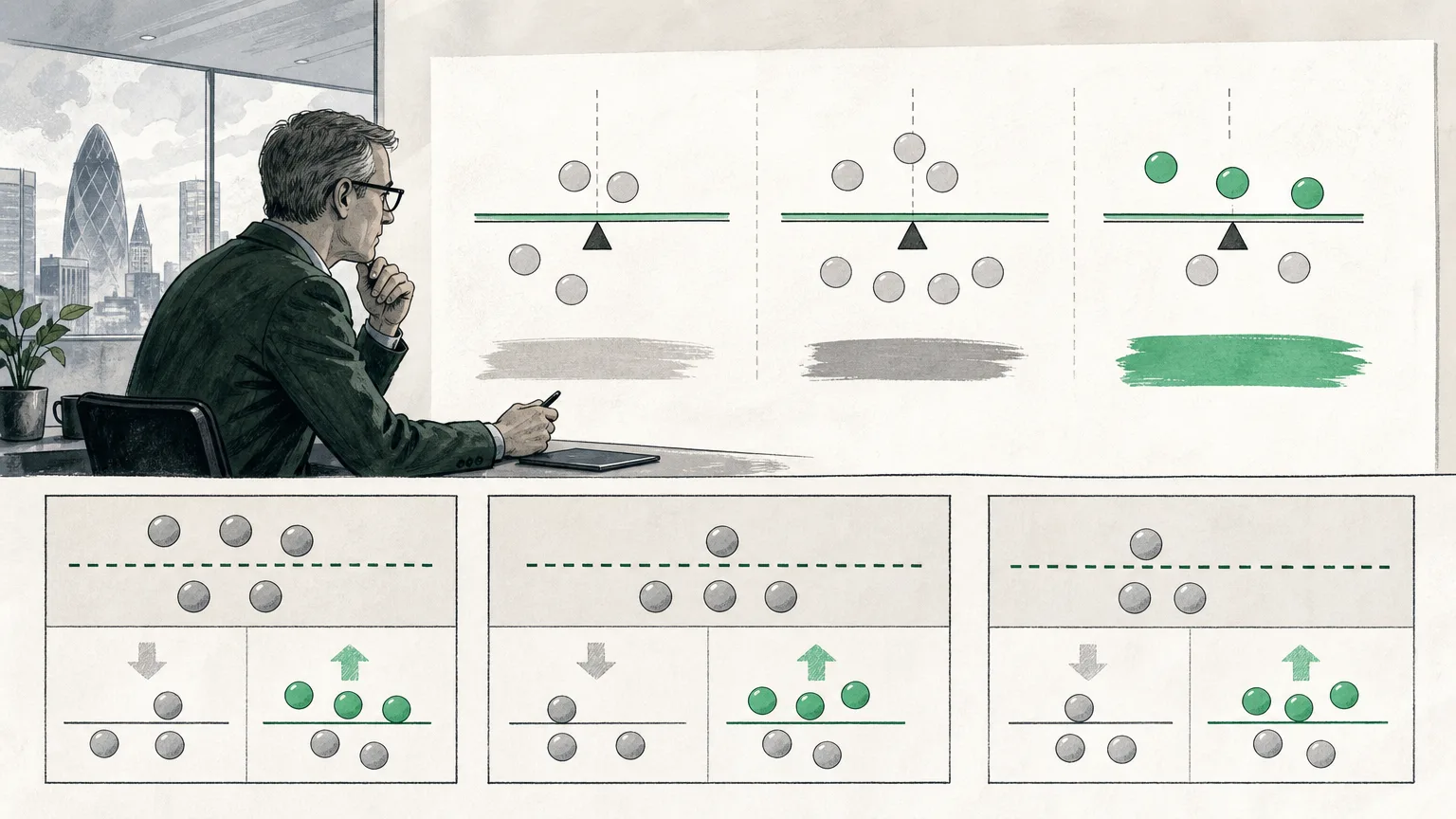
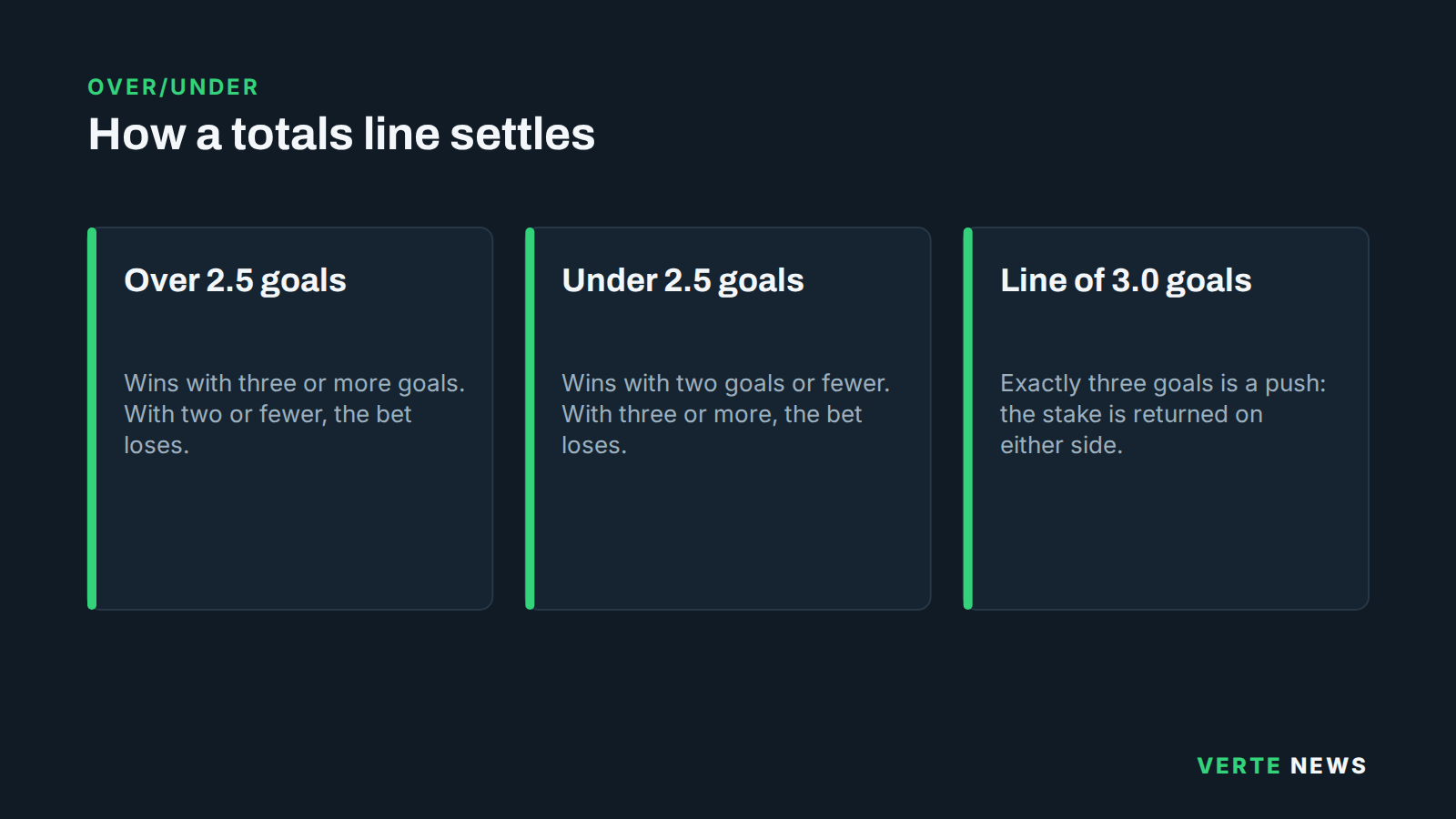
An over/under bet, also called a totals bet, is a wager on whether a count in an event finishes above or below a line set by the bookmaker. The count might be goals, points, corners or cards. In football the most familiar line is 2.5 goals: over 2.5 wins if the match has three or more goals, and under 2.5 wins if it has two or fewer. You are not picking a winner, only the total. It is one of the main types of betting market and one of the simplest to settle.
Why most lines end in .5
Half-goal lines exist so there is always a result. A match cannot have 2.5 goals, so every bet on that line is either won or lost. Bookmakers also offer whole-number lines, such as over/under 3.0. On those, if exactly three goals are scored the bet is a push and the stake is returned. Other sports use the same idea with larger numbers: total points in basketball, total games in tennis, total runs in cricket.
The main line is chosen so both sides are priced reasonably close to each other. If a match is expected to be high-scoring, the headline line might be 3.5 rather than 2.5, instead of the prices on 2.5 becoming very lopsided. Most sportsbooks list several lines for the same match, such as 0.5, 1.5, 2.5, 3.5 and 4.5, with prices that shorten or lengthen accordingly.
A worked example
Suppose over 2.5 goals is priced at 1.90 and under 2.5 at 1.90. A £10 bet on either side returns £19 if it wins, a profit of £9. Each price implies a 52.6% chance (1 ÷ 1.90), so together they total 105.3%. The 5.3 points above 100% are the bookmaker's margin, explained in what the bookmaker's margin is. In practical terms, someone betting on a genuine 50-50 proposition at 1.90 would expect to lose about 50p for every £10 staked over time.
Quarter lines and Asian totals
Asian totals add quarter lines such as 2.25 and 2.75. These split the stake equally across the two nearest lines. A £10 bet on over 2.25 is effectively £5 on over 2.0 and £5 on over 2.5:
- Three or more goals: both halves win.
- Exactly two goals: the over 2.0 half is a push and is refunded; the over 2.5 half loses. You get £5 back.
- One goal or none: both halves lose.
Over 2.75 works the other way: £5 on over 2.5 and £5 on over 3.0. If exactly three goals are scored, the first half wins and the second is refunded.
Quarter lines allow finer pricing, but they are also the most commonly misunderstood totals bets. It is worth checking how the bet slip describes the split before confirming.
What to check before betting on totals
- What counts. Football totals are normally settled on goals in 90 minutes plus stoppage time, not extra time or penalty shoot-outs. Own goals count towards the total.
- Line and price together. Over 2.5 at 2.10 and over 1.5 at 1.35 are different bets with different chances. Compare them as percentages; how to turn odds into implied probability shows the method.
- In-play movement. Totals are among the most active in-play markets. The price on the over drifts as the clock runs down without goals, and the market is usually suspended briefly after a goal.
- Overlap with other markets. Totals overlap with both teams to score: a 2-1 result wins over 2.5 and BTTS yes, but a 3-0 wins only the over.
- Other sports' rules. In tennis, a retirement can void totals bets; in basketball, overtime is usually included in the total. Operators' rules differ, so check them for the sport in question.
Totals are a clear way to express a view about the character of a match rather than its winner. They carry the same margin as any other market, and no choice of line turns betting into a reliable source of income. Setting a deposit limit before you start is a straightforward way to keep a cap on spending.