How betting markets work
A betting market is a set of possible outcomes to one question about an event, each with a price. Here is how markets are structured, priced and settled, and what separates one type from another.

A betting market is a set of possible outcomes for one question about an event, each with a price attached. 'Who wins the match?' is one market; 'how many goals will be scored?' is another; 'who scores first?' is a third. A single top-flight football match can carry hundreds of markets, but they all work the same way: the bookmaker defines the outcomes, prices each one, builds in a margin and settles bets according to published rules. For the wider picture of accounts, bet slips and settlement, see how online sports betting works.
The main market types
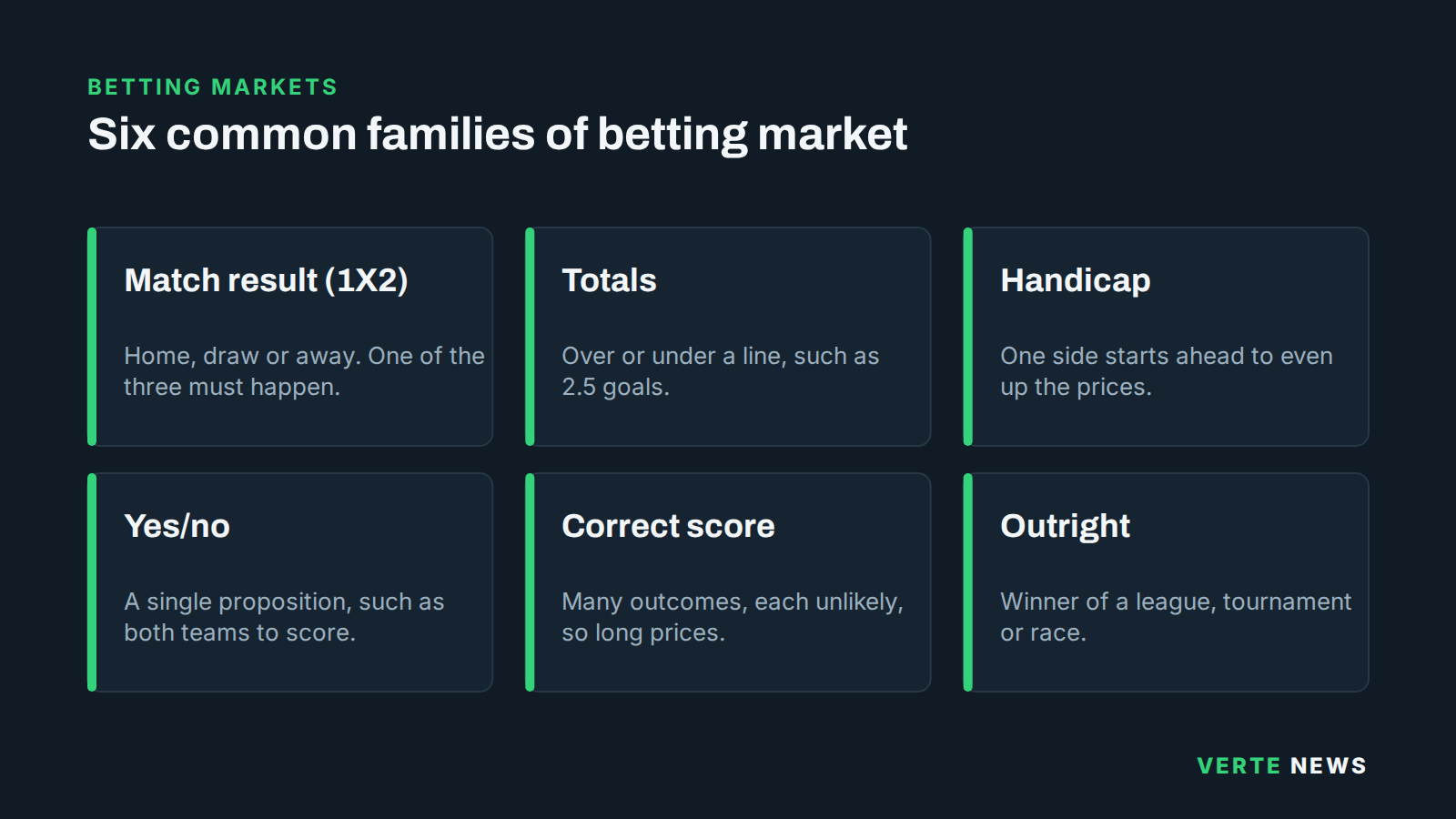
Most markets belong to a handful of families:
- Match result (1X2): home win, draw or away win. Three outcomes, one of which must happen.
- Totals: whether a count such as goals, points or corners finishes above or below a line. Over/under betting explained covers how the lines work.
- Handicaps: one side is given a head start or a deficit so the two outcomes can be priced closer together. Asian handicaps remove the draw by using half-goal lines, or by refunding stakes on certain exact results.
- Yes/no markets: a single proposition, such as whether both teams will score.
- Correct score and goalscorer markets: many possible outcomes, each individually unlikely, so the prices are long.
- Outrights: who wins a league, tournament or race, often settled months after the bet is placed.
On top of these sit combinations. Bet builders combine selections from several markets in one match into a single bet, and accumulators combine selections from different events. Both multiply the odds, and both compound the bookmaker's margin at the same time.
How a market is priced
Each market starts with an estimate of the probability of every outcome, drawn from statistical models, data feeds and the judgement of traders. Those probabilities are turned into odds, and a margin is added so that the implied probabilities sum to more than 100%. The difference is the operator's edge. It tends to be thinnest on the most popular markets, where many bookmakers compete for the same customers, and wider on niche markets with many outcomes, such as correct scores or player specials. How bookmakers set odds goes into the process in more detail.
Once a market opens, the prices move. Money coming in, team news and injuries all shift the odds before an event starts. During in-play betting, prices update continually with the score and the clock, and a market is usually suspended for a few moments after a significant incident, such as a goal, a penalty award or a red card, before reopening at new prices.
Settlement rules matter
Every market has rules that decide which bets win, and they are not always what a casual reader would assume:
- Most football markets are settled on the result after 90 minutes plus stoppage time. Extra time and penalty shoot-outs are usually excluded, unless the market is explicitly about who qualifies or lifts the trophy.
- Player markets have their own rules for players who do not take part. A bet on a player who never comes on may be void, but the details differ between operators.
- Dead heats, abandoned matches and postponed events each have separate rules, normally set out in the operator's general betting rules.
Reading those rules before betting on an unfamiliar market prevents most misunderstandings, and they are also the reference point if a bet is settled in a way you did not expect.
Choosing between markets
Different markets on the same match are different ways of expressing a view about the same underlying events, and none is inherently better value than another. The practical differences lie elsewhere:
- Margin: markets with few outcomes and heavy competition tend to be priced more tightly than exotic ones.
- Variance: long-priced markets such as correct score win rarely; short-priced markets win more often but pay little.
- Complexity: handicaps, quarter-goal lines and combination bets are the easiest to misunderstand, so check how a bet will be settled before placing it.
Understanding how markets are built helps you read a price correctly. It does not create an advantage, and the margin is present in every market an operator offers. UK-licensed sites provide deposit limits and time-outs, which are useful for keeping any betting within a budget set in advance.