How regulation affects gambling operators
For a gambling company, regulation is not a background detail. It decides where the business can operate, what it can sell, how it can market, how much tax it pays and what it costs to stay compliant, and it can change quickly.

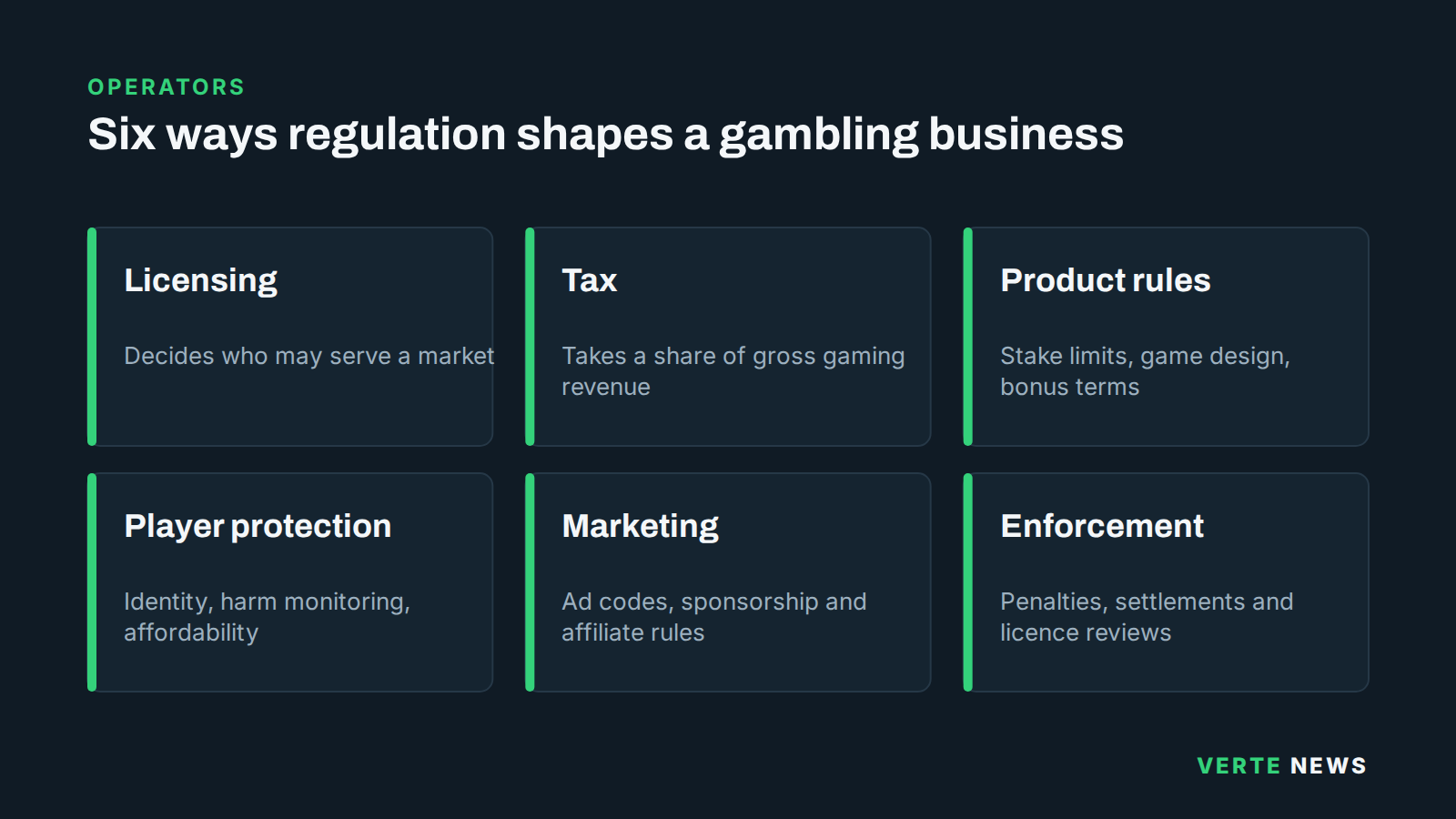
Regulation affects gambling operators at every level of the business. It determines whether they can serve a market at all, which products they can offer and on what terms, how they can advertise, how much of their revenue goes in tax, and how much they must spend on checks and controls. Because these rules are set by governments and regulators and can change at any time, regulatory risk is one of the main things investors and managers watch.
In Britain the central institution is the Gambling Commission, whose role is covered in our explainer on what the UK Gambling Commission does. Tax is set separately by the Treasury, and advertising is governed by codes overseen by the Advertising Standards Authority. Most other regulated markets have a similar division of responsibilities.
Licensing and tax
The most basic effect of regulation is permission. In a regulated market, only licensed operators can legally serve customers, and a licence brings conditions that apply for as long as it is held. Operators have to show that their owners and senior managers are suitable, that their finances are sound and that their systems meet technical standards.
Licences can be suspended or revoked, and regulators can impose financial penalties or agree settlements when operators fall short. For a large group, the loss of a licence in a major market would be a severe blow, which is why compliance departments have grown substantially over the past decade.
Gambling taxes are usually charged on an operator's gross gaming revenue, the amount kept after paying winners, rather than on the amount staked. Britain moved in December 2014 to a point-of-consumption basis, taxing online gambling according to where the customer is located rather than where the operator is based. That change removed much of the advantage of basing an online business overseas.
Tax rates vary widely between countries and between products, and they are a direct lever on profitability. When a government raises the duty on online casino games or sports betting, the margin available to pay for marketing, technology and staff shrinks immediately. Operators may respond by cutting costs, reducing promotions, raising prices through less generous odds, or reconsidering whether a market is worth serving. Our explainer on how sportsbook businesses make money shows where tax sits in that chain.
Product rules and player protection
Regulators increasingly shape the products themselves. In Britain, recent examples include the ban on gambling with credit cards in 2020, rules on game design features such as the speed of online slot spins in 2021, and the introduction of stake limits on online slots in 2025. Since January 2026 the Commission has also capped the wagering requirements attached to bonuses at 10 times.
Player protection rules carry their own costs. Operators must verify customers' identity and age, monitor for signs of harm, and in some cases carry out affordability checks before customers can spend beyond certain levels. These checks require data, staff and technology, and they can reduce revenue from the highest-spending customers, which is part of the reason they are contested.
Marketing and enforcement
Advertising rules limit where, when and how operators can promote themselves, from restrictions on content that might appeal to children to rules on bonus terms and affiliate marketing. Sponsorship has come under similar scrutiny.
Enforcement gives these rules weight. The Gambling Commission publishes the outcomes of its enforcement cases, and several large operators have made substantial payments over failings in anti-money laundering and safer gambling controls. Those cases affect not only the companies involved but the whole sector, because they signal what the regulator expects. The Gambling Commission's website sets out its current requirements and enforcement actions.
Why it matters
Regulation creates both costs and value. It raises the cost of doing business and limits some products, but it also gives licensed operators a legal market that unlicensed competitors are excluded from, at least in principle. Where rules become too restrictive or taxes too high, regulators worry about customers moving to offshore and unlicensed sites that offer none of the protections. Balancing those pressures is the central problem of gambling policy, and the outcome of each decision shows up quickly in operators' results.