How affiliate marketing works in iGaming
Many of the websites that review bookmakers and casinos are paid by the operators they write about. Affiliate marketing is a large and long-established part of the gambling industry, and understanding how it works helps readers judge what they see.

Affiliate marketing in iGaming is a system in which independent websites, apps, social media accounts and other publishers send potential customers to gambling operators and are paid for the customers who sign up and play. The affiliate places a tracked link to an operator; when someone follows that link and opens an account, the operator's systems record where the customer came from, and the affiliate earns a commission under the terms of its deal.
It is one of the main ways online betting and casino businesses acquire customers, alongside television advertising, sponsorship and search and social advertising. Comparison sites, tipster services, bonus listings and review pages are frequently funded this way.
How affiliates are paid
There are three common commercial models.
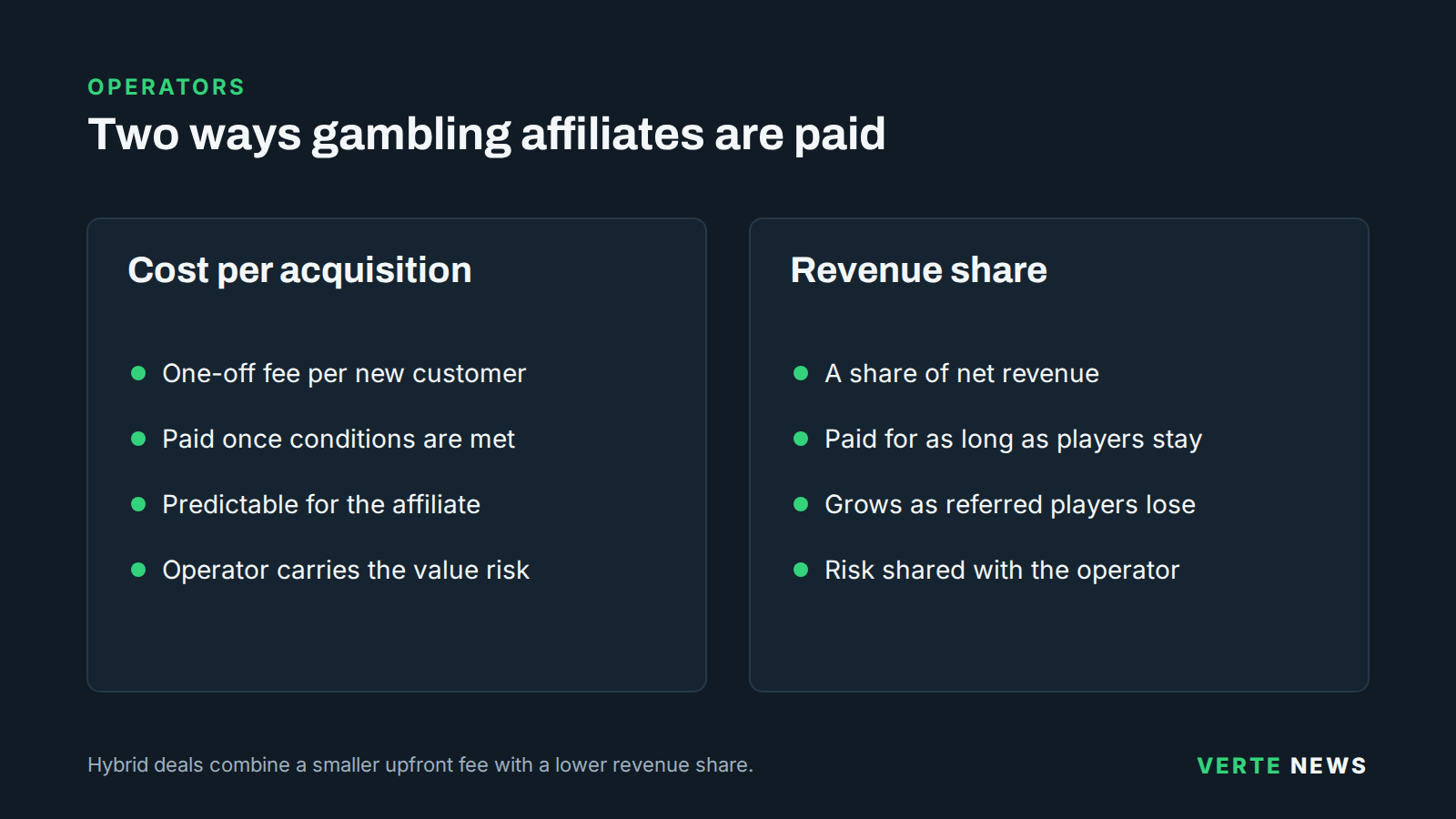
- Cost per acquisition (CPA). The operator pays a one-off fee for each new customer who meets agreed conditions, typically registering and making a first deposit of at least a set amount. The affiliate knows what it will earn per customer, and the operator carries the risk of whether that customer turns out to be valuable.
- Revenue share. The affiliate receives a percentage of the net revenue the operator earns from the customers it referred, usually for as long as those customers remain active. Income builds over time and depends on how much the referred customers lose, which is the feature critics most often point to.
- Hybrid. A combination of a smaller upfront CPA and a lower revenue share, which splits the risk between the two sides.
Deals are often tiered, with better rates for affiliates that deliver more customers, and larger affiliates may negotiate exclusive offers for their audience. Operators typically manage affiliates through dedicated programmes and tracking software, and many run programmes covering several of their brands at once.
Who is responsible for affiliate marketing
In Great Britain, operators cannot outsource their responsibilities. The Gambling Commission's position is that licensees are responsible for the marketing carried out on their behalf by affiliates, and advertising by affiliates must follow the same codes as advertising by the operator itself. Those codes, overseen by the Advertising Standards Authority, cover issues such as misleading claims, appeal to under-18s and how bonus terms are presented. Our guide to UK gambling advertising rules explains them in more detail.
In practice this means operators are expected to vet affiliates, set rules on where and how their brands can be promoted, monitor affiliate content and end relationships that breach them. Operators have faced regulatory action and advertising rulings over marketing carried out by affiliates, which has made many more cautious about who they work with.
Some other jurisdictions go further and require affiliates to register or be licensed directly with the regulator. Rules differ from market to market, which is one reason large affiliate businesses have compliance teams of their own.
What it means for readers
Affiliate marketing is not inherently misleading. Many affiliate sites publish useful information, and commercial funding pays for much of the free content on the internet. But the business model creates obvious pressures. An affiliate paid per sign-up has an incentive to encourage people to open accounts; one paid on revenue share benefits when the customers it refers lose money. Rankings, ‘top ten’ lists and highlighted offers may reflect commercial deals as much as the quality of a product.
Readers can look for a few signals. Does the site disclose that it is paid by operators? Are the terms of offers explained clearly, including how betting bonuses really work? Does it cover safer gambling tools and link to independent support? Does it ever say anything critical about the operators it promotes?
Transparency matters for publishers too. Verte News has such a relationship itself; how we handle it is set out in our editorial standards.
Why it matters to the industry
For operators, affiliates offer customer acquisition that is paid largely on results, which makes marketing budgets more predictable and extends a brand's reach into niches it could not easily target alone. For affiliates, the model has supported sizeable businesses, some of them listed on stock exchanges in Europe and the US.
The relationship is sensitive to regulation. Restrictions on bonuses, tighter advertising rules and changes in search engine policies all affect how affiliates operate, and the same scrutiny that has reshaped football sponsorship applies to marketing carried out through third parties.