What the UK Gambling Commission does
The Gambling Commission licenses, supervises and can sanction every business that offers gambling to consumers in Great Britain. Here is what it does, what it does not do, and why it matters to operators and customers alike.

The Gambling Commission is the statutory regulator for commercial gambling in Great Britain. It decides who may offer gambling, sets the conditions they must follow, checks that they follow them and takes action when they do not. It also advises the government on gambling policy and regulates the National Lottery, a role it took over from the National Lottery Commission in 2013.
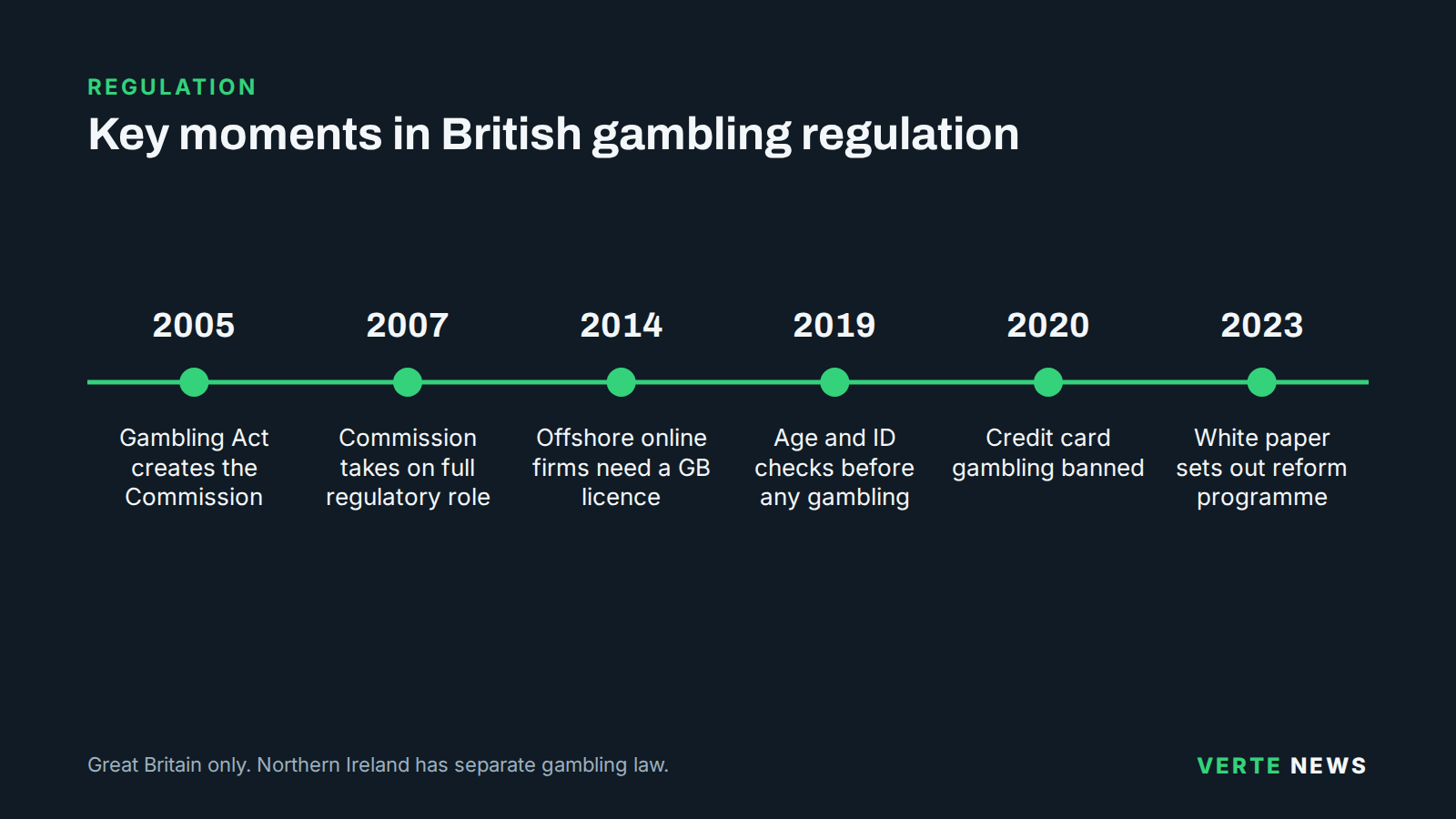
It was created by the Gambling Act 2005 and took on its full regulatory role on 1 September 2007, replacing the Gaming Board for Great Britain. It is a non-departmental public body sponsored by the Department for Culture, Media and Sport, which means ministers and Parliament set the law and the Commission applies it. Its remit covers England, Scotland and Wales; Northern Ireland has its own, separate gambling legislation.
Licensing: who may offer gambling
The Commission's most important power is the licence. Any business that provides gambling facilities to consumers in Great Britain needs an operating licence from it, whether it runs betting shops, an online casino, a bingo hall or a lottery. Since the Gambling (Licensing and Advertising) Act 2014, that includes overseas online operators: the test is where the customer is, not where the company is based. Our guide to how UK gambling licences work explains the types of licence and the application process in detail.
Before granting a licence, the Commission assesses whether the applicant is suitable: who owns and controls it, where its money comes from, whether it has the competence and resources to run gambling properly, and whether its policies meet the rules. Key individuals may need personal licences of their own. Suppliers of gambling software and gaming machines are licensed too, so the regulator's reach extends into the business-to-business supply chain.
Every licence comes with conditions, set out mainly in the Licence Conditions and Codes of Practice (LCCP), plus technical standards for remote gambling. These cover areas such as customer funds, age and identity verification, anti-money laundering controls, complaints handling, marketing and how operators interact with customers who may be at risk of harm.
Compliance and enforcement
Holding a licence is the start of the relationship, not the end. Licensees must pay annual fees, submit regulatory returns and report certain events, such as changes of control or serious incidents. The Commission carries out compliance assessments and can investigate when something appears to have gone wrong.
When it finds failures, it has a range of tools. It can issue warnings, attach additional conditions to a licence, agree regulatory settlements under which an operator pays a sum in lieu of a financial penalty, impose financial penalties, and suspend or revoke a licence. Published enforcement cases have repeatedly focused on weaknesses in anti-money laundering controls and in identifying customers showing signs of harm. The Commission can also prosecute certain offences, including providing gambling without a licence.
Offshore sites that offer gambling to British consumers without a licence are acting unlawfully, but they are harder to reach. The Commission works with payment providers, internet platforms and other regulators to disrupt them. We explain the wider picture in how offshore gambling regulation works.
Rules that protect consumers
Many of the protections British customers take for granted come from Commission rules. Operators must verify age and identity before someone can gamble, a process covered in our explainer on what KYC means in gambling. Online operators must take part in the national self-exclusion scheme, GamStop. Gambling with credit cards has been banned since 14 April 2020. Online slot games are subject to design rules and, following the government's gambling reform programme, maximum stakes per spin.
The Commission also sets expectations on how operators monitor play and step in when spending looks harmful, including checks on whether a customer can afford their level of gambling. Our guide to affordability checks covers how that works in practice.
What the Commission does not do
Some common assumptions about the regulator are wrong. It does not resolve individual disputes between a customer and an operator. Licensed operators must have their own complaints procedure and must give customers access to an approved alternative dispute resolution (ADR) provider if the complaint is not settled. The Commission does want to hear about problems, because patterns of complaints inform its compliance work, but it will not order a particular payout.
It does not license premises directly either. Betting shops, bingo halls, arcades and casinos also need premises licences from their local licensing authority, usually the local council, which applies the same Gambling Act principles locally.
Nor does it make the law. Changes such as the online slot stake limits flowed from the government's 2023 white paper, High stakes: gambling reform for the digital age, and were implemented through legislation and Commission rule changes. The Commission consults publicly before changing its own licence conditions, and those consultations and their outcomes are published on the Gambling Commission website.
Why it matters
For operators, the Commission is the gatekeeper to the British market, and its conditions shape product design, marketing, payments and customer management. For consumers, a Commission licence means a business is accountable to a British regulator: it must protect customer funds to a disclosed standard, follow the rules on fairness and safer gambling, and offer an independent route for complaints. Checking that a site holds a current licence, which can be done on the Commission's public register, is one of the simplest protections available.