How gambling operators enter new markets
Gambling is licensed country by country, and sometimes state by state, so expansion is never as simple as switching on a website. Operators have to choose a route in, win a licence, localise their product and budget for a costly launch.

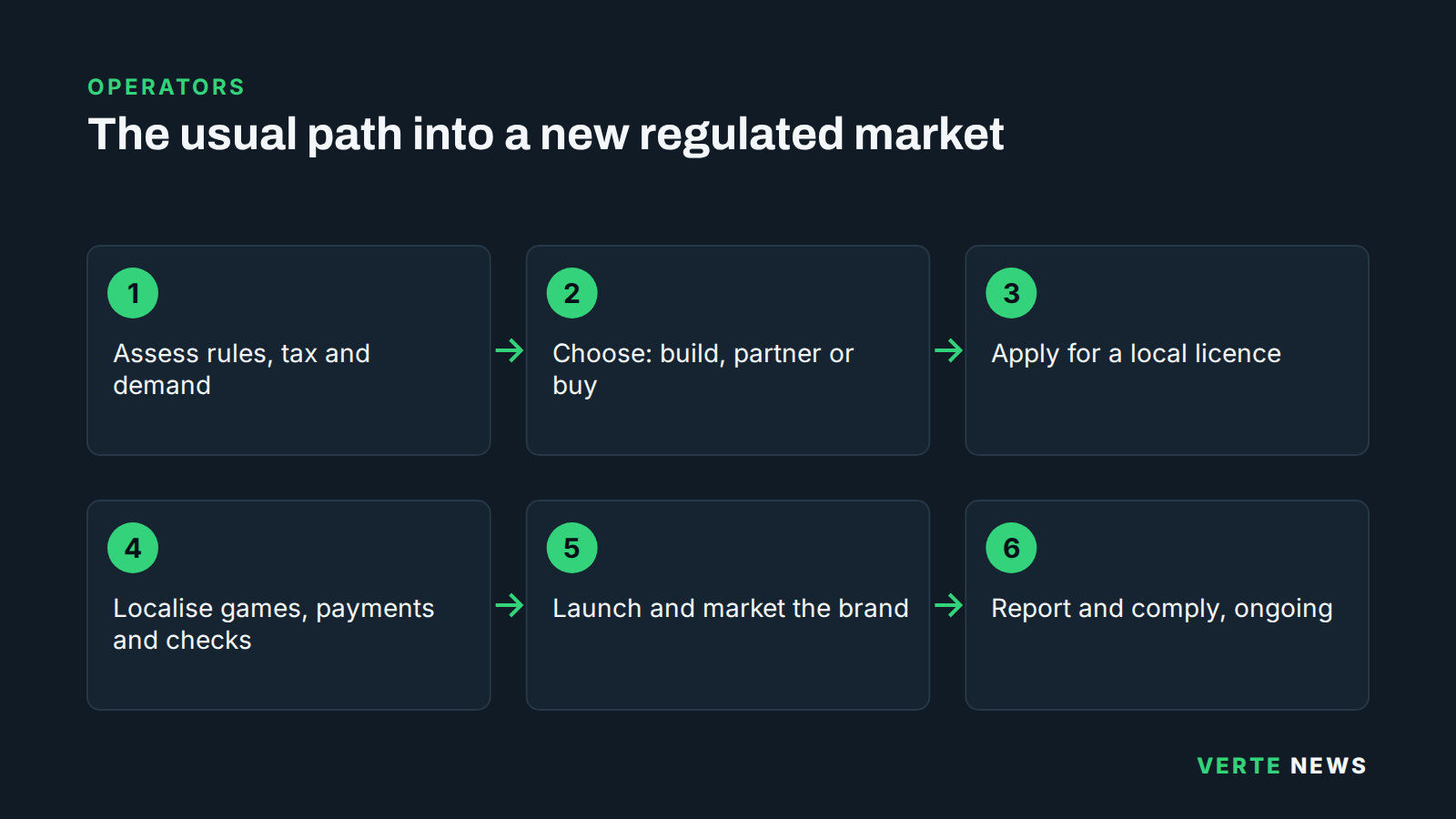
Gambling operators enter new markets by obtaining a local licence, or by partnering with or buying a business that already has one, and then adapting their product, payments and marketing to that market's rules. Because gambling is regulated nationally, and in countries such as the US and Canada by state or province, there is no single international permission. Each new market is, in effect, a separate business launch.
The opening of a regulated market is therefore a major event for the industry. When the US Supreme Court struck down the federal ban on state-authorised sports betting in 2018, and when countries such as the Netherlands, Germany and Brazil introduced new online regimes, operators spent years preparing applications, forming partnerships and planning launches.
Three ways in
Operators usually choose between three routes, often combining them.
- Build. The operator applies for a licence in its own name and launches an existing brand, adapting it to local rules. This gives full control but is slow, and a foreign brand may be unknown to local customers.
- Partner. Some markets require or encourage a local partner. In some US states, online sportsbooks must operate through an arrangement with a land-based casino, racetrack or tribal operator that holds the underlying licence. Joint ventures, such as BetMGM between Entain and MGM Resorts, are another form of partnership.
- Buy. Acquiring an established local operator brings a licence, a customer base and a trusted brand in one step. Flutter Entertainment has used this route repeatedly, buying established brands such as Sisal and Snai in Italy and taking a majority stake in MaxBet in Serbia, rather than launching its own brands there.
The right route depends on how quickly the operator wants to move, how much it is willing to spend, and whether local brands carry an advantage. In markets where betting has long been part of everyday life, customers often prefer familiar names.
Winning the licence
Licensing is the gate through which every route must pass. Regulators typically assess the ownership and finances of the applicant, the integrity of its senior people, its anti-money laundering and safer gambling controls, and the technical standards of its systems. Our explainer on UK gambling licences shows how one established regulator approaches this.
Newly regulated markets often add their own requirements: a locally incorporated company, a local bank account or server, a fixed licence fee, restrictions on bonuses or advertising, or a cap on the number of licences. Some also require operators to have stopped targeting the country's customers without a licence before they can apply: the Netherlands, for example, applied a 'cooling-off' period to applicants before its regulated online market opened in October 2021. That can mean leaving a market for a period before re-entering it legally.
Localising and launching
Once licensed, an operator must adapt its product. Sports betting markets need to cover the sports and leagues local customers follow. Casino games may need to be recertified to local technical standards. Payments must support the methods people actually use, identity checks must work with local documents and databases, and customer service must operate in the local language.
Much of this depends on suppliers. Operators rely on B2B providers for platforms, content, data and payments, and a supplier's own licence in the new market can determine how quickly a launch can happen.
The launch itself is usually expensive. New markets tend to see intense competition for early customers, with heavy advertising and generous promotions, because operators believe that market share won early is hard to lose. Many operators accept losses for several years in a new market in the hope of building a profitable position.
Why it matters
Market entry decisions shape the structure of the industry. They explain why the largest groups own collections of national brands, why partnerships with land-based companies are common in North America, and why new regulated markets are followed by waves of acquisitions.
They also carry risk. A market can become less attractive after launch if tax rises, product rules tighten or advertising is restricted, and operators have withdrawn from markets where the economics stopped working. Our explainer on how regulation affects gambling operators looks at those pressures in more detail.