The rules on gambling advertising in the UK
Gambling adverts in the UK are governed by several overlapping sets of rules, from the advertising codes enforced by the ASA to Gambling Commission licence conditions. Here is who sets them, what they say and how they are enforced.

Gambling can be advertised in the UK, but the content, placement and targeting of adverts are tightly controlled. The core content rules sit in the UK advertising codes, written by the Committees of Advertising Practice (CAP for non-broadcast, BCAP for broadcast) and enforced by the Advertising Standards Authority (ASA). On top of that, the Gambling Commission makes compliance with those codes a condition of every operator's licence, and adds rules of its own on areas such as bonuses and direct marketing.
Who sets the rules
Several bodies are involved, and each covers a different part of the picture.
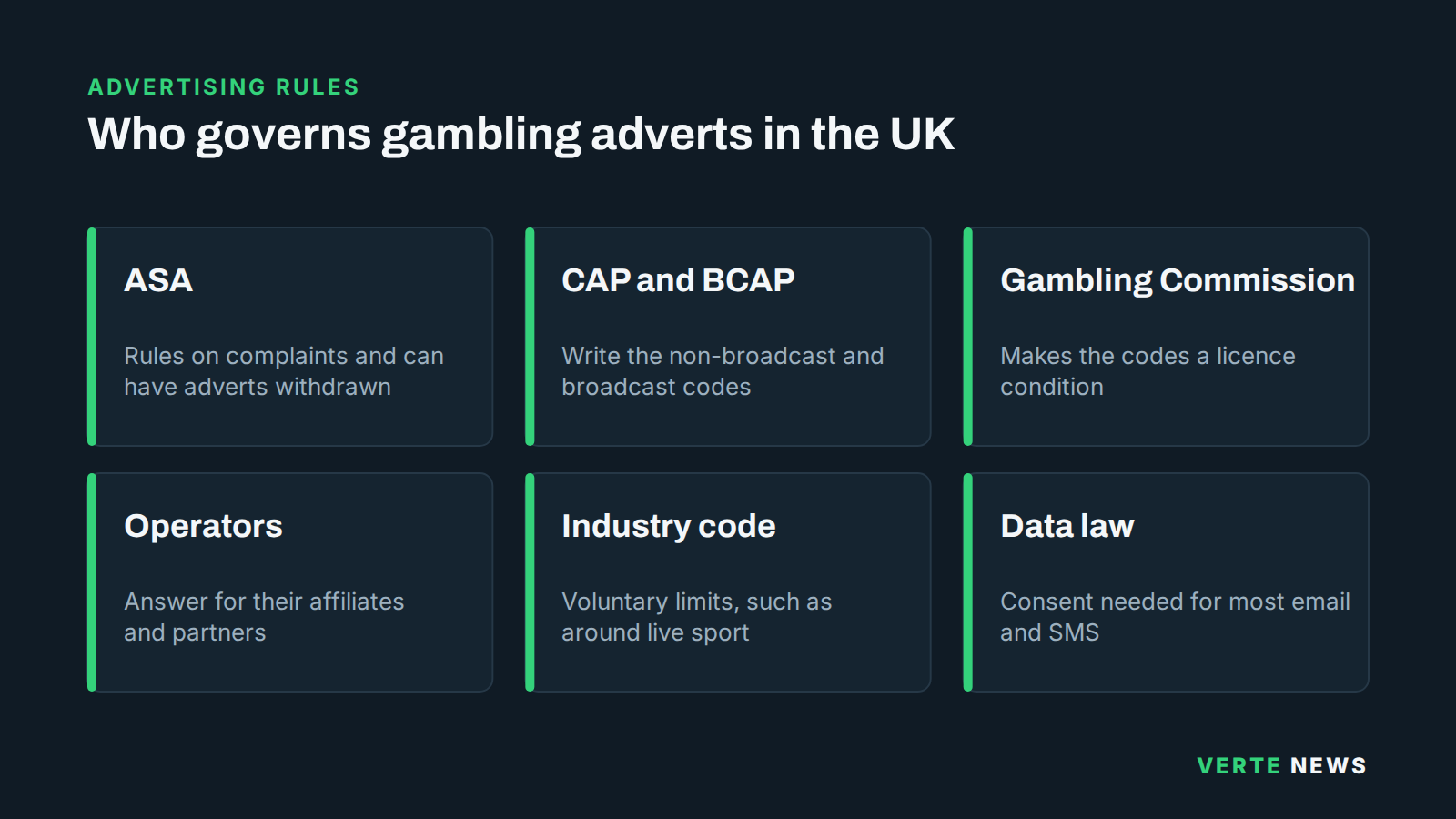
- The ASA is the UK's independent advertising regulator. It investigates complaints and its own monitoring findings, and rules on whether an advert breaches the codes. Its rulings are published on the ASA website.
- CAP and BCAP write the codes. Both contain a dedicated gambling section, supported by more detailed guidance on how the rules are interpreted.
- The Gambling Commission requires licensees to follow the codes and sets further conditions on marketing, including rules on free bets and bonuses and on direct marketing. It can take regulatory action against an operator for marketing failures, including failures by affiliates marketing on its behalf.
- The industry has its own voluntary code for socially responsible advertising, which adds commitments such as the whistle-to-whistle ban on television betting adverts during live sport before the 9pm watershed.
Direct marketing by email and text message is also subject to general data protection and electronic marketing law, which requires consent in most cases.
What the advertising codes require
The central principle of the gambling rules is that marketing must be socially responsible, with particular regard to protecting children, young people and other vulnerable people from harm or exploitation. In practice, gambling adverts must not:
- portray, condone or encourage gambling behaviour that is socially irresponsible or could lead to financial, social or emotional harm;
- suggest that gambling can solve financial problems, provide an alternative to work or enhance personal qualities or social success;
- exploit the susceptibilities or inexperience of children, young people or vulnerable people;
- be likely to be of strong appeal to under-18s;
- feature anyone who is, or seems to be, under 25 in a significant role, apart from limited exceptions such as an operator's own betting pages.
The strong appeal rule, which took effect in October 2022, was a significant tightening. Previously the test was whether an advert was of particular appeal to children compared with adults. Under the current test, an advert breaches the code if it is likely to strongly appeal to under-18s, whatever its appeal to adults. That has limited the use of well-known sports stars, social media personalities and some video game imagery in gambling marketing. The codes also restrict where adverts can appear, so that they are not placed in media where under-18s make up more than 25% of the audience.
Promotions attract their own scrutiny. The ASA has repeatedly ruled against adverts that give prominence to a free bet or bonus while hiding significant conditions. The Gambling Commission has also tightened the rules on incentives: from 19 January 2026, wagering requirements on bonuses are capped at ten times the bonus amount, and a single offer can no longer require customers to use more than one type of gambling, such as a sports bet that unlocks casino free spins. Our explainers on betting bonuses and wagering requirements cover how those offers work.
How the rules are enforced
The ASA does not fine advertisers. When it upholds a complaint it requires the advert to be withdrawn or changed, publishes its ruling and can apply further sanctions, such as asking media owners and platforms to refuse space or, for persistent offenders, referring the matter to Trading Standards or, for broadcast adverts, Ofcom. For licensed gambling operators, a published ruling also matters because breaching the codes is a breach of licence conditions, which the Gambling Commission can act on.
Operators are responsible for marketing done on their behalf. Where an affiliate website or social media partner publishes a non-compliant advert, the operator can be held to account. That is why operators audit their partners closely, as described in our guide to how affiliate marketing works in iGaming.
Sponsorship and sport
Sponsorship is treated differently from conventional advertising, but the same principles run through it. Logos on shirts, stadium boards and kit are subject to the codes when they appear in marketing communications, and the strong appeal rule has shaped how players are used in gambling promotions. Separately, Premier League clubs agreed in April 2023 to remove gambling sponsors from the front of matchday shirts from the 2026–27 season, a change now in effect, while still allowing sleeve and other placements. Our explainer on why betting companies sponsor football clubs looks at the commercial logic.
What it means for consumers
For the public, the rules provide a clear route for concerns. Anyone who thinks a gambling advert is misleading, irresponsible or aimed at children can complain to the ASA free of charge. For adverts that appear to come from unlicensed operators targeting British consumers, the Gambling Commission is the body to tell.