How offshore gambling regulation works
Many online gambling companies are licensed in small jurisdictions far from their customers. This explainer covers why offshore licensing exists, how it differs from local licensing, and why an offshore licence does not open every market.
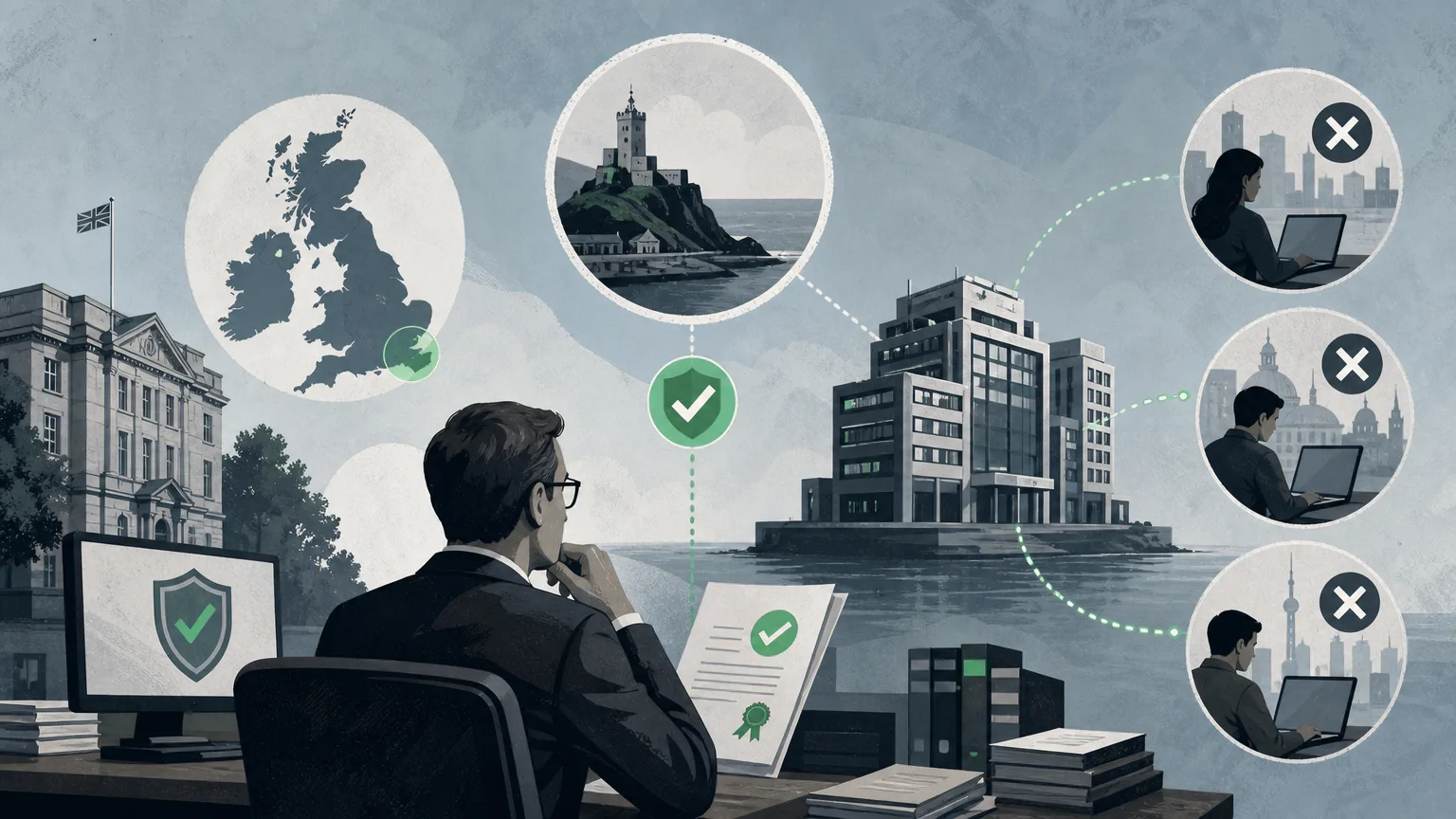
Offshore gambling regulation means licensing online gambling from a jurisdiction other than the one where most customers live. A company might be licensed in Malta, Gibraltar, the Isle of Man or Curaçao while taking bets from players in many other countries. Whether that is lawful depends not on the offshore licence alone but on the law of each country where the customers are.
Why offshore licensing developed
When online gambling grew in the late 1990s and 2000s, most countries had no licensing system for it. A number of smaller jurisdictions saw an opportunity and created one. They offered a legal base, predictable rules, tax arrangements that were often favourable and, in some cases, EU membership or close ties to the British legal system. Operators could set up in one place and serve customers internationally, and their host jurisdictions gained jobs and revenue.
The main hubs have different histories and reputations. Malta, an EU member state, has a detailed framework run by the Malta Gaming Authority. Gibraltar and the Isle of Man are long-established British-linked centres with their own regulators. Curaçao, part of the Kingdom of the Netherlands, historically issued licences under a lighter master-licence system; a new National Ordinance on Games of Chance, in force since December 2024, replaced it with direct licensing by the Curaçao Gaming Authority. The standards expected of licensees, and the resources available to supervise them, vary considerably between jurisdictions.
Point of supply and point of consumption
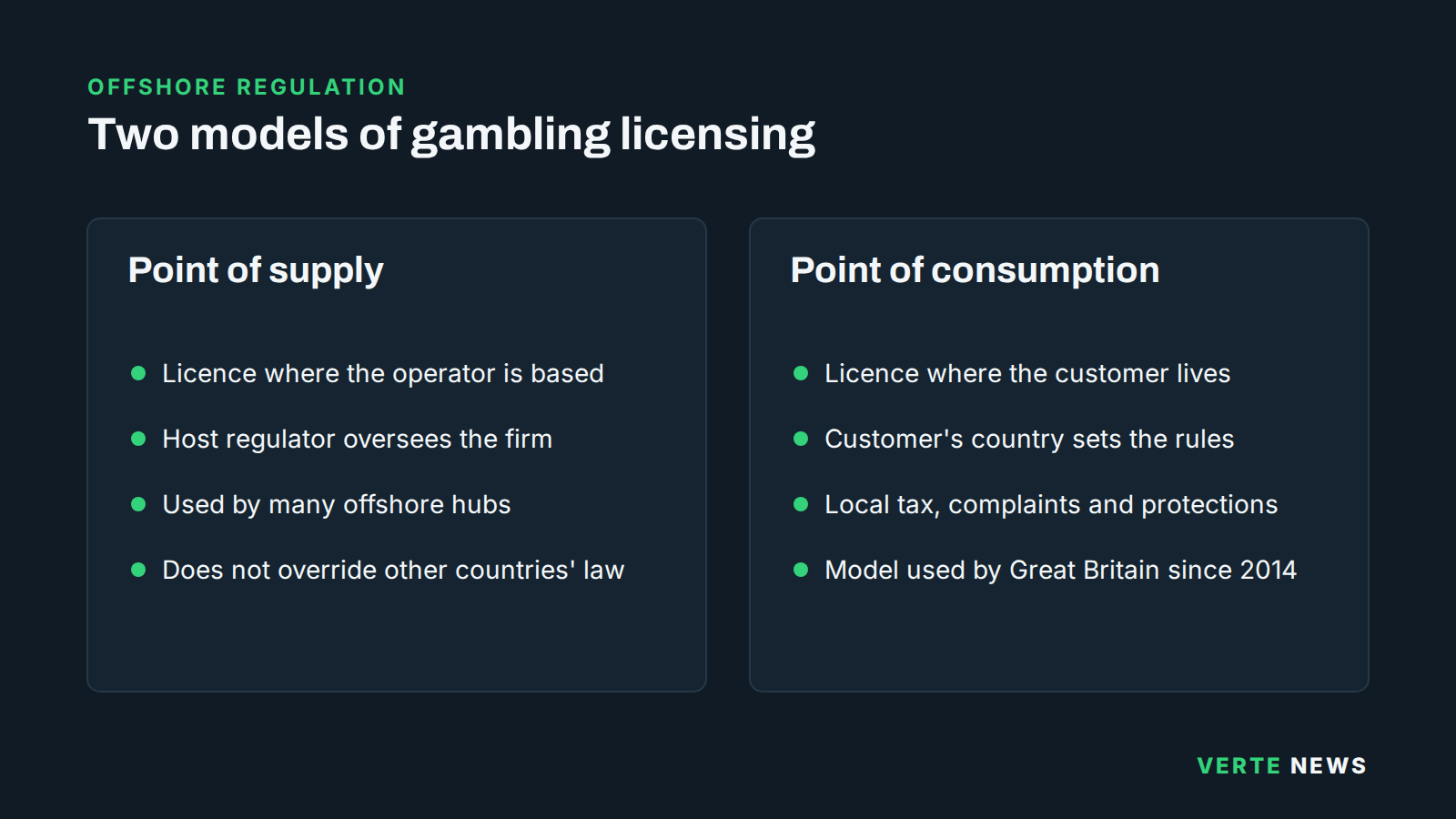
The key distinction in this area is between two models of regulation.
- Point of supply. The operator needs a licence where it is based. The regulator oversees the business and, in principle, the licence is treated as sufficient to serve customers elsewhere.
- Point of consumption. The operator needs a licence in each country where its customers are, whatever its home base. The customer's country sets the rules, collects tax and handles complaints.
Over the past two decades, many larger markets have moved to the second model. Great Britain did so through the Gambling (Licensing and Advertising) Act 2014: any operator serving British consumers needs a Gambling Commission licence and must follow British rules for those customers, as explained in how UK gambling licences work. Several European countries now run their own licensing systems on a similar basis, as do regulated US states and other markets.
What an offshore licence does and does not allow
An offshore licence authorises activity under the law of the issuing jurisdiction. It does not override another country's law. If a country requires a local licence, serving its residents without one is unlawful there, regardless of what the offshore regulator permits. Offshore regulators differ in how far they restrict their licensees from serving such markets.
Countries without local licensing, or that prohibit online gambling but struggle to enforce the ban, are where offshore-licensed operators have traditionally been most active. The industry often describes these as grey markets, as distinct from regulated (white) markets and black markets, where gambling is prohibited or offered illegally. The terms are informal, and whether a given market is grey depends on legal interpretation that can be disputed.
How local regulators respond
Regulators in point-of-consumption markets cannot license or inspect an offshore company that refuses to apply, but they have other tools. These include:
- blocking payments between local banks and unlicensed sites;
- asking internet service providers or app stores to block access;
- working with search engines and social media platforms to remove advertising;
- cooperating with other regulators, including the offshore regulator itself;
- prosecuting or penalising businesses and individuals that promote unlicensed gambling.
The Gambling Commission uses several of these approaches against unlicensed sites targeting British consumers. Their effectiveness varies, and illegal operators adapt, which is why regulators treat the unlicensed market as an ongoing challenge.
What it means for operators
For a gambling business, offshore licensing is now usually one part of a wider strategy rather than the whole of it. A typical international operator holds an EU or British-linked licence as a base, adds local licences in regulated markets and assesses country by country whether any remaining markets can be served lawfully. Our explainers on how gambling operators enter new markets and how regulation affects gambling operators look at the commercial side.
What it means for consumers
For customers, the licence that matters is the one covering their own country. A British customer using a site licensed only offshore loses access to British protections such as GamStop, stake limits, age verification rules and approved dispute resolution. That is the situation described in our explainer on what non-GamStop means. The Gambling Commission's public register on the Gambling Commission website shows whether a business is licensed to serve Great Britain.