How sportsbook businesses make money
A sportsbook does not need to predict results to make money. It builds a margin into its prices, manages its exposure, and keeps a share of everything staked. Whether that becomes a profit depends on tax, marketing and the cost of running the business.

Sportsbooks make money by building a margin into their odds, so that across a large number of bets they pay out less than they take in. The bookmaker is not trying to guess every result correctly. It is trying to price each market slightly in its own favour, keep its exposure to any single outcome under control, and let volume do the rest.
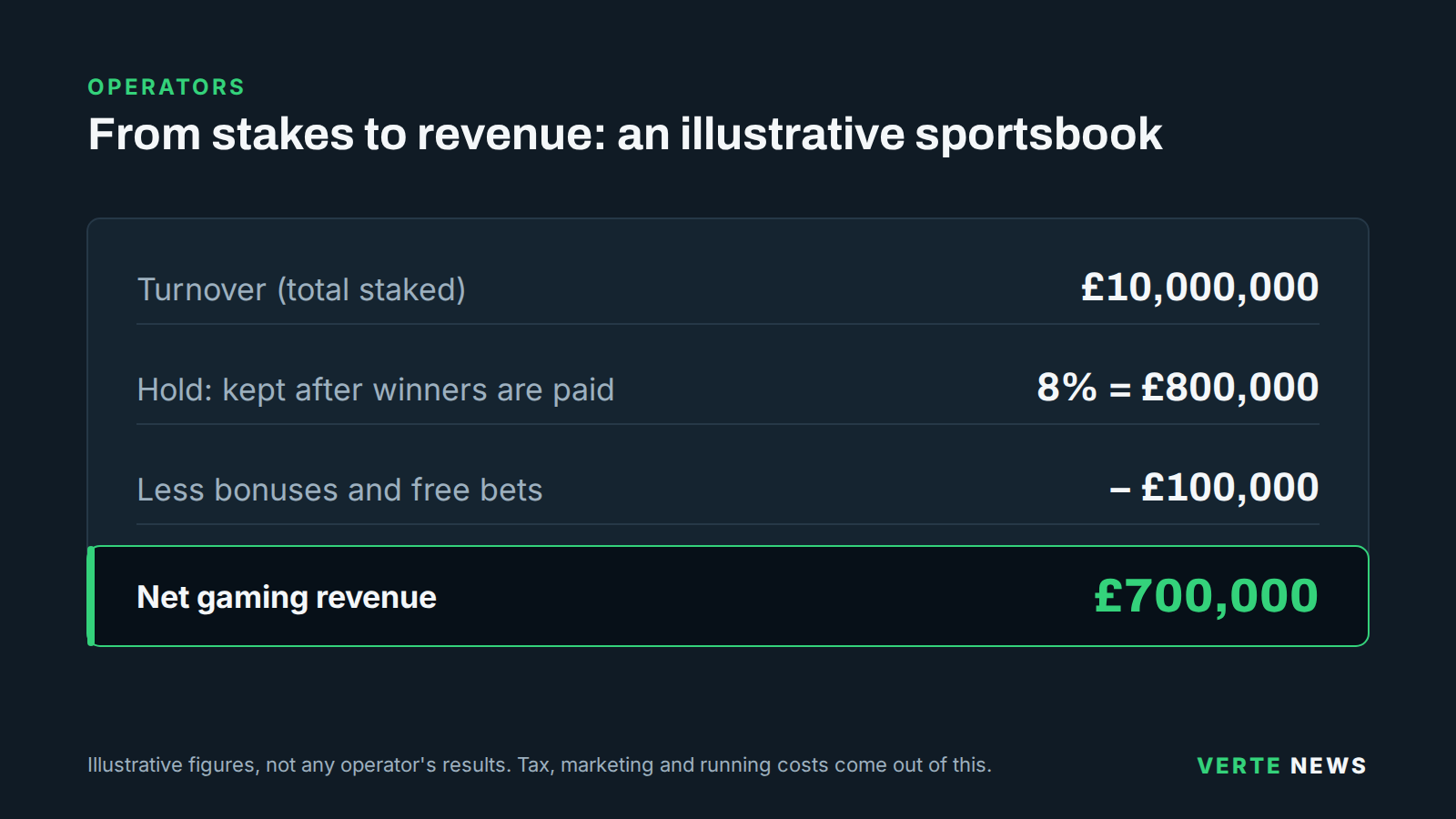
What is left after winning bets are paid is the sportsbook's gross revenue. Whether it turns into profit depends on everything that comes afterwards: bonuses, betting duties, marketing, technology, data and staff.
The margin in the price
Every set of odds a bookmaker offers implies a probability for each outcome. In a fair market those probabilities would add up to exactly 100%. In a bookmaker's market they add up to more, and the excess is the margin, sometimes called the overround. Our explainer on the bookmaker's margin shows how to calculate it from any set of prices.
A simple example is a two-way market priced at 1.91 on each side. Each price implies a probability of about 52.4%, so the two together come to roughly 104.7%. If the bookmaker took equal stakes on both sides, it would pay out about 95.5% of the money staked whatever happened, and keep the rest.
Real books are never perfectly balanced, which is why bookmakers set odds using a combination of models, market information and judgement, and then move them as money comes in. Traders adjust prices to attract bets on the side they need, limit stakes on markets where they are exposed, and in some cases restrict accounts that consistently beat their prices. Margins also vary widely by market: a major football match usually carries a thinner margin than a multi-leg accumulator or a niche market, where uncertainty is greater and competition weaker.
From margin to revenue
The industry measures performance with a few standard terms.
- Turnover or handle is the total amount staked.
- Hold or gross win margin is the share of turnover the sportsbook keeps after paying winning bets. Unlike the theoretical margin in the odds, it reflects what actually happened, so it rises and falls with results.
- Gross gaming revenue is turnover multiplied by hold: the money kept before costs.
- Net gaming revenue is gross gaming revenue after deducting the cost of bonuses and free bets.
Hold can swing sharply from one period to another. A run of favourites winning, or a single upset in a heavily backed event, can turn a strong quarter into a weak one. That is why listed operators often point to the effect of sports results when explaining their figures, and why investors watch the trend in turnover and customer numbers as closely as the headline revenue.
The mix of bets matters too. Accumulators and bet builders combine the margin on each selection, so they tend to give the bookmaker a bigger edge than a single bet, which is one reason operators promote them heavily. Promotions and free bets do the opposite: they attract and retain customers but reduce the revenue kept.
The costs that decide profit
A large share of gross revenue goes before a sportsbook sees any profit.
- Betting duties. Operators pay tax on their gross profits in most regulated markets. In Britain these duties are charged on the basis of where the customer is located, and rates are set in the Budget.
- Marketing. Television advertising, sponsorship, affiliate commissions and customer promotions are usually among the largest costs, particularly in newly opened markets.
- Technology and data. Trading platforms, official data feeds, pricing services and streaming rights are costly, whether built in-house or bought from suppliers.
- Payments, compliance and people. Payment processing, identity checks, safer gambling monitoring and customer service all scale with the size of the business.
These costs are largely fixed or grow more slowly than revenue, which is why scale is so valuable. A large operator can spread the cost of technology, data rights and compliance over more customers than a small one, and can afford to offer more markets. It is a large part of the reason the industry has consolidated into groups such as Flutter Entertainment.
Why it matters
Understanding the business model explains much of the behaviour customers see: prices that differ between bookmakers, heavy promotion of multi-leg bets, generous offers to new customers, and limits on those who win consistently. It also explains why tax changes and new rules can have a large effect. When a duty rises or a product is restricted, the margin that pays for everything else shrinks, and operators respond by cutting costs, changing their product mix or, in some cases, leaving a market.