How casino game providers work
Most online casino games are not made by the casino. They are built, certified and hosted by specialist studios, then distributed to many operators at once under commercial agreements.

A casino game provider, or studio, is a business-to-business company that designs games such as slots, table games and live dealer tables and supplies them to online casino operators. The operator chooses which games to put in its lobby; the provider builds the game, has it certified, hosts it on its own servers and is usually paid a share of the revenue it generates. NetEnt, Pragmatic Play and Playtech are examples of studios whose games appear across many different casinos.
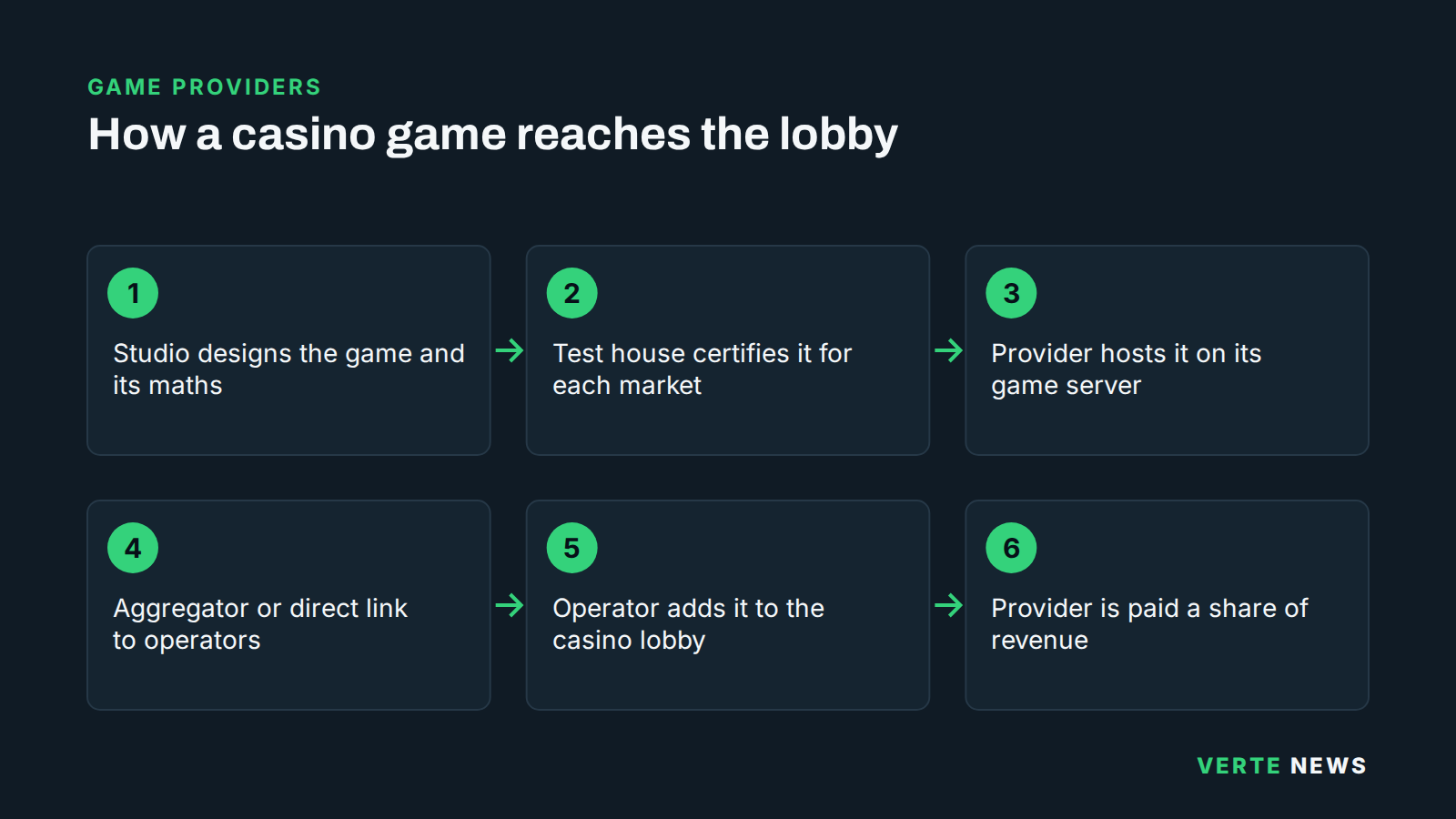
From idea to casino lobby
A new slot typically goes through these stages:
- Design. Artists and developers create the theme, features and interface; mathematicians build the maths model, which sets the RTP, the volatility and how often each outcome occurs.
- Certification. An independent test house checks the random number generator, the maths and the game's behaviour against the technical standards of each market where it will be offered.
- Hosting. The game runs on the provider's remote game server. When you press spin at a casino, the request goes to that server, which produces and records the result and sends it back.
- Distribution. The provider connects to operators directly or through an aggregator: a company that bundles games from many studios behind a single integration, so an operator does not need hundreds of separate connections.
- Launch and monitoring. The operator adds the game to its lobby, and both sides monitor how it performs.
Because the game runs on the provider's server, a casino does not hold its own copy of the maths. That is one reason the same slot looks and behaves identically across sites, and why fairness rests on the provider's certified software rather than the operator's say-so. How results are generated is explained in how random number generators keep games fair.
How providers are paid
The common model is revenue share. The provider takes an agreed percentage of the gross gaming revenue its games produce at each operator, meaning stakes minus winnings. Rates are negotiated and vary with the provider, the operator and any aggregator in between.
An illustrative example, using hypothetical figures: players at one casino stake £2,000,000 on a studio's slots in a month. If those games return 96% to players, gross gaming revenue is about £80,000 (4% of £2,000,000). At an assumed 10% revenue share, the provider earns about £8,000 and the operator keeps about £72,000, from which it pays its own costs and tax. If an aggregator is involved, it takes a cut too.
Providers may also offer operators a choice of RTP versions of the same game, for example 96% or 94%. A lower-RTP version raises the revenue per pound staked for both parties. That is why the figure in a game's help screen on the site you are using is more reliable than one quoted elsewhere; see what RTP means.
Licensing and responsibility
In Great Britain, companies that make or supply gambling software used by British customers need a gambling software licence from the Gambling Commission, separate from the operator's, and a studio that hosts games on its own servers for other operators' customers also needs a game host licence. Games offered to British players must meet the Commission's technical standards and be tested by an approved test house before release. Online slots must also follow design rules introduced in October 2021, including a minimum spin speed of 2.5 seconds and a ban on autoplay. Other regulators, such as the Malta Gaming Authority, have their own requirements, which is one reason a game can be available in one market and not another.
Live casino is a specialised part of the same model, with studios employing dealers and streaming tables; see how live casino works. The wider supplier landscape, including platforms and payment providers, is covered in how B2B suppliers power the gambling industry.
Why it matters to players
Understanding the provider model clears up some common myths. A casino cannot quietly alter a certified game to pay less on a particular day: in regulated markets, changes to game software go through testing and version control. What an operator can do is choose which approved RTP version to offer, which is why checking the stated figure matters.
Equally, a well-known studio name does not make a game better value. The maths is still designed so that players lose on average, and the game's volatility shapes how that loss arrives, as explained in what slot volatility means. The useful checks are the site's licence, the RTP shown for that game on that site, and the limits you set for yourself before you play.