How bookmakers set odds
Odds start as a probability estimate, gain a margin, and are then reshaped by money, team news and rival prices. What that process means for the number you see on screen.
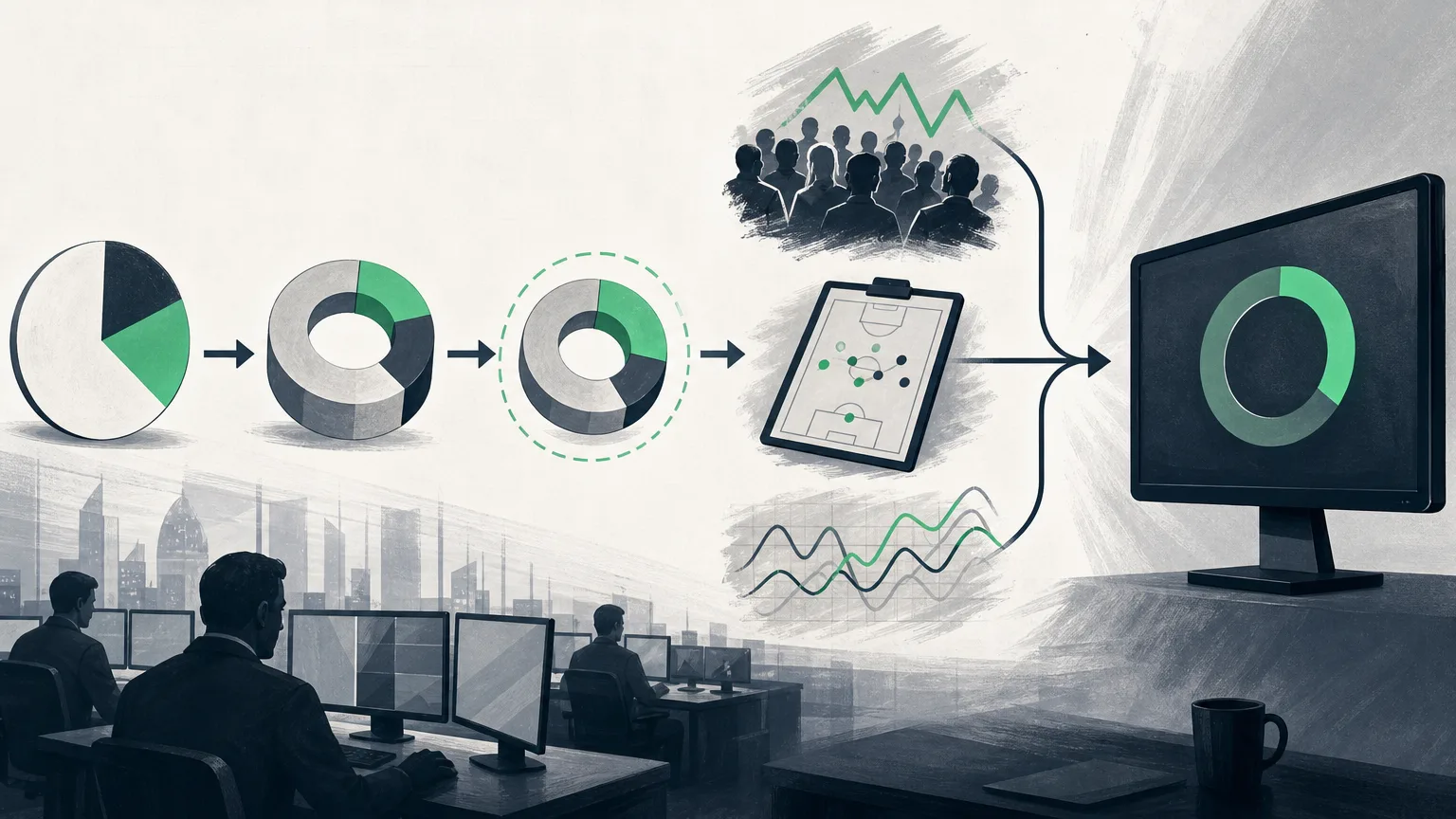
Every price in online sports betting comes out of the same process, and bookmakers set odds in three stages. First they estimate the probability of each outcome, usually with statistical models and data. Then they convert those probabilities into prices and add a margin, so the implied chances in the book add up to more than 100%. Finally, they adjust the prices as money, team news and other bookmakers' prices come in. The number on the screen is therefore not a pure forecast: it is an estimate, plus the operator's cut, shaped by the market.
Stage one: estimating the probability
For major sports, the starting point is a model. Football models typically rate each team's attacking and defensive strength from past results and underlying data such as shots and expected goals, then estimate how many goals each side is likely to score. From that goal distribution the model can derive the probability of a home win, a draw, an away win, a given number of total goals or both teams scoring. Tennis, basketball and other sports have their own equivalents, built on serve and return statistics or scoring rates.
Not every operator builds its own models. Many rely wholly or partly on specialist trading and data suppliers that provide prices across thousands of events; our explainer on how B2B suppliers power the gambling industry describes that layer. Traders then review the output, applying knowledge a model may lack, such as a late injury or a team likely to rest players before a cup final.
Stage two: from probability to price
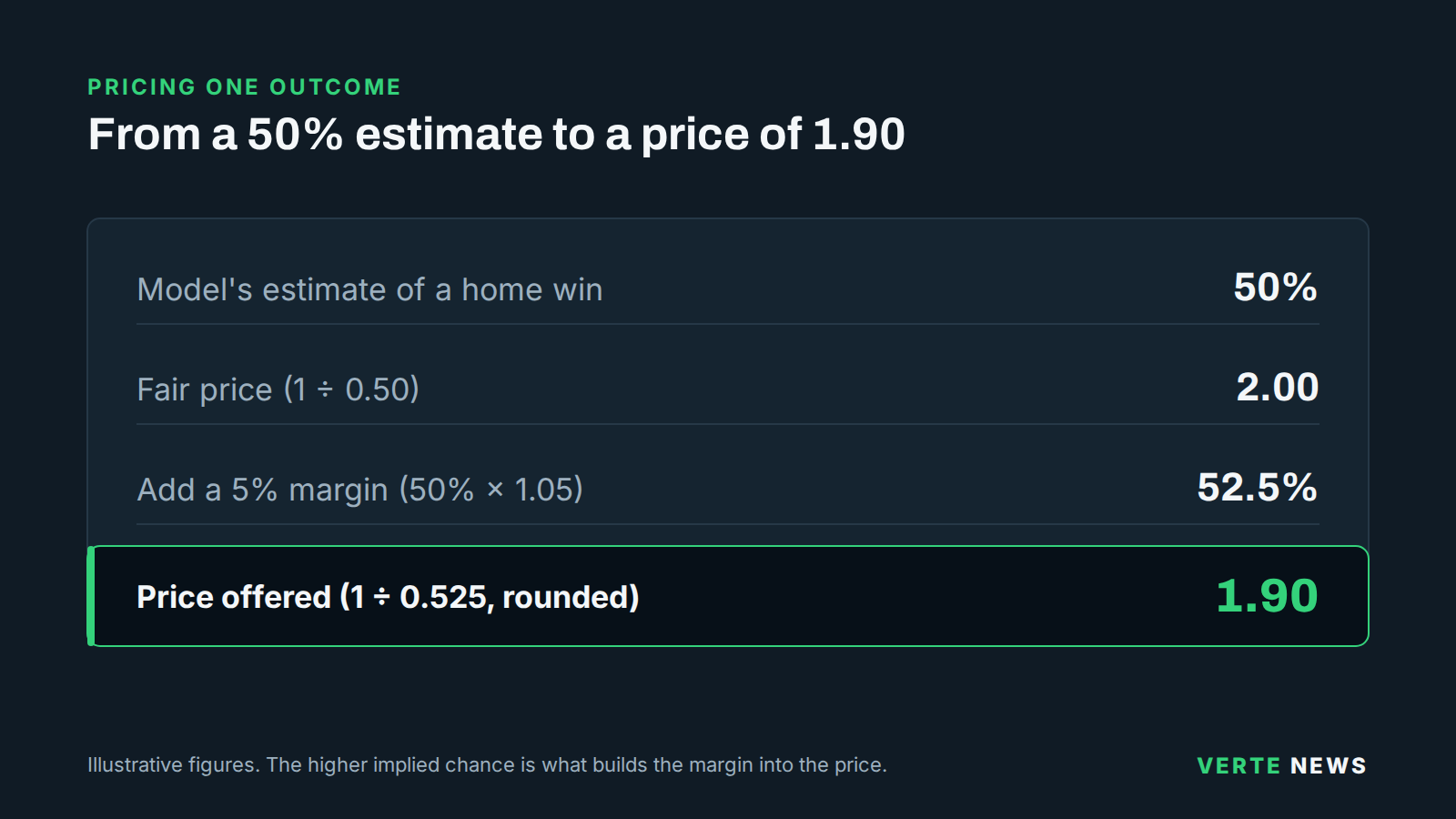
A probability converts to decimal odds by dividing 1 by it. Suppose a model gives the home side a 50% chance, the draw 25% and the away side 25%. The fair odds would be 2.00, 4.00 and 4.00, and their implied probabilities would add up to exactly 100%. A bookmaker offering those prices would expect, at best, to break even over time before any of its costs.
So the bookmaker scales the probabilities up. Increasing each by 5% gives 52.5%, 26.25% and 26.25%, which convert to about 1.90, 3.80 and 3.80. Add up the implied probabilities of those rounded prices – 52.6% + 26.3% + 26.3% – and the book comes to roughly 105.3%. That excess is the bookmaker's margin, and it is why the average bettor loses money over time.
The margin is not always spread evenly. Operators may shade the price of popular outcomes, such as a big club playing at home, or of outcomes on which they already hold a lot of liability. A long-observed pattern in betting markets, often called the favourite-longshot bias, is that outsiders tend to be priced less generously relative to their true chances than favourites. How pronounced that is varies by sport and market.
Stage three: the market takes over
Opening prices are a first draft. Once a market is live, several forces move it. Team news and weather change the underlying probabilities. The volume of money on each side changes the bookmaker's exposure: if far more has been staked on one outcome than another, the operator may shorten that price to slow the flow and lengthen the others to attract balancing bets. Bets from customers the bookmaker regards as well informed can move a price on their own, even at modest stakes.
Bookmakers also watch each other and the betting exchanges, where prices are set by customers trading against one another. Because busy exchange markets carry little built-in margin, they are a useful reference for where the market thinks the true probability lies; our comparison of a bookmaker and a betting exchange explains why. The fuller picture of price movement is in why betting odds move.
What it means for the bettor
Three practical points follow. First, a price reflects the bookmaker's commercial position as well as its view of the event, so it is not a neutral forecast. Second, because every price includes a margin, a bettor needs to be right more often than the odds imply just to break even. At 1.90, a bet has to win more than 52.6% of the time to show a profit over the long run; on a genuine coin-flip contest, it wins 50%. Third, comparing prices across operators shows how much the margin varies, but no comparison removes it.
Seen that way, odds are the price of a product, set by a business that expects to profit from selling it. That is worth keeping in mind before staking anything, along with the deposit limits and time-outs that licensed operators provide.