Why betting companies sponsor football clubs
Gambling brands have become some of football's most visible sponsors because the sport delivers exactly the audience they want, week after week. The Premier League's move to take betting logos off the front of shirts shows how that bargain is being redrawn.
Betting companies sponsor football clubs because football is the sport their customers bet on most, and a club sponsorship puts a brand in front of that audience every week of the season, on television, online and in the stadium. For clubs, gambling brands have been among the most willing buyers of shirt, sleeve and stadium rights. For operators, the deals are a form of mass-market advertising that also borrows some of a club's familiarity and credibility.
That arrangement is now under more pressure than at any time since online betting grew up. Premier League clubs agreed in April 2023 to withdraw gambling sponsorship from the front of their matchday shirts from the end of the 2025–26 season, making 2026–27 the first season without betting brands in that position, and the rules on how betting brands can use footballers and clubs in advertising have tightened.
What a sponsor is paying for
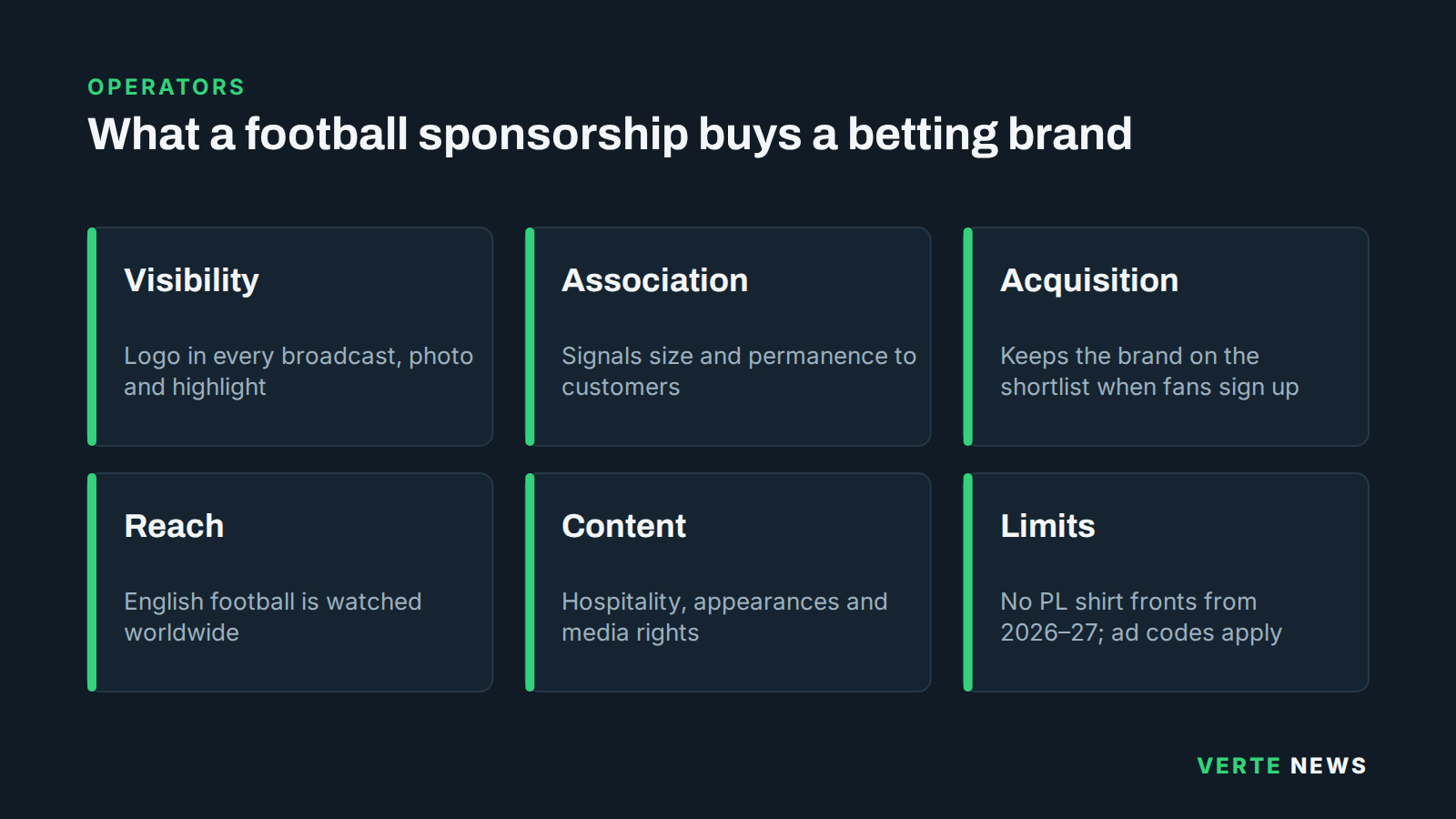
The most obvious return is visibility. A front-of-shirt logo appears in every match photograph, highlight clip and broadcast, and English football is shown in a very large number of countries. Sleeve deals, perimeter advertising boards, stadium naming and training kit offer cheaper versions of the same exposure.
Sponsors also buy association. Being the ‘official betting partner’ of a well-known club signals size and permanence, which matters in a sector where customers can switch between operators in seconds. Deals often include hospitality, player appearances and content rights, although advertising codes now restrict how some of those can be used.
Much of the value is about acquiring customers. Sponsorship keeps a brand familiar so that when someone decides to open an account, it is on the shortlist. It works alongside television advertising, social media and affiliate marketing, each aimed at a different stage of the same process. Because a new customer can be worth a significant amount over time, operators have been willing to pay large sums for the most visible rights.
Not all sponsors target British fans
A notable feature of recent seasons was that several shirt sponsors were brands with little presence in Britain. They were aimed chiefly at customers in Asia and other overseas markets, where English football has huge audiences but where the brand could not legally advertise in the same way. Some of these companies reached the British market, if at all, through white-label arrangements, in which a brand operates under another company's licence.
This created a mismatch that critics highlighted: British fans saw brands they could not easily identify, and clubs relied on revenue from markets whose regulation was far removed from the Gambling Commission's. The Commission has since scrutinised white-label arrangements more closely. In 2025 one white-label provider, TGP Europe, left the British market after enforcement action, and the Commission warned several clubs about the risks of promoting unlicensed gambling websites.
How the rules are changing
Two developments have reshaped the market in Britain.
- Premier League front-of-shirt withdrawal. Clubs agreed in April 2023 to stop carrying gambling sponsors on the front of matchday shirts from the end of the 2025–26 season, and the change applies from 2026–27. Sleeve sponsorship, perimeter boards and other arrangements are still permitted, so gambling brands remain visible in the stadium and on broadcasts.
- Advertising codes. Since October 2022, gambling advertisements in the UK must not be likely to be of strong appeal to under-18s. In practice this sharply limits the use of well-known footballers and other sports stars in betting adverts. Our guide to UK gambling advertising rules explains how the codes work.
Sports bodies including the Premier League, the English Football League and the FA, working with the Betting and Gaming Council, have also adopted voluntary codes of conduct for gambling sponsorship. Clubs outside the Premier League can still carry gambling brands on the front of their shirts, and the English Football League has long had a betting company, Sky Bet, as its title sponsor, under a deal that runs to 2028–29.
Why it matters
For clubs, gambling money has filled a significant part of the commercial income below the very top of the game, where alternatives are scarcer. Removing it from shirt fronts forces clubs to find replacement sponsors, often at lower fees, while leaving room for betting brands elsewhere on the kit and around the ground.
For operators, the change is less about disappearing from football than about reallocating budgets. Money that once bought the most prominent position on the shirt can shift to sleeves, digital channels, broadcast sponsorship or markets with fewer restrictions. The best-known example of a long-standing local tie, Bet365 and Stoke City, shows that the relationship between betting and football can run deeper than a sponsorship contract.
The debate is likely to continue. Supporters of the current approach argue that a legal industry should be able to advertise within clear rules. Critics argue that the sheer volume of betting marketing around football normalises gambling for young fans. The Premier League decision was a voluntary compromise between those positions rather than a settled answer.