What the Malta Gaming Authority does
Malta's regulator licenses many of Europe's online gambling companies and their suppliers. Here is how the Malta Gaming Authority works, what its licences cover, and what they do and do not allow.
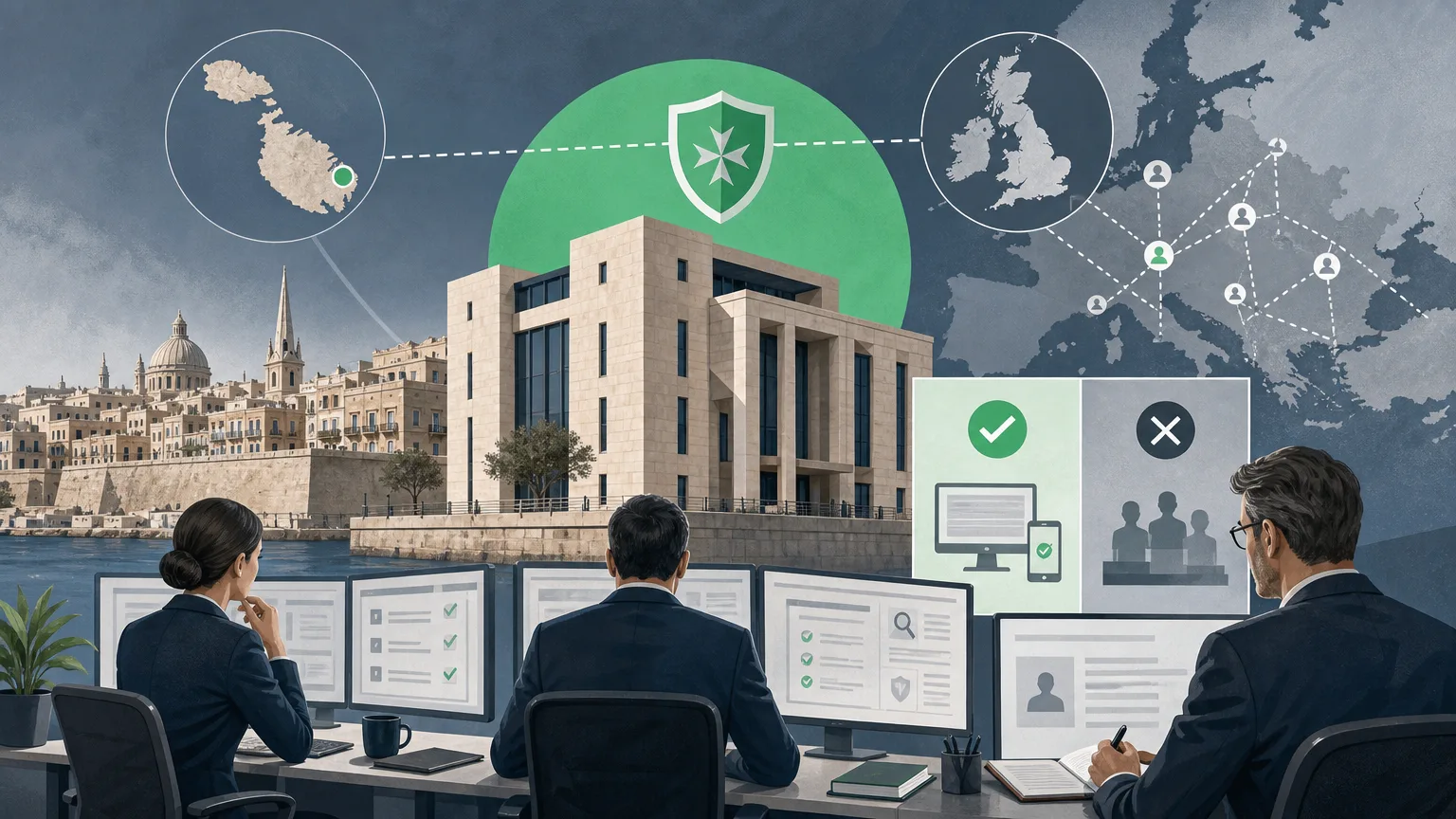
The Malta Gaming Authority (MGA) is the regulator responsible for gambling in and from Malta. It licenses and supervises companies that offer gambling to consumers and companies that supply games and technology to them, and it enforces Maltese gaming law against both. Because many international online gambling businesses are based on the island, its decisions reach far beyond Malta's own small population.
Malta was one of the first European Union member states to create a dedicated framework for remote gambling, with its Remote Gaming Regulations of 2004. That early start, together with an English-speaking workforce, EU membership and a cluster of specialist lawyers, auditors and suppliers, helped turn the island into one of the industry's main European hubs. The current framework is built on the Gaming Act (Chapter 583 of the Laws of Malta), in force since 1 August 2018, which replaced the Remote Gaming Regulations and other earlier laws with a single framework.
What the MGA licenses
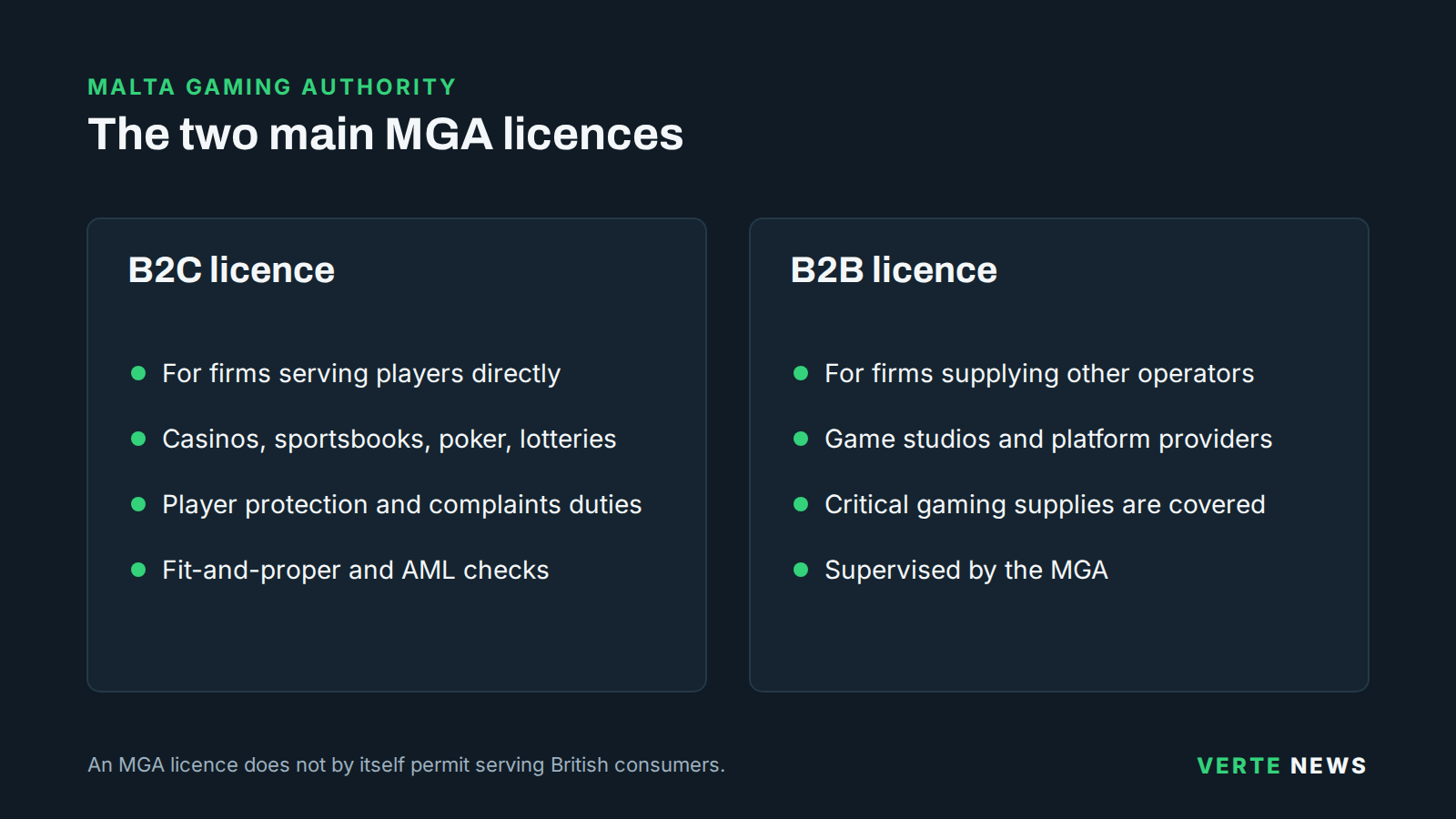
Under the 2018 framework, the MGA issues two main kinds of licence:
- a business-to-consumer (B2C) licence, for companies that offer gambling directly to players, such as online casinos, sportsbooks, poker rooms and lotteries;
- a business-to-business (B2B) licence, for companies that supply critical gaming services to other operators, such as game studios, platform providers and some managed services.
Licences are organised by the kind of game involved. Broadly, the framework distinguishes games of chance played against the house (such as casino games), fixed-odds betting, games where players compete against each other and the operator takes a commission (such as poker or betting exchanges), and controlled skill games. An operator's licence specifies which of these it may offer.
The B2B licence is one reason the MGA matters even to businesses that never serve a Maltese player. Many game studios and platform providers hold one. Our guide to how casino game providers work explains where suppliers sit in the chain.
How supervision works
The MGA's process follows a familiar pattern for gambling regulators. Applicants undergo fit-and-proper checks on their owners, directors and key staff, have to show the source of their funding and must demonstrate that their systems meet technical requirements before going live. Once licensed, companies are subject to ongoing compliance monitoring, audits and reporting duties, and must appoint individuals to key functions such as compliance and anti-money laundering.
Player protection is part of the framework. MGA licensees must have responsible gambling measures such as deposit limits and self-exclusion tools, must segregate or protect player funds and must handle complaints, with a route to the regulator's own player support function if a dispute is not resolved. Anti-money laundering supervision is the responsibility of Malta's Financial Intelligence Analysis Unit (FIAU), with the MGA carrying out compliance examinations of gaming licensees on its behalf, and licensees count as subject persons under Maltese anti-money laundering law.
When licensees fall short, the MGA can impose administrative penalties, suspend licences and cancel them. It publishes notices of regulatory actions on the MGA website, which is also where its public register of licensees can be checked.
What an MGA licence does not allow
An MGA licence authorises a company under Maltese law. It does not, by itself, give permission to serve consumers in every other country. EU law allows member states to regulate gambling nationally, and many countries inside and outside the EU require operators to hold a local licence to serve their residents. A company serving British customers therefore needs a UK Gambling Commission licence as well, and it must follow British rules for those customers.
In markets that do not have their own licensing system, or that have not yet enforced one, some operators rely on their MGA licence alone. Whether that is lawful depends on the law of the country concerned, and it has been tested in courts in other EU countries, including player claims for refunds of losses in Austria and Germany, some of which have reached the Court of Justice of the European Union. We look at this in more detail in how offshore gambling regulation works.
Why operators choose Malta
For an operator, an MGA licence is often a base rather than a destination. It provides a recognised, EU-based regulatory home, access to a deep pool of industry talent and suppliers, and a licence that can support entry into markets that accept it, while the business adds local licences where required. Our explainer on how gambling operators enter new markets sets out how multi-licence strategies are built.
For consumers, the practical point is simple. An MGA licence means a company is regulated by an EU authority with its own rules and complaint route. But the protections that apply depend on where the customer lives and which licence the operator is using to serve them. For someone in Great Britain, the relevant protections are those of the Gambling Commission, and a site serving them should hold a Commission licence.