What slot volatility means
Volatility describes how a slot's payouts are spread out: frequent small wins or rare large ones. It changes how a session feels, not how much the game takes on average.

Slot volatility, sometimes called variance, describes how a game's payouts are distributed. A low-volatility slot pays small wins often; a high-volatility slot pays out less often but includes much larger wins, with long stretches of losing spins in between. Volatility does not change how much a game returns on average; that is set by its RTP. Two games with the same RTP can feel completely different to play because their volatility differs.
Volatility versus RTP
RTP answers the question: how much does this game keep over the long run? A 96% RTP means an expected loss of £4 for every £100 staked, across a very large number of spins; see what RTP means. Volatility answers a different question: how far from that average are my results likely to be over a session?
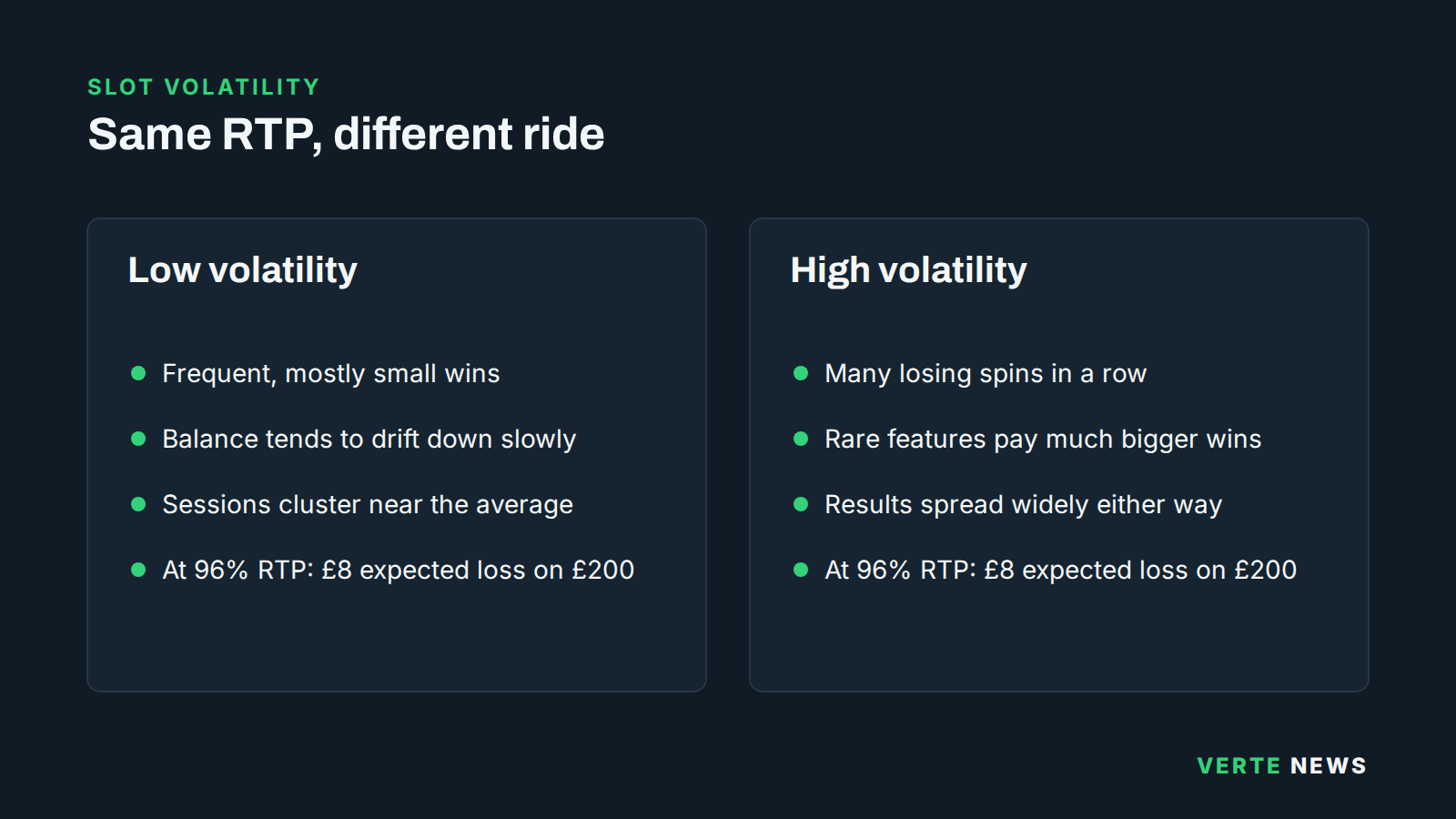
Consider two slots, both at 96% RTP, played at £1 a spin for 200 spins. You stake £200 on each, and the expected loss on each is the same: £8. The likely outcomes are not.
- On the low-volatility game, wins arrive frequently, many of them for less than or about the stake. The balance tends to drift down gradually, and most sessions end fairly close to the expected loss.
- On the high-volatility game, many spins return nothing, and much of the RTP is concentrated in rare features or top prizes. Many sessions end down by well over £8, sometimes by most of the stake, while a small number end well ahead after a big hit.
Averaged over many players, the two games take the same share. It is the spread, not the cost, that changes. On a high-volatility game the typical session tends to be worse than the average, because the average is propped up by a few large wins that most players never see.
How volatility is built and shown
Volatility comes from the game's maths model: how often each symbol combination lands, what it pays, and how much of the total return sits in bonus rounds, multipliers or jackpots. A game where a large share of the RTP comes from a rare feature will be highly volatile. A related measure, hit frequency, tells you how often a spin returns anything at all, but a 'hit' can be a win smaller than your stake.
There is no single industry standard for reporting volatility. Some studios label games low, medium or high, or show a scale of icons; others say nothing. The labels are relative and not directly comparable between studios. The designer sets the model, and it is checked alongside the RTP by independent test houses; see how casino game providers work. The results themselves come from the game's random number generator, so no spin is influenced by the one before.
Why volatility is not a strategy
It is tempting to treat volatility as a lever: low volatility to make money last, high volatility to chase a big win. Neither changes the expected outcome. A low-volatility game spreads the same expected loss over more time, which can mean longer sessions, more total staking and so a larger total cost. A high-volatility game can empty a balance quickly, which may encourage chasing losses or raising stakes.
Some practical points follow:
- choose a game for how it feels to play, not in the hope of beating it;
- on high-volatility games, expect long losing runs and set a loss limit before you start;
- watch total staking, not just deposits: re-staked wins are still exposed to the house edge;
- treat claims that a game is 'due' or 'hot' as false, because each result is independent.
In Great Britain, online slots also operate within rules designed to slow play and limit exposure. Since 2021 there has been a minimum of 2.5 seconds per spin, no autoplay, and no celebrating a return that is no more than the stake as if it were a win. Since 2025 there have been maximum stakes of £5 per spin for adults aged 25 and over and £2 for those aged 18 to 24; the details are in the UK's online slot stake limits explained.
Stake limits cap how much a single spin can cost, but not how many spins you play. Deposit limits, reality checks and time-outs are available on every licensed site, and they are the tools that actually control what a session costs, whatever the game's volatility.