What Flutter Entertainment is
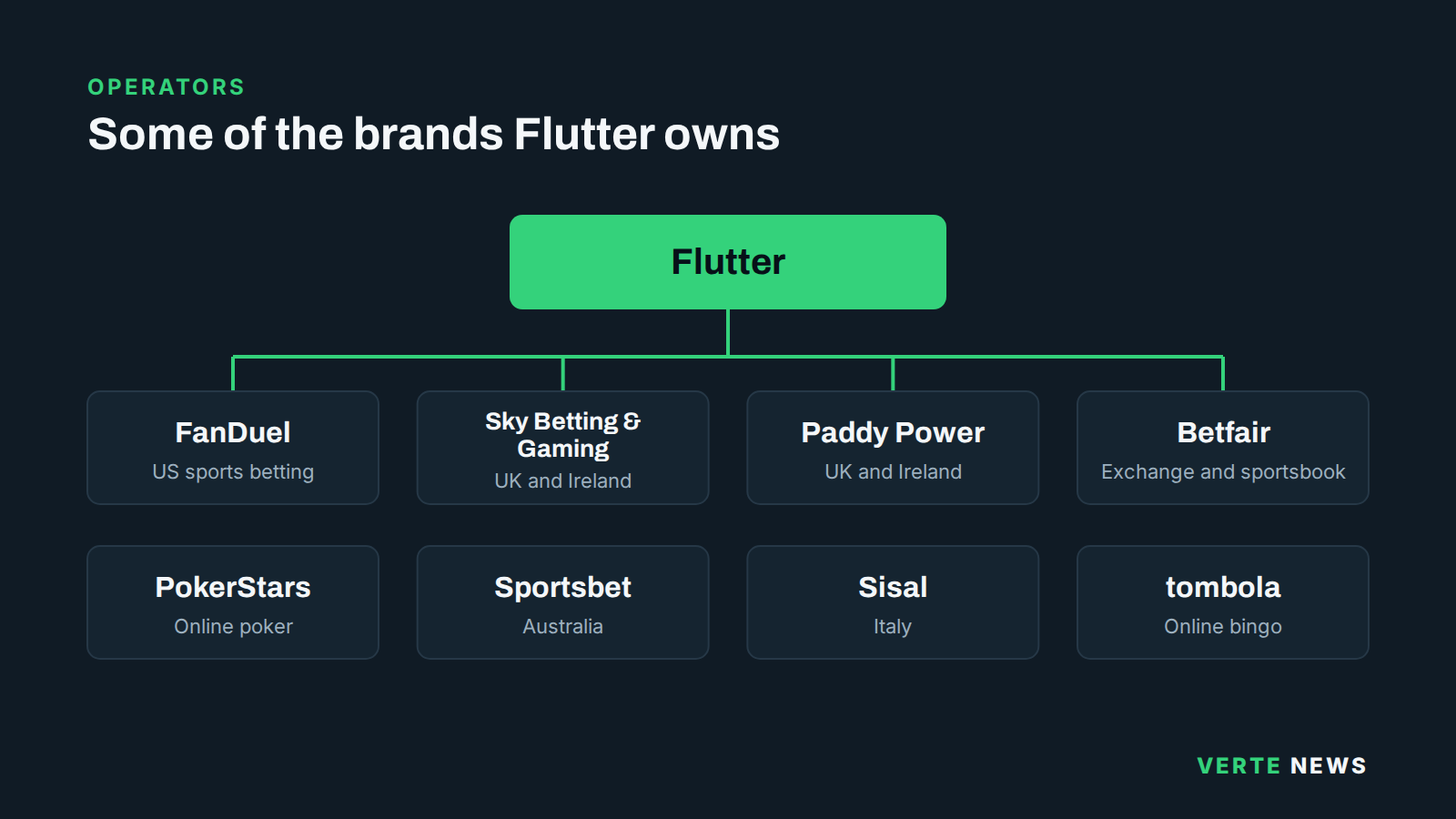
Flutter Entertainment owns FanDuel, Paddy Power, Betfair, Sky Bet and PokerStars. It was built almost entirely through mergers and acquisitions, and its story explains much about how the modern online gambling industry is structured.

Flutter Entertainment is one of the largest online betting and gaming groups in the world. It owns FanDuel, the leading US sports betting brand, alongside Paddy Power, Betfair, Sky Betting & Gaming and PokerStars, and a string of strong national brands elsewhere, including Sportsbet in Australia and Sisal in Italy. The company is incorporated in Ireland and its shares are listed only on the New York Stock Exchange, under the ticker FLUT, after it cancelled its London listing in August 2026.
Flutter is a useful case study because almost every stage of its growth has come through a merger or an acquisition. Understanding how it was assembled explains a good deal about how the modern industry works.
How Flutter was built
The group began with the 2016 merger of two quite different businesses. Paddy Power was an Irish retail and online bookmaker known for provocative marketing. Betfair had pioneered the betting exchange, where customers bet against each other and the operator takes a commission rather than setting the odds. The combined company, Paddy Power Betfair, renamed itself Flutter Entertainment in 2019.
The next step was larger. In 2020 Flutter combined with The Stars Group, a Canadian company that owned PokerStars and had itself bought Sky Betting & Gaming in 2018, the business behind Sky Bet. In one transaction Flutter added one of Britain's biggest online sports betting brands and the world's best-known online poker brand.
Acquisitions continued outside the English-speaking markets. Flutter bought tombola, the online bingo operator, and Sisal, one of Italy's largest gambling companies, in 2022. It has since taken a majority stake in MaxBet in Serbia and, in 2025, bought Snai, another leading Italian brand, deepening its position in a market it regards as one of the most attractive in Europe.
FanDuel and the United States
The most consequential move was into the United States. After the Supreme Court struck down the federal ban on state-authorised sports betting in 2018, Flutter (then Paddy Power Betfair) took a controlling stake in FanDuel, then best known for daily fantasy sports, and folded its existing US business into it. It has owned FanDuel outright since buying the last minority stake, from Boyd Gaming, in 2025. As states legalised online sports betting one by one, FanDuel grew into what Flutter describes as America's number one sportsbook.
The US is now Flutter's largest single market, and that shift in the group's centre of gravity lay behind its decision to list its shares in New York in January 2024, make that its primary listing in May 2024 and, in August 2026, cancel its London listing altogether. The company argued that American investors would better understand, and value, a business whose growth was increasingly concentrated in the US.
How the group is organised
Flutter reports its results in two broad segments, US and International, and runs its brands with a considerable degree of local autonomy. Its stated strategy, which it calls the ‘Flutter Edge’, is to pair strong local brands with shared group resources: pricing and risk management, technology platforms, product development and data. A customer in Australia and a customer in Ireland may use brands that look nothing alike, but parts of the machinery behind them are shared.
This structure is typical of the large listed operators. A group owns several consumer brands, each with its own marketing and customer base, and seeks economies of scale behind the scenes. The same basic logic underpins Entain, although each group has made different choices about which markets to prioritise and how far to integrate its brands.
Why Flutter matters
Scale brings real advantages in a business where margins on each bet are thin and fixed costs are high. A larger group can spread the cost of technology, sports data rights and compliance over more customers, and can price more markets with more confidence. Our explainer on how sportsbook businesses make money sets out why those economics favour size.
Scale also concentrates regulatory exposure. Flutter operates under a large number of licences, and changes to tax or product rules in Britain, individual US states, Australia or Italy feed directly into its results. That is why announcements from regulators and finance ministries can move its share price, and why regulation is as central to understanding Flutter as any of its brands.
For readers, the practical point is that familiar names on the high street, on television and on phone screens are often parts of a much larger whole. Paddy Power, Sky Bet and Betfair compete for customers in Britain and Ireland, but their profits ultimately flow to the same shareholders. That concentration is not unusual in the sector, but it is worth knowing when reading about competition, consumer choice or the impact of a new tax.