The casino terms that decide whether a withdrawal is paid
Most disputes between online casinos and their customers are not about the games. They are about withdrawals, and they are usually settled by a handful of clauses in the terms and conditions that few players read before they deposit.

An online casino's terms and conditions are a contract, and when a withdrawal is delayed, reduced or refused, the operator will point to a clause in them. In the licensed British market those terms must be fair and clearly presented, and a customer can take a dispute to an approved alternative dispute resolution service. Outside it, the terms are often the only rulebook, and how they are applied depends on the operator and whichever regulator, if any, oversees it.
The clauses that matter are rarely on the promotions page. They sit in the general terms, the bonus terms and the payments policy, and five of them account for most withdrawal disputes.
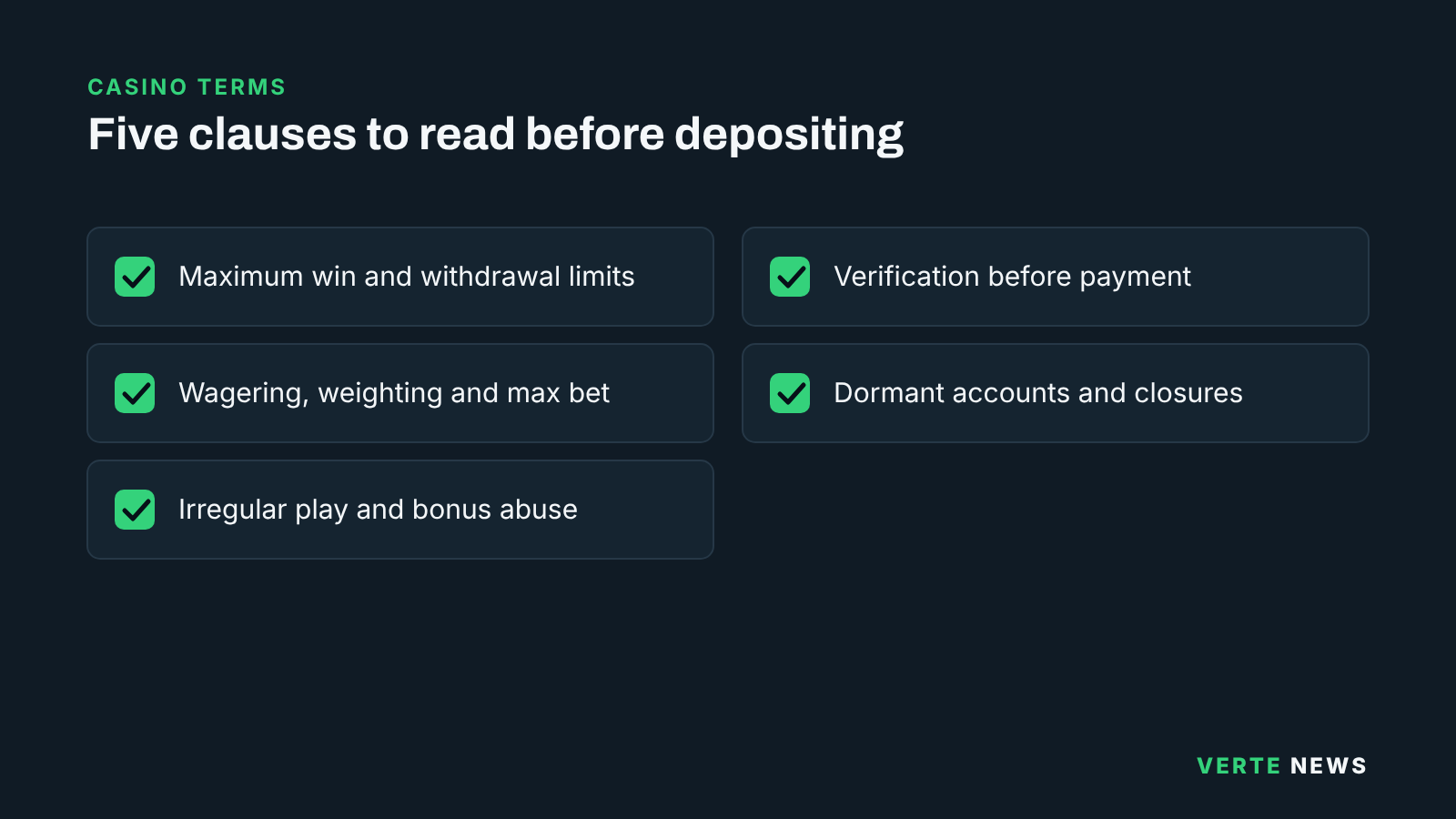
Maximum win and withdrawal limits
Many casinos cap how much can be won from a bonus, a free-spins offer or, in some cases, a single game round. Separately, they set limits on how much can be withdrawn per day, week or month, so a large win may be paid in instalments. Neither is unusual on its own. What matters is whether the cap is stated clearly before the customer plays, and whether instalment limits are proportionate to the sums the site accepts as deposits.
Bonus rules: wagering, game weighting and maximum bet
A bonus usually has to be staked a set number of times before winnings from it can be withdrawn. Our explainer on what wagering requirements mean sets out the arithmetic. Two further rules cause most disputes: game weighting, under which some games count for little or nothing towards the requirement, and a maximum stake while the bonus is active. Breaking the maximum-stake rule, even once, is a common ground on which casinos void bonus winnings.
Irregular play and bonus abuse
Most terms reserve the right to void winnings for "irregular" or "abusive" play. Some define it narrowly, for example multiple accounts or low-risk betting patterns used to clear a bonus. Others leave it open. A broadly worded clause gives the operator wide discretion, which is the point at which an independent complaints route matters most.
Verification before payment
Operators are expected to know who their customers are, and almost all require identity and address documents before paying a withdrawal, sometimes along with proof of the payment method or source of funds. Our guide to what KYC means in gambling covers why. Delays are most often caused by documents requested only at the point of withdrawal, so checking the requirements at sign-up saves time.
Dormant accounts and closures
Terms usually allow an operator to charge fees on, or close, an account left inactive for a set period, and to close accounts at its discretion. The clause to look for is what happens to the balance on closure: whether it is returned, and on what conditions.
Reading terms before depositing
A practical order is the payments policy first (minimum and maximum withdrawals, processing times, fees), then verification, then the bonus terms of any offer being considered, and finally the account-closure and irregular-play clauses. If the licence, regulator or company name cannot be found and checked on the regulator's own register, the rest of the terms count for little. Our guide on what to check before choosing a bookmaker applies equally to casinos.
Daily All In, a sister title in the same group, publishes a shortlist of casinos licensed outside Great Britain that it says it rates only after making a real withdrawal. Those casinos sit outside the British system described in what “non-GamStop” means, and the checks above apply to each of them.
Where to get help
Anyone who has self-excluded through GamStop should not use casinos outside the scheme. Free, confidential support is available from the National Gambling Helpline, run by GamCare, on 0808 8020 133, 24 hours a day, and from BeGambleAware.
Photo credits
Illustration: Verte News