How the zero pocket creates roulette's built-in house edge
A single number pays 35 to 1 on a wheel with 37 or 38 pockets, and that gap between payout and true odds is where the casino's edge comes from.
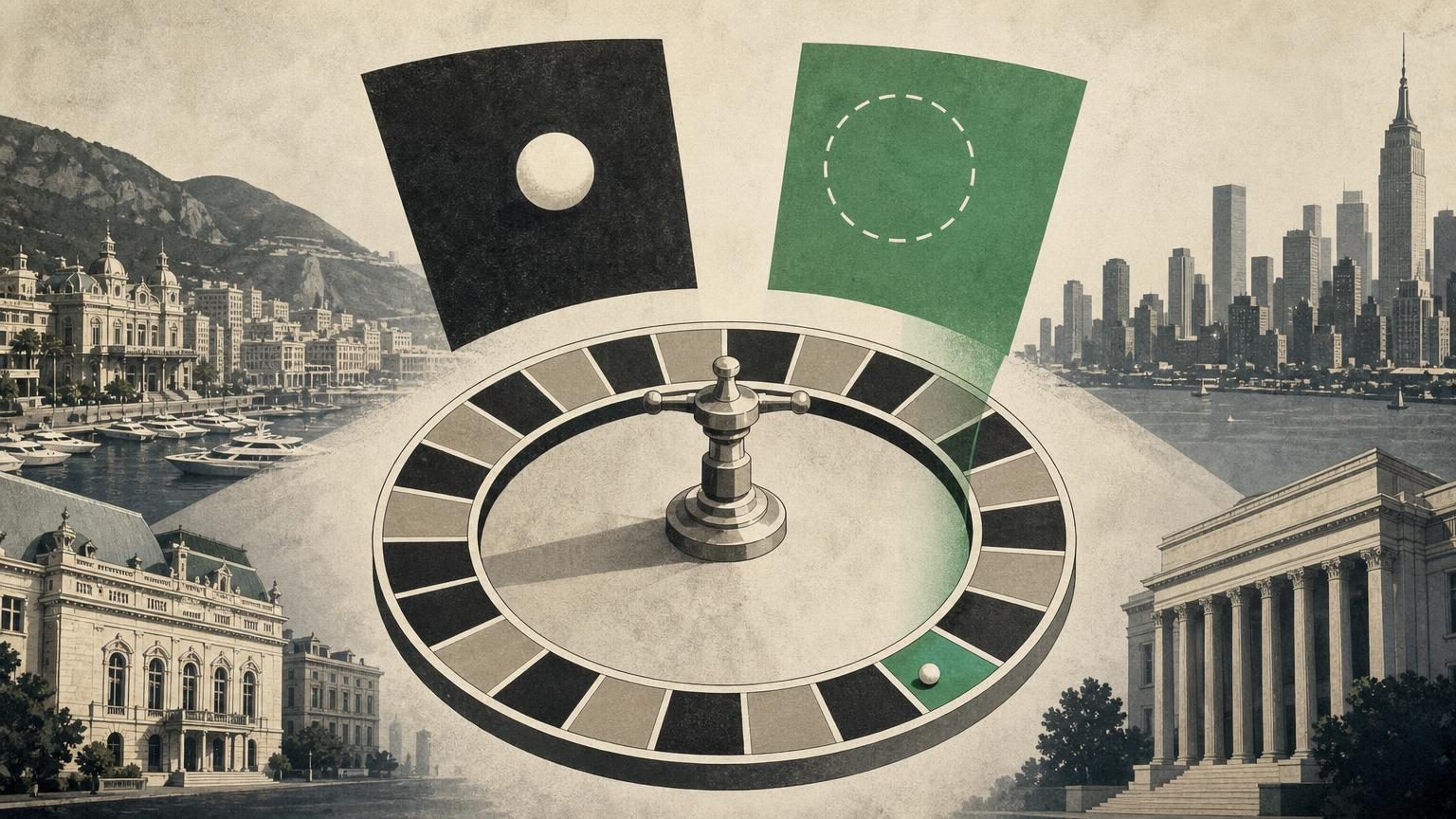
A roulette wheel is advertised as a game of chance, and it is one, but the arithmetic behind it is fixed before the ball ever leaves the croupier's hand. The edge comes from a simple mismatch: the payout on a winning bet is always slightly lower than the true odds of that bet landing.
Take a straight-up bet on a single number. If a wheel had exactly 36 pockets, numbered 1 to 36, a bet paying 35 to 1 would be mathematically fair — the casino would break even over time, because the 1-in-36 chance of winning exactly matches a 35 to 1 payout plus the return of the stake.
But no roulette wheel has only 36 pockets. The European wheel adds a single green zero, making 37 pockets in total. The payout for a winning number still stays at 35 to 1, even though the true probability of hitting any given number is now 1 in 37, not 1 in 36. That one extra pocket, un-paid-for in the odds, is the entire source of the house's advantage.
Worked through as an expected value, a $1 bet on a single European number loses 36⁄37 of the time and wins 35 times the stake 1⁄37 of the time: −1 × 36⁄37 + 35 × 1⁄37 = −0.0270. That is a house edge of 2.70%, according to Wikipedia's reference entry on roulette, and the same 2.70% applies across most even-money, column and dozen bets on the European layout, because every bet type is built around the same 37-pocket wheel.
Why the American wheel is worse
American roulette adds a second zero, 00, bringing the wheel to 38 pockets while payouts stay exactly as they are in Europe. The same calculation now runs −1 × 37⁄38 + 35 × 1⁄38 = −0.0526 — a house edge of 5.26%, almost double the European figure, according to the same source.
A rarer triple-zero wheel, with 39 pockets, pushes the edge further still, to 7.69% by the same method. Wikipedia notes the odds for a player on the American wheel are never better than roughly −5.26% of the stake and can run as low as about −7.89% depending on the bet chosen.
How the two wheels came to differ
The split has a documented history. Early roulette in late-18th-century Paris already used two zero-style house pockets, and some early American wheels went further, adding a slot known as the American Eagle that gave the house an extra edge before the practice died out, according to Wikipedia. In 1843, François and Louis Blanc introduced a single-zero wheel at a casino in Bad Homburg, Germany, to undercut rivals still running the double-zero game. When the Blanc family later moved to Monte Carlo, the single-zero wheel became the dominant European format and spread with it, while the double-zero wheel remained the standard in the United States, where it had travelled up the Mississippi from New Orleans.
Some tables soften the edge slightly through the en prison rule, which Wikipedia states can reduce the house edge on even-money bets to roughly 1.35–1.38% on a single-zero wheel and 2.63% on a double-zero wheel.
None of this is a prediction about any individual session. The percentages describe what happens to turnover averaged across a very large number of spins, not what any one player will walk away with. Wikipedia's entry on casino games is explicit that betting systems cannot change these underlying odds, and that short-term variance — measurable through standard deviation — is typically far larger than the expected loss, which is precisely what can make a losing game feel, for a while, like a winning one.