Who owns Bet365
Bet365 is one of the world's biggest online bookmakers, yet it has never been listed on a stock exchange. It is controlled by the Coates family from Stoke-on-Trent, and that private ownership shapes almost everything about how it is run.

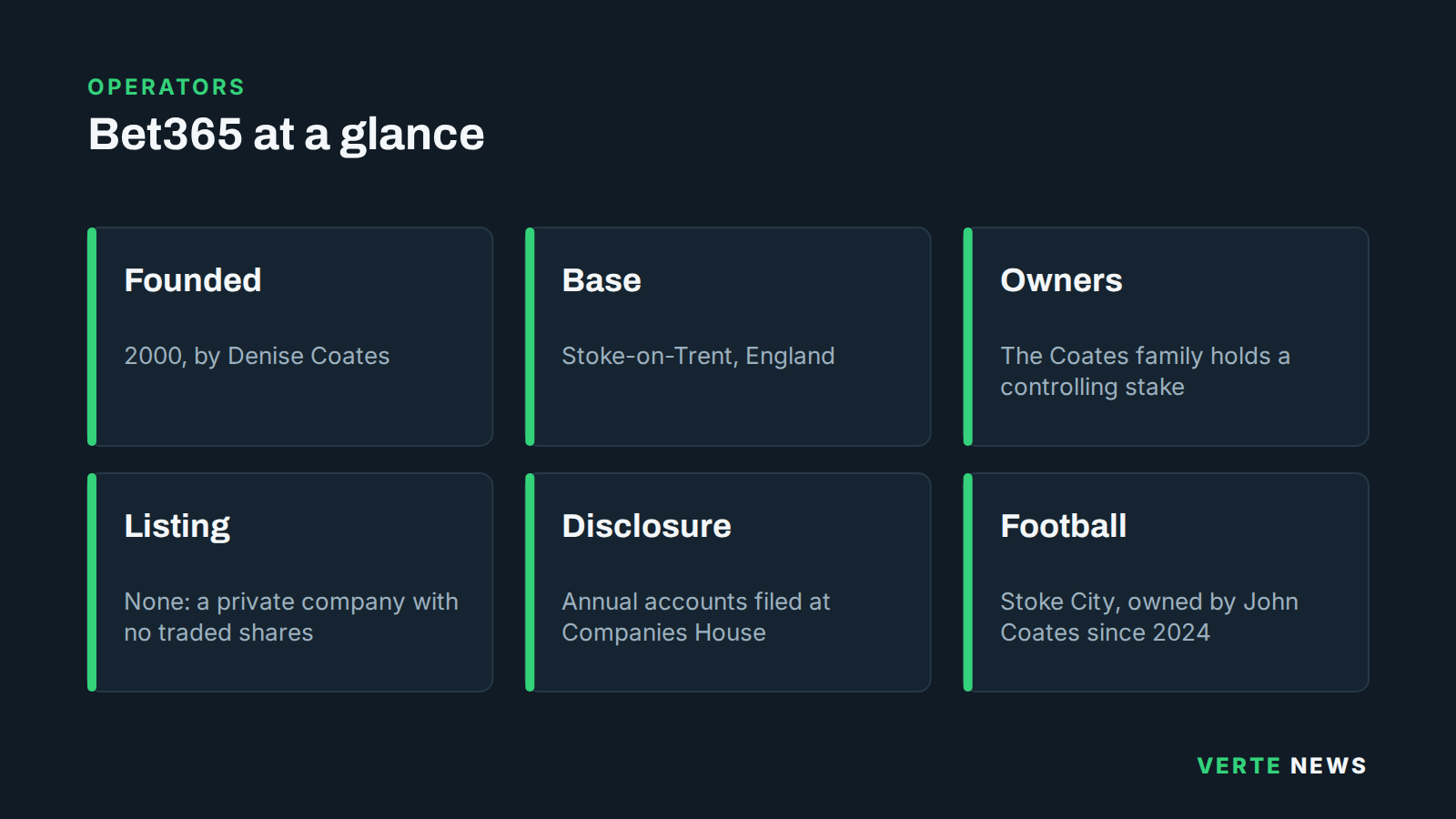
Bet365 is owned by the Coates family. The Stoke-on-Trent company is privately held and controlled by the family. Denise Coates, who founded the business in 2000 and runs it as joint chief executive with her brother John, is reported to be the majority shareholder. It has no shares traded on any stock exchange, which makes it unusual among the largest online bookmakers, most of which are listed companies answerable to outside investors.
That private status shapes how the business is run, what the public can find out about it, and why its ownership draws attention whenever the family's finances are reported.
From betting shops to an online bookmaker
The family's involvement in gambling pre-dates the internet. Peter Coates built up a chain of high-street betting shops in the Potteries, and his daughter Denise, who worked in the family business after university, saw the potential of online betting at the end of the 1990s. Bet365 was launched in 2000, with the existing shop business helping to finance the venture. The family later sold the shops, reportedly to Coral in 2005, to concentrate on the online operation.
Staying close to those roots has been a deliberate choice. Bet365 is still headquartered in Stoke-on-Trent, where it has described itself as the city's largest private sector employer, although much of its international business is run through subsidiaries licensed outside the UK, including in Malta.
What private ownership means
Because Bet365 is not listed, it does not publish quarterly trading updates, hold results calls with analysts or answer to institutional shareholders at an annual meeting. Decisions about expansion, technology and dividends are taken by a small group of owners and directors rather than by a board balancing the demands of a large and changing shareholder register.
That does not make the business a closed book. As a UK company, its parent files annual accounts at Companies House, and those filings are the main public source for its revenue, profit, tax and directors' pay. The pay awarded to Denise Coates has drawn press coverage for years precisely because the accounts make it visible. Any headline figure should be read with care, however: the accounts are published many months after the financial year they cover, and the numbers can move sharply from one year to the next.
Private ownership also allows a long investment horizon. Bet365 develops much of its technology in-house, including its sportsbook platform, rather than relying as heavily on the B2B suppliers that many rivals use. It has also concentrated on building a single global brand rather than assembling a portfolio of names.
That contrasts with groups such as Flutter Entertainment and Entain, which grew largely through mergers and acquisitions financed with the help of public equity and debt markets. Their shareholders can buy and sell stakes every trading day; Bet365's cannot, and its strategy does not need to be explained to the market in the same way.
Stoke City and the local connection
The family's other best-known asset is Stoke City Football Club. Peter Coates, a long-standing supporter, has been involved with the club for decades. The club was owned through the Bet365 group until August 2024, when it was demerged from the group and John Coates became its outright owner. The club's ground still carries the bookmaker's name, a local tie that pre-dates much of the wider debate about why betting companies sponsor football.
Bet365 holds a Gambling Commission licence to serve customers in Great Britain and operates under local licences in a range of other markets, including more than a dozen US states that have legalised online sports betting. Each market brings its own licensing, tax and product rules, so the company, like its competitors, has to adapt the same brand to very different regulatory regimes. Our explainer on how gambling operators enter new markets sets out how that process usually works.
Why ownership matters
For customers, the identity of a bookmaker's owners makes little day-to-day difference. The protections that apply depend on the licence under which a person bets, not on whether the company behind it is listed or private.
For the industry, ownership matters a great deal. A family-controlled company can move quickly and ignore short-term market sentiment, but decisions about succession, investment or a possible sale are taken privately and can arrive without the long public build-up that a listed company would face. Any change in control at Bet365 would be one of the more significant events in the sector; in 2025 press reports said the family was considering options including a full or partial sale. Because ownership details can change, the most reliable picture comes from the company's latest filings at Companies House rather than from older press reports.