MGM Osaka construction advances toward 2030 opening in Japan
MGM Resorts and Orix Group are building Japan's first integrated resort on Osaka's Yumeshima island, with gaming limited to 3% of floor space under strict regulatory mandates.
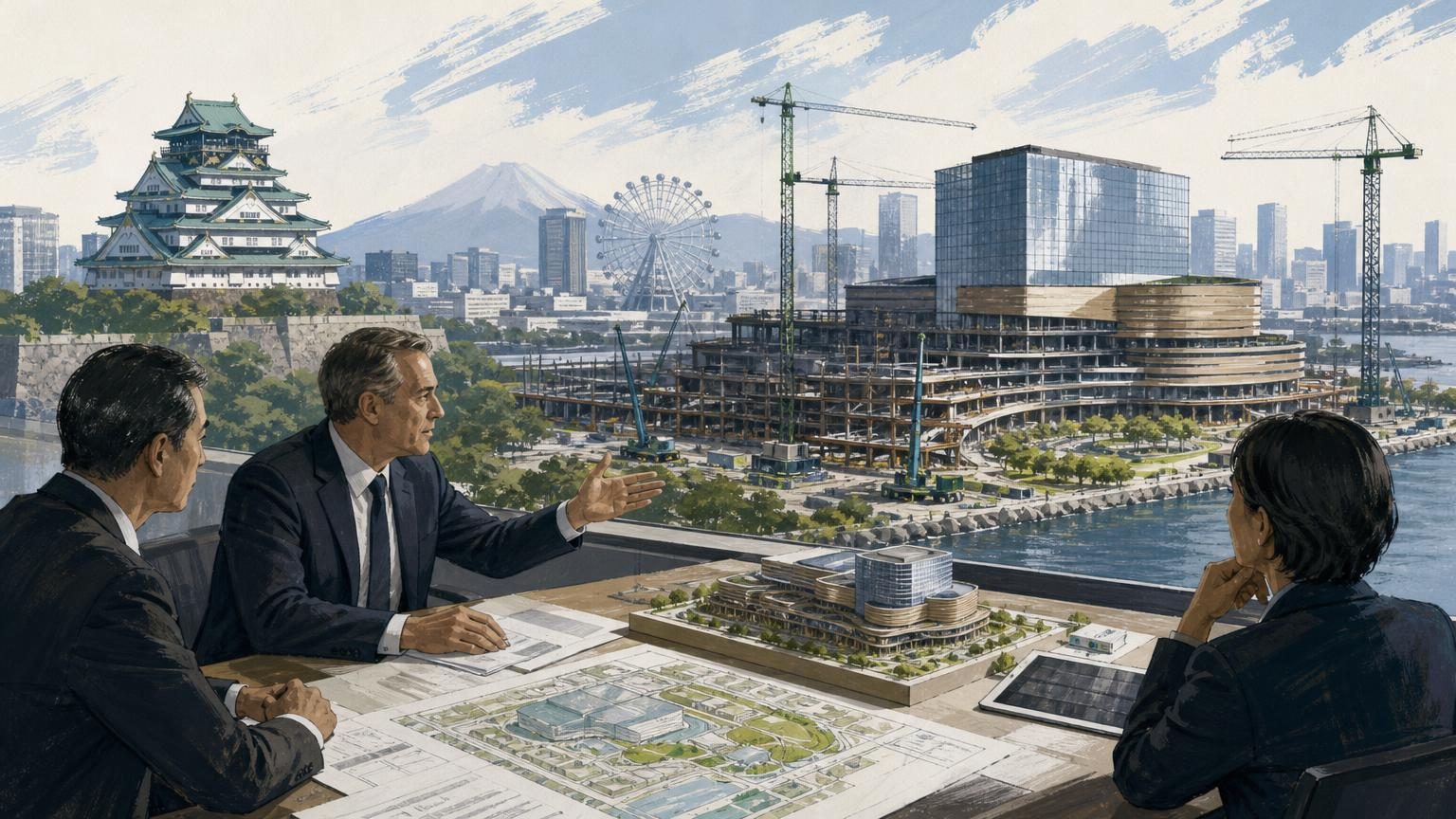
MGM Japan president and chief executive Ed Bowers has acknowledged the scale of the challenge in bringing casino gambling to Japan for the first time, telling iGaming Business that "there's a lot of trepidation about being the first to have this very large casino in Japan, and the issues it could bring, and we understand all of this."
The project, MGM Osaka, is a joint venture between MGM Resorts International and Japanese financial services group Orix Group. Its estimated cost of ¥1.5 trillion, roughly US$9.5 billion at current exchange rates, makes it the most expensive integrated resort built anywhere, according to iGaming Business. The site is rising on the artificial island of Yumeshima, which hosted World Expo 2025, with an opening targeted for late 2030.
Nobuki Watanabe, a longtime Orix executive, chairs the venture, with Bowers as chief executive. iGaming Business reports MGM Osaka is currently Japan's largest construction project, covering a 49-hectare site where crews are driving roughly 3,600 support columns into the ground to counter liquefaction risk on the reclaimed land.
An Osaka subway station, partly funded by MGM Osaka, opened in January last year to serve Expo visitors and now sits at the doorstep of the IR site. Kintetsu Group's railway arm, one of 22 mostly local investors holding a combined 12% stake in the project, is planning a direct rail link from Yumeshima to the tourist city of Nara, 45 kilometres east. A ferry and cruise terminal and a bus depot are also planned.
According to the 31 July update of the area development plan compiled annually by Osaka City, Osaka Prefecture and MGM Osaka, the resort's total floor space will reach 780,000 square metres. Its largest building, eventually 27 storeys, will house two hotels and the casino, with the full complex offering around 2,500 guest rooms across three hotels, more than a fifth of them suites of 105 to 150 square metres.
MICE capacity is mandated under Japan's IR regulations and written into the development plan: MGM Osaka will provide 400,000 square feet of conference space, 330,000 square feet of exhibition space and a 3,500-seat theatre. The plan cites MGM as "the largest MICE operator in Las Vegas, generating annual accommodation demand for 2.5 million rooms, hosting over 9,000 shows and events annually," and Bowers said the operator expects to meet Japan's requirements for hosting a set volume of overseas MICE events.
Regulations also require a tourism attraction centre, though Bowers said the specifications are less exact here. He described its three functions as acting as a concierge, selling tickets and experiences, and operating as what Japanese policy calls a "tourism sending facility" that directs visitors elsewhere in the country.
Bowers contrasted this with Singapore's approach, where the goal was simply to draw visitors to the resort itself. "What Japan said is that we want you to attract people to Japan, but then we want you to send people to other parts of Japan as well," he said, calling the IR's role as a "tourism multiplier" the central policy aim behind the project.
Japan recorded 42.68 million international arrivals last year and is on pace to exceed 41 million this year, Japan National Tourism Organisation data show, despite disruption from the Iran war and a 56.7% drop in mainland Chinese arrivals, around 3.8 million fewer visitors, through August. The government's target of 60 million arrivals by 2030 has been adjusted this year to address overtourism in destinations such as Kyoto, 63 kilometres from Yumeshima, with a shift toward higher-spending visitors.
Bowers said MGM Osaka is "honour-bound to think about how we can work with Japan to make sure that we are focused on their tourism policies," adding that the casino itself remains the commercial payoff: "the quid pro quo is we get a casino, which is where we'll make all our money."
Under Japan's IR framework, gaming space is capped at 3% of total floor area, limiting MGM Osaka's casino to 23,400 square metres within the far larger resort.