Nebraska voters reject online sports betting despite $22.5m campaign
Both ballot measures needed for mobile wagering failed decisively, with DraftKings and FanDuel having funded nearly all of the industry's spending push, SBC Americas reports.
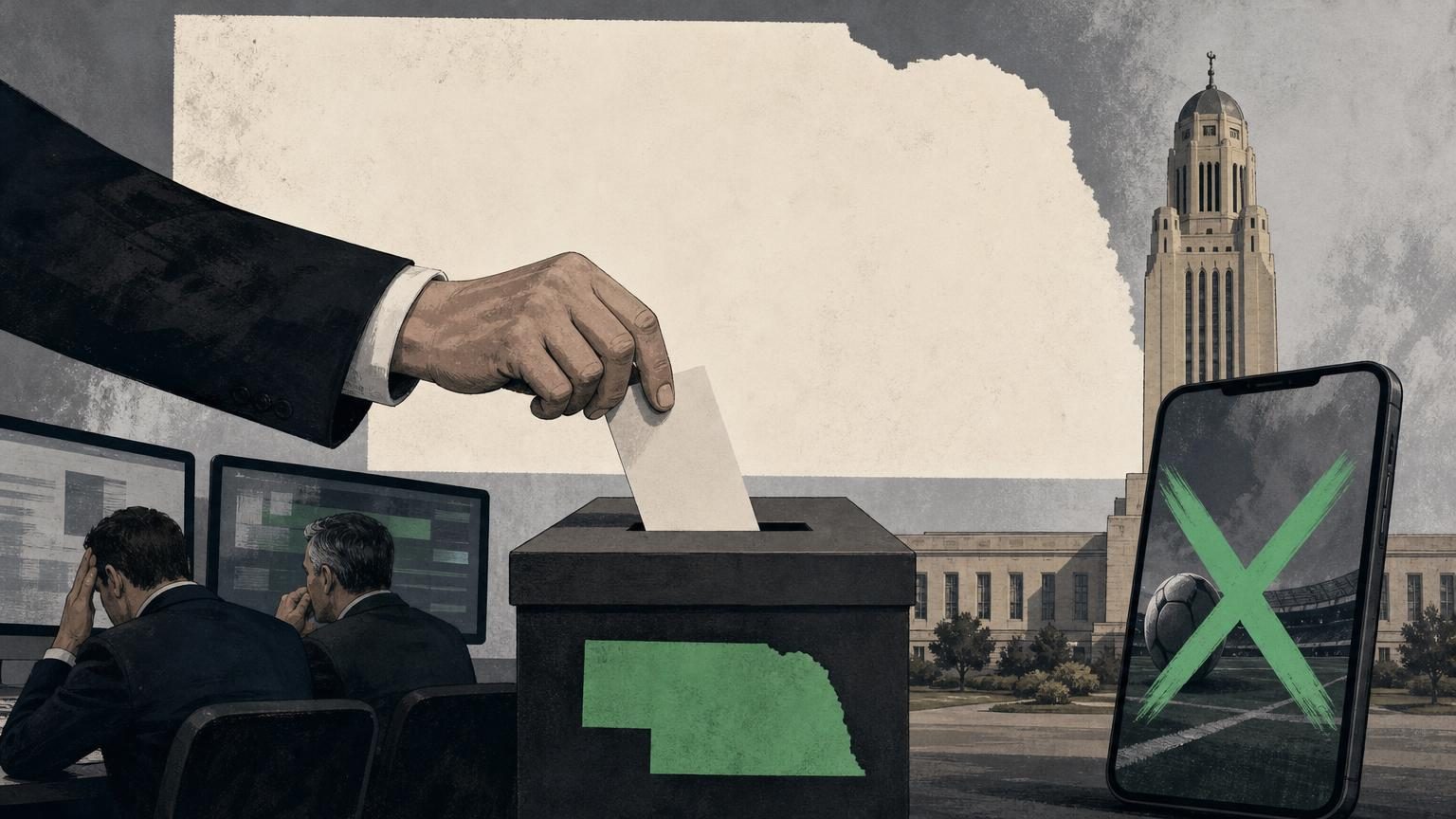
Nebraska voters have rejected the two ballot measures needed to legalise online sports betting, leaving the state's regulated market confined to in-person wagers at licensed racetrack casinos, SBC Americas reports.
Initiative 440, the constitutional amendment required to permit mobile wagering, fell 55% to 45%, while Initiative 441, the statutory framework that would have governed it, lost 54.5% to 45.5%, according to unofficial returns reported Wednesday morning. Both measures had to pass for online betting to launch.
The campaign was financed almost entirely by two national operators. DraftKings and FanDuel accounted for more than $20m of the $22.5m raised by Tax Relief Nebraska, the gaming industry political action committee that led the push. DK Crown Holdings and FanDuel each gave $10.4m, with additional contributions from BetMGM and Fanatics, the PAC's filings through October 29 show.
Nebraska was one of several states where gambling expansion failed at the ballot on the same night. A proposed casino spanning three Indiana counties, Allen, DeKalb and Steuben, was turned down by 64.6% of voters there, and a horse racing measure also failed in Virginia.
Josh Kirschner, partner and deputy leader of Holland & Knight's gaming practice, said all three measures were defeated and called the results a sign that voters currently have little appetite for expanded gambling. "It was a true pushback against expansion of mobile gaming," he said.
A separate gaming industry source described the Nebraska result as a "total repudiation" of expansion efforts.
Brendan Bussmann, managing partner of advisory firm B Global, argued the spending masked basic errors in how the campaign was run. "You never tested the negatives, you ran with an argument with a non-believable number, and you took poor advice from the locals that didn't know how to run a ballot initiative on this topic," he said, adding that the campaign's execution beyond signature-gathering had been weak.
Tax Relief Nebraska's central pitch promised more than $166m in property tax relief over ten years. Bussmann questioned the figure directly, saying "that is not a believable number," and pointed to the state's experience since 2020, when voters approved casino gambling at racetracks under a law taxing gaming revenue at 20% and directing 70% of that to property tax relief credits.
The Legislature had projected casinos would generate about $34m for tax relief in fiscal 2022-23. Actual revenue came in at $8m, rising to only $14m the following year. "The numbers don't lie with what you've done versus numbers you throw out there," Bussmann said.
State Sen. Mike Jacobson estimated online betting would have generated roughly $17m a year. Nebraskans paid $5.6bn in property taxes in 2025, so that projected sum represented only a sliver of the total. Bussmann said the tax-relief framing was always a weak hook for the campaign.
Lynne McNally, director of government relations for WarHorse Casino, told Nebraska Public Media she was disappointed by the outcome, noting that unregulated online betting is already taking place across the state. "Nebraska is just losing out on tax revenue … that's a real loss for the state of Nebraska," she said, adding that without regulation the activity would remain "the Wild West out there."
Operators had first tried the legislative route. Sen. Eliot Bostar introduced a bill in January 2025 that would have put online betting before voters in 2026 through partnerships with racetrack casinos, following an earlier 2024 push backed by Gov. Jim Pillen. Bostar withdrew the 2025 bill amid a filibuster led by Sen. Brad von Gillern, prompting Tax Relief Nebraska to launch its ballot campaign in September 2025. The plan would have permitted up to 12 mobile platforms tied to licensed racetracks at the same 20% tax rate casinos already pay.
Industry observers cited in the report expect proponents to face a wait of four to six years before another ballot attempt is viable.