CFTC sues Utah, warns of irreparable harm over Kalshi crackdown
The CFTC and Justice Department asked a federal court to stop Utah enforcing gambling law against Kalshi, days after Utah sued the exchange and two Susquehanna firms.
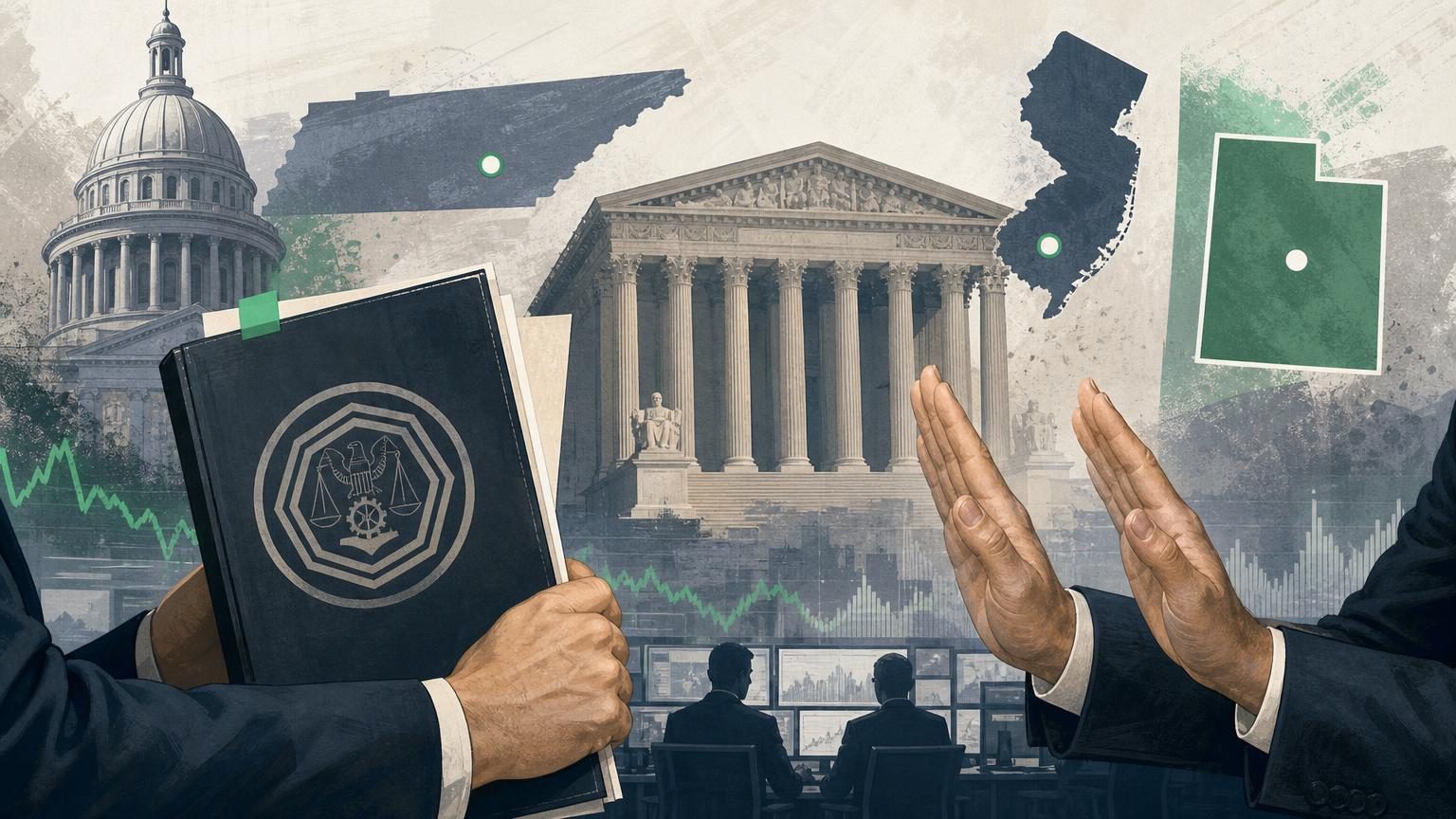
The Commodity Futures Trading Commission and the US Department of Justice filed suit against Utah on Monday, seeking to halt the state's attempt to police prediction-market exchanges through its gambling statutes.
Named as defendant is Utah Attorney General Derek Brown. The federal filing argues that letting Utah enforce its own rules against CFTC-regulated markets would cause the agency harm that cannot later be fixed, language the complaint frames as "irreparable injury" requiring a court order now rather than after the fact.
The move answers a civil suit Brown brought on 20 October in Utah's Third District Court in Salt Lake County, which named five Kalshi entities alongside two Susquehanna trading affiliates, Susquehanna International Group and Susquehanna Government Products. Brown's suit accuses the group of running unlawful gambling and brands Kalshi's activity a public nuisance.
Utah's state complaint followed a setback for Kalshi in federal court in August, when a judge threw out the jurisdictional argument underpinning the exchange's own earlier lawsuit against the state.
Gambling itself is barred under Utah law, and the state's filing points to Kalshi having marketed its sports and election contracts as legal nationwide regardless. Brown's office says the company kept accepting wagers from Utah residents even after the federal court ruling went against its jurisdictional claim, and it puts the fees Kalshi drew from Utah accounts at between $30.6m and $61.2m, a sum it wants returned through restitution and disgorgement alongside a block on sports, election, political and culture-related contracts enforced via geolocation.
In its 33-page response, the CFTC asks the court to find that Utah's gambling code, its election-betting ban and its public-nuisance law cannot reach exchanges the agency designates and regulates, and to issue both preliminary and permanent injunctions stopping Utah investigating or pursuing those entities and their partners.
The agency's reasoning leans on the Supremacy Clause, arguing that allowing individual states to regulate federally overseen contracts would leave exchanges answering to, as the filing puts it, "50 regulators across the country," and would breach a federal requirement that exchanges give all eligible participants impartial access nationwide.
The complaint also reaches back more than a century, citing 19th-century state bans on futures trading as gambling and quoting Justice Oliver Wendell Holmes's 1905 opinion that caution is owed before disturbing the natural evolution of complex markets.
Utah, notably, already holds the upper hand in the underlying federal dispute. Kalshi sued Governor Spencer Cox and Brown in February, only for Governor Cox to sign House Bill 243 in March, classifying proposition bets as gambling. US District Judge Robert Shelby granted Utah summary judgment on 4 August, ruling the Commodity Exchange Act does not override state gambling law, and the Tenth Circuit Court of Appeals refused Kalshi an injunction pending its appeal on 8 September. That appeal has not been decided.
The CFTC's new complaint does not mention either ruling. Instead it cites rulings that favoured the industry elsewhere: the Third Circuit's April decision for Kalshi in New Jersey, preliminary injunctions won in Illinois and Minnesota, and the Ninth Circuit's August ruling in Nevada, which found that the Commodity Exchange Act expressly preempts state swap regulation on federally regulated exchanges, even as that same Nevada panel separately found Kalshi's sports contracts likely do not qualify as swaps at all.
Because the new suit lands in the same federal district that already sided with Utah, any appeal would again go before the Tenth Circuit, which still has Kalshi's pending case before it. Kalshi has stood by its federal preemption argument since Utah filed its state suit.
Utah becomes the tenth state the CFTC has sued over prediction markets since April, following Arizona, Connecticut, Illinois, Kentucky, Minnesota, New Mexico, New York, Rhode Island and Wisconsin, according to SBC Americas. Federal judges have granted preliminary relief in some of those cases, while three related petitions await action at the Supreme Court.